
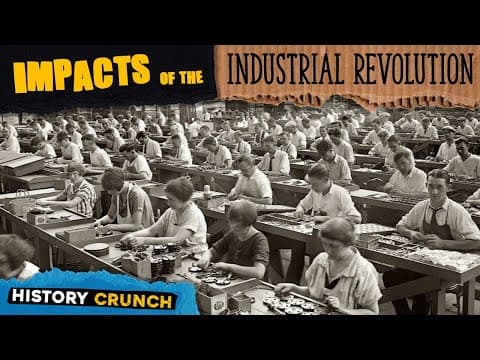
The Industrial Revolution, spanning from 1750 to 1850, significantly transformed societies worldwide, leading to the rise of socialism, labor movements, early feminism, urbanization, and groundbreaking inventions that continue to shape our lives today.
The Industrial Revolution is one of the most significant events in human history, profoundly affecting nations across the globe. Originating in Britain around 1750 and lasting until approximately 1850, its impacts are still evident in contemporary society. Historians have identified several key consequences of this transformative period, including the growth of socialism and labor movements, the emergence of feminism, urbanization, and the development of new inventions and technologies.
One of the primary impacts of the Industrial Revolution was the rise of socialism. This ideology emerged in the mid-19th century as a response to the harsh realities of laissez-faire capitalism, which prioritized individualism and often led to exploitation within industrialized societies. Issues such as low wages, child labor, and a lack of workers' rights prompted the development of socialist thought.
Prominent figures like Karl Marx played a crucial role in this movement. Marx's theories, articulated in works such as the Communist Manifesto and Das Kapital, criticized the exploitation of the working class and advocated for a more equitable society devoid of class divisions. Another notable socialist, Robert Owen, was an industrialist and utopian socialist who operated textile mills in New Lanark, Scotland. Owen opposed child labor, refusing to hire children under ten, and provided his workers with education and healthcare, which were uncommon at the time.
Socialism has had a lasting impact on modern societies, transforming laissez-faire capitalist systems into mixed economies. Today, most democratic nations incorporate elements from both sides of the economic spectrum.
The labor movement also emerged as a significant response to the dire conditions faced by the working class during the Industrial Revolution. Workers endured dangerous environments, long hours, and inadequate pay, leading to the formation of labor unions. These unions united individuals within specific jobs or industries to advocate for improved working conditions.
Labor unions remain a vital component of modern democratic societies, continuing to fight for workers' rights and better conditions in various industries.
Another critical impact of the Industrial Revolution was the establishment of early feminist movements. Feminism, fundamentally the fight for equality between men and women, gained momentum during this period. Women played essential roles in the workforce but were often undervalued and paid significantly less than their male counterparts.
The early feminist movements that arose during this time encouraged women to organize and protest for greater equality in society. One of the primary goals was to secure the right to vote, marking a significant step toward gender equality.
The Industrial Revolution also contributed to significant urbanization. Industrial cities and towns expanded rapidly as farmers and their families migrated in search of work in newly established factories and mines. This trend of urban migration continues globally, as people move to cities for employment opportunities.
Finally, the Industrial Revolution was marked by numerous inventions and innovations that have had a lasting impact on our world. The textile industry, in particular, saw remarkable advancements due to the efforts of inventors such as Richard Arkwright, Eli Whitney, James Hargreaves, John Kay, and Edmund Cartwright. These innovators developed machines and techniques that greatly enhanced production efficiency.
For instance, Edmund Cartwright's invention of the power loom revolutionized the textile industry by automating the weaving process and significantly speeding up production. The conveniences and efficiencies we enjoy today across various industries can be traced back to these groundbreaking inventions.
In summary, the Industrial Revolution was a pivotal period that reshaped societies worldwide. Its impacts, including the rise of socialism, the labor movement, early feminism, urbanization, and technological innovations, continue to influence our lives today. Understanding these historical developments helps us appreciate the complexities of modern society and the ongoing struggles for equality and workers' rights.



















