
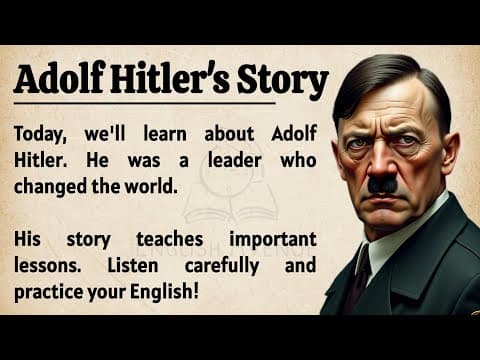
This blog post explores the life of Adolf Hitler, from his troubled childhood and artistic aspirations to his rise as a political leader and the catastrophic consequences of his actions during World War II. It emphasizes the importance of compassion, unity, and the lessons learned from history to prevent future tragedies.
Welcome to an exploration of one of history's most controversial figures, Adolf Hitler. His story is filled with dreams, failures, ambition, and power. From a small boy with big dreams to a man who changed the world forever, this is the story of Adolf Hitler like you've never heard before.
Adolf Hitler was born on April 20, 1889, in Braunau am Inn, Austria, to Alois and Clara Hitler. As a child, Adolf was not particularly special; he enjoyed playing outside, drawing, and dreaming of a bright future. However, his life was not without challenges. His father, Alois, was strict and had different aspirations for his son, wanting him to pursue a government job. In contrast, Adolf dreamed of becoming an artist, often expressing this desire to his supportive mother, Clara.
Adolf's childhood was marked by conflict with his father, who dismissed art as a viable career. After Alois's sudden death when Adolf was 13, the young boy felt a profound loss, which led him to skip school and abandon his studies. Once a good student, he became disinterested in academics, focusing instead on his passion for drawing.
After finishing school, Adolf moved to Vienna, the capital of Austria, with hopes of becoming a famous painter. He applied to the Academy of Fine Arts but faced rejection twice, which left him humiliated and devastated. During this period, he struggled to make ends meet, living in poor conditions and selling postcards to tourists. The death of his mother further deepened his anger and sense of isolation, leading him to blame others for his failures.
In 1914, with the outbreak of World War I, Adolf saw an opportunity to find meaning in his life. He joined the German Army and proved to be a brave soldier, earning two medals for his courage. However, the war ended in 1918 with Germany's defeat, leaving Adolf furious and feeling betrayed by the country's leaders.
Returning to a chaotic Germany, Adolf joined the German Workers Party, where he quickly became a powerful speaker. His passionate speeches resonated with the public, who were desperate for hope in a time of despair. He renamed the party the National Socialist German Workers Party, or the Nazi Party, and designed its infamous symbol, the swastika.
As Germany faced economic hardship and social unrest, Adolf's rhetoric blamed specific groups for the nation's problems, which garnered him a growing following. In 1923, he attempted a coup known as the Beer Hall Putsch, which failed, resulting in his imprisonment. During his time in jail, he wrote Mein Kampf, outlining his ideology and vision for Germany.
By 1933, Adolf Hitler was appointed Chancellor of Germany. He promised jobs, a strong military, and a brighter future, gaining the trust of the people. However, his regime quickly turned authoritarian. He controlled the media, suppressed dissent, and established the SS and Hitler Youth to promote Nazi ideology.
In 1939, Hitler ordered the invasion of Poland, igniting World War II. Initially, his army achieved significant victories, but as the war progressed, the tide turned against Germany. Adolf's ambitions led to the horrific Holocaust, where millions of innocent people were systematically murdered.
By 1944, Germany was losing the war. Adolf became increasingly paranoid, retreating to his bunker in Berlin as the Soviet Army closed in. Despite the dire situation, he refused to surrender, believing it a sign of weakness. On April 29, 1945, he married Eva Braun in a simple ceremony, knowing their time was short.
On April 30, 1945, Adolf Hitler and Eva Braun took their own lives in the bunker. The war in Europe ended shortly after, with Germany surrendering on May 8, 1945. The aftermath left the country in ruins, and Hitler's dreams of power resulted in immense destruction and loss of life.
Adolf Hitler's story serves as a stark reminder of the dangers of unchecked ambition, hatred, and the misuse of power. His choices led to suffering not only for himself but for millions of others. This narrative teaches us that every decision we make shapes our future, emphasizing the importance of compassion and unity.
In a world often divided by anger and judgment, we must choose love over hate, humility over pride, and unity over division. By fostering understanding and kindness, we can create a future filled with hope rather than regret.
The life of Adolf Hitler is a complex tale of ambition and tragedy. It reminds us that history is not just about the past; it teaches us how to build a better future. As we reflect on these lessons, let us strive to ensure that such horrors never happen again, working together towards peace and understanding.



















