
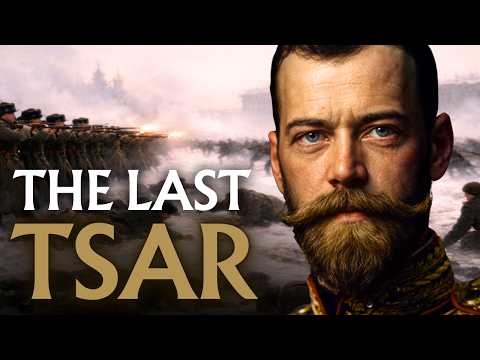
Tsar Nicholas II, the last emperor of Russia, faced immense challenges during his reign, including political unrest, military defeats, and the rise of revolutionary movements. His indecisiveness and reliance on autocratic rule ultimately led to his abdication and execution during the Bolshevik Revolution, marking the end of the Romanov dynasty and the beginning of a new era in Russian history.
The man known to history as Tsar Nicholas II of Russia was born Grand Duke Nicholas Alexandrovich Romanov on May 18, 1868, at the Alexander Palace in Tsarskoe Selo, near St. Petersburg. His reign was marked by significant turmoil, leading to the Russian Revolution and the eventual fall of the Romanov dynasty.
Nicholas II was the eldest son of Tsar Alexander III and Maria Fyodorovna, born Princess Dagmar of Denmark. The Romanov family had ruled Russia since 1613, and Nicholas's upbringing was heavily influenced by the political climate of the time. His childhood was characterized by a strict education, overseen by governesses and military tutors, which shaped his personality and leadership style.
The Romanovs ascended to power during a tumultuous period in Russian history, following the Time of Troubles. By the time of Nicholas's birth, the Russian Empire had expanded significantly, becoming the largest country in the world. However, the empire was also facing internal challenges, including rising nationalism and demands for reform.
Nicholas became Tsar in 1894 after the death of his father. His coronation was marred by tragedy when a stampede at a public celebration resulted in over a thousand deaths. This event foreshadowed the difficulties he would face as ruler.
Initially, Nicholas relied on the conservative policies of his father, which included repression of revolutionary movements. His indecisiveness and desire to please those around him led to inconsistent policymaking. He struggled to balance the demands for reform with the need to maintain autocratic control.
Under the guidance of Finance Minister Sergei Witte, Russia underwent rapid industrialization, which, while modernizing the economy, also led to social unrest. Poor working conditions and high taxes resulted in strikes and peasant riots, creating a volatile political environment.
By the early 20th century, various political factions emerged, including the Socialist Revolutionary Party and the Social Democrats. These groups capitalized on the discontent among workers and peasants, advocating for radical changes to the political system.
In 1904, Nicholas faced a significant military challenge when Russia went to war with Japan over territorial disputes in Manchuria and Korea. The war ended in a humiliating defeat for Russia, further eroding Nicholas's authority and prestige.
The discontent culminated in the 1905 Revolution, sparked by events such as Bloody Sunday, where peaceful protestors were shot by the military. In response, Nicholas issued the October Manifesto, which promised civil liberties and the establishment of a legislative assembly, the Duma. However, he remained reluctant to relinquish his autocratic powers.
The Duma's formation did not stabilize the political landscape. Nicholas's attempts to control the Duma and his reliance on military force to suppress dissent led to further unrest. The assassination of key political figures, including Interior Minister Vyacheslav von Plehve, highlighted the growing instability.
As World War I began, Nicholas took personal command of the Russian army, hoping to boost morale. However, military defeats and economic hardship led to widespread discontent. By early 1917, strikes and protests erupted in Petrograd, culminating in the abdication of Nicholas on March 15, 1917.
Nicholas initially abdicated in favor of his son, Alexei, but later decided on his brother, Grand Duke Michael, as the successor. The Provisional Government placed Nicholas and his family under house arrest, marking the end of the Romanov dynasty's rule.
The Bolshevik Revolution in October 1917 led to the overthrow of the Provisional Government. Nicholas and his family were moved to Ekaterinburg, where they were executed on July 17, 1918, by Bolshevik forces. Their deaths marked a brutal end to the imperial family and the autocratic rule in Russia.
Nicholas II's legacy is complex and debated among historians. While some view him as a weak ruler who failed to adapt to the changing political landscape, others argue that he was a victim of circumstances beyond his control. His reign ultimately set the stage for the rise of communism in Russia and the profound changes that followed.
The life of Tsar Nicholas II reflects the tumultuous history of Russia in the early 20th century. His reign, marked by personal tragedy and national upheaval, ended with the fall of the Romanovs and the rise of a new political order. The legacy of Nicholas II continues to evoke discussion about leadership, governance, and the impact of historical events on the course of a nation.



















