
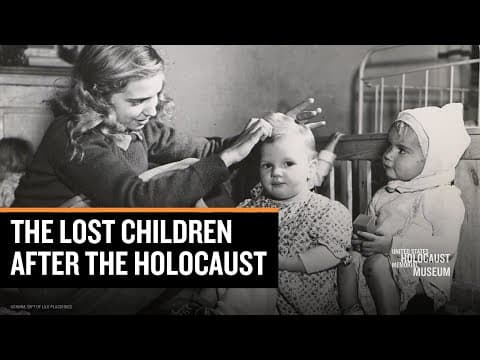
This blog post explores the experiences of children who found refuge at Kloster Indersdorf after World War II, highlighting their traumatic pasts, the challenges they faced, and the compassionate efforts of aid workers like Greta Fisher to provide them with a nurturing environment.
At the end of World War II, tens of thousands of European children were left without homes, each carrying painful stories of loss and trauma. This blog post focuses on one particular group of these children who found shelter at Kloster Indersdorf, a medieval monastery located about ten miles from the liberated Dachau concentration camp in Germany.
The children's home established in Kloster Indersdorf was unique in that it served a diverse range of ethnic and religious groups, despite the U.S. government's order to separate displaced persons based on ethnicity. At any given time, the center housed about 300 children, including Jewish boys and girls who had survived concentration camps or had been hidden by their parents, who were later killed during the Holocaust. Tragically, no one came to reclaim these children.
In addition to Jewish children, the home also accommodated Christian children, some of whom had been taken from their East European parents shortly after birth due to their parents being imprisoned in German forced labor camps. Others were kidnapped by the Nazis because they were deemed ethnically German or possessed so-called "Aryan" traits. Many of these children had spent their formative years in ideological schools designed to indoctrinate them into Nazi ideology.
After the war, the United Nations Relief and Rehabilitation Administration (UNRRA) was established to assist those who could not return to their hometowns. UNRRA worked closely with the Allied occupation authorities in Germany, with nearly half of its budget funded by the American government. One of the aid workers who played a crucial role in setting up the children's home was Greta Fisher.
Greta was a remarkable individual, born and raised in Czechoslovakia. As a young Jewish woman, she survived the Holocaust as a refugee in England while her parents were imprisoned in the Theresienstadt ghetto, where they were ultimately killed. After the war, at the age of 35, she took a job with UNRRA and was stationed in Germany. Greta faced the chaos of the post-war period, including rampant food and supply shortages, while being responsible for the care of the children under her supervision.
The Kloster Indersdorf monastery provided ample space and facilities for the large number of children, including a primitive gymnasium and a baroque dining hall. However, it was also freezing in winter and lacked hot water, making it a challenging environment for both the children and the staff. Some nuns who had been evicted by the Nazis returned to help care for the children, overcoming these obstacles.
Among the children at Kloster Indersdorf were Jewish teenage boys from Romania, specifically the Kleinman and Farkas families. Lazar Kleinman, whose father was the village rabbi, and the Farkas brothers, Lipot and Erwin, were initially unaware of the violence against Jews until their families were rounded up and deported to Auschwitz-Birkenau.
Upon arrival at Auschwitz, Polish prisoners advised the boys to pretend to be older to avoid being murdered. This advice saved their lives, as nearly everyone else in their families was sent to the gas chambers. The boys endured harrowing experiences in various concentration camps before reuniting at Flossenburg in Germany.
In the final weeks before liberation, the boys formed a family unit, supporting each other through the trauma they had experienced. As American troops approached Flossenburg, the boys were forced on a death march, during which they relied on each other for survival. After liberation, they were reunited at Kloster Indersdorf, where they found comfort in their shared experiences.
Despite their shared trauma, the diverse backgrounds of the children led to tensions within the home. Some Christian children harbored deep-seated anti-Jewish sentiments, which contributed to conflicts among the children. Greta Fisher worked tirelessly to foster understanding and coexistence among the children, often facing significant challenges in changing their perceptions.
The staff at Kloster Indersdorf aimed to create a nurturing environment for the children, ensuring they felt welcome and cared for. They became surrogate parents, providing food, comfort, and emotional support. Greta emphasized the importance of acknowledging and discussing the children's painful experiences, allowing them to process their trauma.
The staff also worked diligently to track down any surviving relatives of the children. They collaborated with an American photographer to take pictures of the children, hoping someone might recognize them. Many children had lost their identities due to the chaos of war, and the staff aimed to help them reclaim their sense of self.
Today, the site of Kloster Indersdorf is recognized for its role in providing refuge and healing for children after the war. The building has been transformed into both a school and a museum, and the town has hosted reunions for surviving children and their families. Greta Fisher's legacy continues to be honored, with a school in Dachau named after her.
The stories of the children at Kloster Indersdorf are a poignant reminder of the resilience of the human spirit in the face of unimaginable adversity. Greta Fisher and her colleagues exemplified compassion and dedication, providing a safe haven for children who had lost everything. Their efforts not only helped these children heal but also laid the groundwork for their future lives, allowing them to reclaim their identities and find a sense of belonging in a world that had once turned against them.



















