
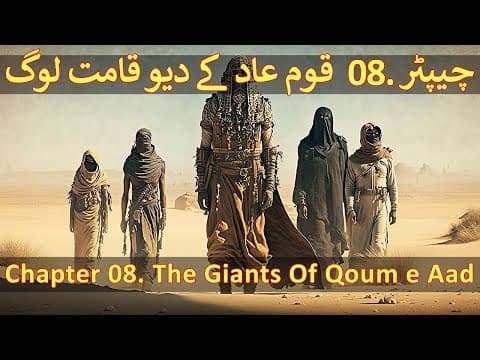
The blog explores the historical and archaeological significance of the lost city of Iram and its inhabitants, the people of Aad, as mentioned in the Quran. It discusses their origins, architectural achievements, pride, and the divine punishment they faced, leading to their disappearance. The narrative combines religious texts with archaeological findings to provide a comprehensive understanding of this ancient civilization.
The story of the lost city of Iram and its inhabitants, the people of Aad, is a fascinating tale rooted in ancient history and religious texts. Mentioned in the Quran, these people are often considered a myth by modern scholars, yet their legacy continues to intrigue researchers and historians alike. This blog post delves into the origins of the people of Aad, their architectural marvels, their pride, and the divine punishment that led to their disappearance.
The lineage of the people of Aad traces back to Sam, the son of Prophet Noah. Sam's descendants spread across Arabia and Asia, and the term "Semitic" is derived from his name. Sam had a son named Iram, and Iram's grandson was Aad. In the heart of the desert, a city named Iram was established, and its inhabitants were known as the people of Aad. The Quran mentions the people of Aad 24 times, with a detailed account provided in Surah Al-A'raf.
The city of Iram is described in Surah Al-Fajr as a place of grandeur, often referred to as the "people of Iram who had pillars". This description has led to various interpretations, suggesting that the people of Iram were unmatched in their architectural achievements. They built massive pillars, which served not only as structural supports but also as symbols of power and pride.
The pillars constructed by the people of Iram were not merely for aesthetics; they represented strength and stability. In ancient architecture, columns were essential for countering natural forces such as earthquakes and strong winds. The grandeur of these pillars was a testament to the civilization's advanced engineering skills and their desire to showcase their power.
As the people of Aad prospered, they became increasingly proud of their achievements. Their pride culminated in a declaration of superiority, questioning, "Who is more powerful than us?" This arrogance did not go unnoticed by the divine, leading to their eventual downfall. The Quran warns against such pride, emphasizing that true strength lies with Allah.
The punishment for the people of Aad came in the form of a devastating wind, described in the Quran as fierce and unrelenting. This wind lasted for seven nights and eight days, destroying everything in its path. The people of Aad, who once stood tall like their pillars, were reduced to nothing, tossed about like hollow tree trunks.
Despite the lack of concrete evidence regarding the city of Iram, some archaeological findings hint at its existence. The Ebla tablets, discovered in Syria, mention a term resembling "Aad-dah", providing a faint trace of this lost civilization. Additionally, explorers like Bertram Thomas and geologists such as Nicholas Clapp have reported findings in the Rub' al Khali desert that suggest the presence of ancient ruins, possibly linked to the city of Iram.
The story of Iram serves as a cautionary tale about pride and the consequences of turning away from divine guidance. The people of Aad, once a powerful civilization, became a lost chapter in history, their city buried beneath the sands of time. The remnants of their existence, however, continue to spark curiosity and research, as scholars seek to uncover the truth behind this enigmatic civilization.
The lost city of Iram and the people of Aad represent a significant part of ancient history, intertwined with religious narratives and archaeological pursuits. Their story is a reminder of the impermanence of power and the importance of humility. As we continue to explore the mysteries of the past, the tale of Iram remains a poignant example of how pride can lead to downfall, echoing through the ages as a lesson for future generations.



















