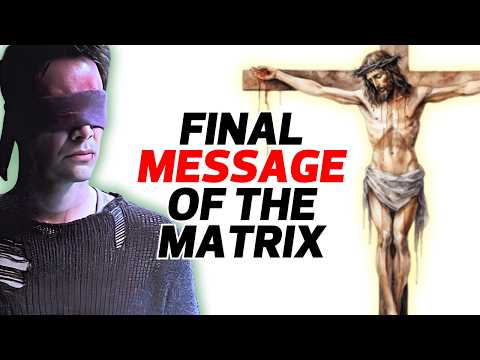
The Matrix trilogy's ending, inspired by Christian symbolism, reveals that Neo's victory is not through force but through selfless sacrifice and love. The machines designed the prophecy of 'The One' to control humanity, but Neo's unpredictable choice breaks the cycle, emphasizing that love and selflessness are forces beyond rational calculation.
The Matrix trilogy, crafted by the Wachowskis, is renowned not only for its groundbreaking visuals and action but also for its deep philosophical and symbolic layers. Among these layers, Christian symbolism stands out prominently. Neo, the protagonist, embodies traits reminiscent of Jesus Christ: he dies and resurrects, is called "The One," and performs miracles. However, the trilogy's message goes beyond symbolism to convey a powerful and transformative idea.
In the climactic ending, Neo stands before the Deos Ex Machina, blind and defenseless. He is no longer fighting or running; instead, he fully understands his role and what he must do to end the war and save humanity from extinction. This moment is pivotal:
"If that's true then I've made a mistake, and we should kill me now."
Neo has made a deal with the ruler of the Machine City, ready to sacrifice himself in exchange for peace. When asked what he wants, his answer is simple:
"Peace."
As a child watching the film, many viewers, including myself, expected an epic battle where the rebels would defeat the machines through force. The ending, however, subverts this expectation. Knowing the Christian inspiration behind the story, it becomes clear why the trilogy concludes this way.
Neo's final act is not just heroic; it is the only move in the entire war that the machines could not predict or calculate. This unpredictability is crucial to understanding the Wachowskis' message.
Trinity's final words encapsulate the film's core thesis:
"I wished I had one more chance to say what really mattered, to say how much I loved you, how grateful I was for every moment I was with you."
Love, sacrifice, and selflessness are portrayed not as weaknesses but as powerful weapons that rational, calculating systems cannot comprehend or counter. These qualities change the course of history because they are acts made without expectation of reward or recognition.
To fully grasp why Neo's self-sacrifice is the only path to victory, we must revisit the Architect scene. This scene is often misunderstood as complicated exposition but is actually a clear explanation of the film's philosophy.
The Matrix is described as a probability engine where every choice, action, and human variable is calculated and predicted. Neo is told:
"You are the eventuality of an anomaly which, despite my sincerest efforts, I have been unable to eliminate from what is otherwise a harmony of mathematical precision."
Neo is not unique in the traditional sense; he is a necessary glitch, an error correction mechanism that keeps the system running.
The Architect reveals a chilling truth: Neo is the sixth "One." Five previous versions have faced the same choice and made the same decision—to save Zion, select 23 people to rebuild, and reboot the system. This cycle has repeated itself, ensuring the machines' control over humanity.
The machines did not just anticipate rebellion; they engineered it. They embedded hope and the prophecy of "The One" into the system to manipulate humans into fighting, resisting, and ultimately complying when the moment of truth arrives.
The Architect can predict Neo's decision before it happens, indicating that the machines have already won.
Despite the machines' calculations, Neo's choice is different. He refuses to follow the predetermined path. His decision to sacrifice himself for peace and love is an act that cannot be predicted or controlled by the machines.
This choice signifies the triumph of human qualities—love, selflessness, and sacrifice—over cold, rational systems. It challenges the notion that everything can be calculated and controlled.
The Matrix trilogy's ending is a profound statement about the power of love and sacrifice in a world dominated by logic and control. Neo's victory is not through force or rebellion but through an unpredictable act of selflessness that breaks the cycle of control.
This message resonates deeply, reminding us that the most powerful forces in history are often those that cannot be quantified or predicted. The Wachowskis use Neo's journey to illustrate that true change comes from giving everything away without expectation, embodying the very essence of hope and humanity.
Next time you watch The Matrix, remember that its ending is not just about a battle won but about the enduring power of love and sacrifice to transform even the most rigid systems.