
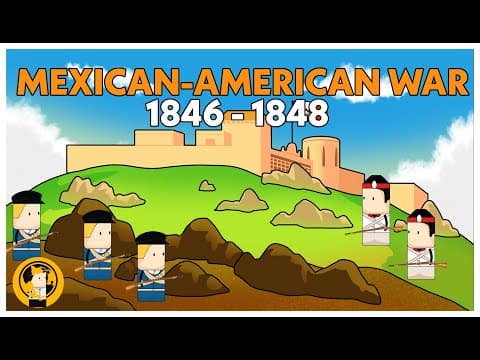
The Mexican-American War, fueled by territorial ambitions and the concept of Manifest Destiny, resulted in significant territorial gains for the United States while leaving Mexico in turmoil. The conflict reshaped borders, ignited debates over slavery, and set the stage for future conflicts, impacting both nations for generations.
The Mexican-American War, a significant conflict in the mid-19th century, was rooted in territorial disputes and national ambitions. This blog post explores the origins, key battles, and lasting impacts of the war on both Mexico and the United States.
The war's origins can be traced back to the early 19th century, particularly with the rebellious province of Texas. After the Texas Revolution, Texas gained independence from Mexico and sought to join the United States. However, Mexico was unwilling to let go of Texas, fearing that allowing one province to leave could encourage others to follow suit.
At the same time, the United States was driven by the ideology of Manifest Destiny, the belief that it was their divine right to expand westward across North America. This ambition included not just Texas, but also California and New Mexico, which were seen as ripe for American settlement and economic opportunity.
In 1845, the United States annexed Texas, which Mexico viewed as a direct violation of its sovereignty. This act heightened tensions between the two nations, especially as Mexico was grappling with internal issues such as political instability and economic difficulties. The diplomatic efforts to resolve these tensions failed, leading to increased hostilities.
The situation escalated in April 1846 when American and Mexican forces clashed near the Rio Grande, which the United States considered its border with Texas. The skirmish resulted in American casualties, prompting President James K. Polk to declare war on Mexico on May 13, 1846.
The first major battle occurred near Palo Alto, Texas, where American forces led by General Zachary Taylor faced off against General Mariano Arista's Mexican army. Despite being outnumbered, the American forces utilized superior artillery and tactics, resulting in a decisive victory with minimal American casualties compared to the heavy losses suffered by the Mexican army.
Following Palo Alto, the Battle of Resaca de la Palma took place on May 9, 1846. The American forces again emerged victorious, inflicting significant casualties on the Mexican army while sustaining relatively few losses themselves. This victory further boosted American morale and confidence.
As the war progressed, American forces, under General Stephen W. Kearney, successfully captured New Mexico with little resistance. In California, the Bear Flag Revolt led to the establishment of a short-lived California Republic, which was soon overtaken by American forces.
In March 1847, General Winfield Scott executed a daring amphibious assault on Veracruz, leading to its capture. This victory opened the path for the American advance toward Mexico City, where fierce battles ensued, including the pivotal Battle of Cerro Gordo.
The most significant battle occurred in September 1847 at Chapultepec Castle, where American forces captured the stronghold, paving the way for the occupation of Mexico City. The Mexican government, facing overwhelming military pressure, sought peace negotiations.
The war officially ended with the signing of the Treaty of Guadalupe Hidalgo on February 2, 1848. This treaty resulted in Mexico ceding vast territories, including California, New Mexico, Arizona, Nevada, Utah, and parts of Colorado and Wyoming, to the United States.
From the perspective of the United States, the war was a triumph that fulfilled its Manifest Destiny. The acquisition of new territories spurred economic growth, particularly with the discovery of gold in California, leading to a population boom and increased westward migration. However, the question of slavery in these new territories reignited fierce debates between the North and South, contributing to the sectional tensions that would eventually lead to the American Civil War.
Conversely, the consequences for Mexico were devastating. The loss of vast territories resulted in economic and political turmoil, hindering the nation's development and weakening its geopolitical standing. The war exacerbated internal divisions and set the stage for future conflicts and upheavals.
The Treaty of Guadalupe Hidalgo included provisions to protect the rights of Mexican residents in the ceded territories, but these protections were often ignored. Mexican Americans faced discrimination and marginalization, struggling for recognition and equality in the newly acquired lands.
The war also strained relations between the United States and other nations, with countries like Britain and France expressing skepticism over American expansionism. This tension contributed to further conflicts, including the French intervention in Mexico during the 1860s.
The Mexican-American War was a pivotal moment in the history of both nations, reshaping borders and igniting debates that would resonate for generations. Its legacy continues to influence the cultural and political landscape of the United States and Mexico today, reminding us of the complexities of territorial expansion and its far-reaching consequences.



















