
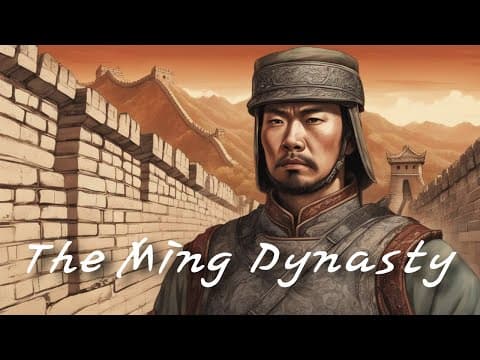
The Ming Dynasty, lasting from 1368 to 1644, marked a significant period in Chinese history characterized by cultural revival, military strength, and economic prosperity. Founded by Zhu Yuan Zhang, the dynasty restored Han Chinese rule, expanded territory, and left a lasting cultural legacy despite its eventual decline due to corruption and peasant revolts.
A dynasty is essentially a succession of rulers from the same family or group that maintains power over multiple generations. Dynasties play a crucial role in civilization by providing stability, continuity, and principles that hold societies together over long periods. Among these, the Ming Dynasty of China stands out as one of the most significant, lasting nearly 300 years from 1368 to 1644. This period is often regarded as one of the greatest in China's long imperial history, marked by a revival of Han Chinese rule after centuries of Mongol dominance.
To understand the significance of the Ming Dynasty, we must first look at its founder, Zhu Yuan Zhang. Born a peasant in the 1330s during the chaotic late Yuan Dynasty, which was ruled by the Mongols, Zhu experienced firsthand the hardships of hunger, disease, and war. He joined a Buddhist monastery where he learned to read and write. When rebels rose against the Mongols, Zhu joined the rebellion and quickly gained renown as a skilled military commander. Through alliances, conquests, and tactical brilliance, he united the rebels and captured the Yuan capital of Nanjing in 1356. After the last Yuan emperor fled north in 1368, Nanjing became the capital of the new Ming Dynasty, proclaimed by the victorious Zhu, now known as the Hong Wu Emperor.
The early Ming Dynasty oversaw a magnificent revival of Han Chinese culture, science, and technology. The arts flourished, with significant contributions to drama, poetry, and novels, including the famous "Romance of the Three Kingdoms." Neo-Confucianism expanded and became the state doctrine, emphasizing ethics and virtues. To restore agriculture, the Hong Wu Emperor initiated vast irrigation projects, including the repair and expansion of the famed Dujiangyan irrigation system, which significantly boosted crop yields for a growing population.
Long-distance trade routes were re-established across China and beyond, leading to a booming economy and commercial activity. Historian Charles Hucker noted that this period paralleled other global flourishing eras, such as the Muromachi period in Japan and the Golden Age of the Ottoman Empire.
At its peak, the Ming military included over 1 million troops, far larger than contemporary European kingdoms. After founding the Ming Dynasty, Zhu centralized all armed forces under his direct imperial command, ensuring loyalty to the emperor and reducing regional divisions. The military was organized under five army commands headquartered around the capital, with troops recruited from all over China, often serving in units grouped by their home province to inspire unity.
The Ming military utilized advanced weaponry, including early firearm prototypes and cannon batteries. Cavalry, infantry, and naval forces were all part of the mighty Ming arsenal, employing a balanced combined arms approach. Training focused on discipline and cohesion, with daily drills in tactical maneuvers. This disciplined military system allowed the Ming to repel threats, such as Mongol raiders from the north, and secure trade routes at sea.
Under the Yongle Emperor, the Ming Dynasty controlled one of the largest empires in human history, spanning over 5 million square miles. After overthrowing the Mongol-led Yuan Dynasty, the Ming spent decades pacifying northern China and fortifying the Great Wall against Mongol incursions. Massive military campaigns pressed into Mongolia to destroy remnant Yuan forces, greatly expanding Ming control.
Admiral Zheng He's naval voyages projected Ming power into Southeast Asia, India, Arabia, and even the East African coast. While not directly controlling these regions, the Ming asserted naval dominance and expanded tribute trade networks westward. Ming armies also conquered vast regions like Yunnan, Guizhou, and Tibet, enriching the Ming court through tribute.
The Ming Dynasty is renowned for its cultural and diplomatic achievements. The Forbidden City emerged as a massive imperial palace complex at the heart of Beijing, meticulously planned according to philosophies like feng shui. This architectural marvel remains one of the largest palace complexes on Earth.
In exploration, Zheng He's massive naval expeditions ventured as far as Africa, establishing the Ming as a maritime powerhouse long before European ships reached those shores. The stability and affluence of the Ming era led to a surge in arts and literature, producing classics like "Journey to the West" and anthologies of poetry and drama that are still cherished today.
Despite its achievements, the Ming Dynasty faced numerous challenges by the late 1500s. Corruption plagued the bureaucratic government and tax system, leading to widespread hunger as emperors hoarded wealth. Peasant revolts erupted, including the rebellion led by Li Zicheng in the 1640s, which gained strength and captured ancient capitals. In April 1644, Beijing fell to Li Zicheng, leading to the suicide of the last Ming emperor and the dynasty's collapse.
However, the end of the Ming was merely the beginning of a captivating chapter in Chinese history, paving the way for the Manchu conquest and the new Qing Dynasty. The Ming Dynasty left an enduring cultural legacy that continues to shape Chinese society today.
The Ming Dynasty's contributions to Chinese civilization are profound:
The Ming Dynasty's vast territory and trade networks allowed Chinese culture to permeate surrounding societies more deeply than ever before. This cultural exchange and innovation enriched China's civilization and left traditions that resonate to this day. The remarkable journey of the Ming Dynasty illustrates the complexities of power, culture, and legacy in one of history's most influential periods.



















