
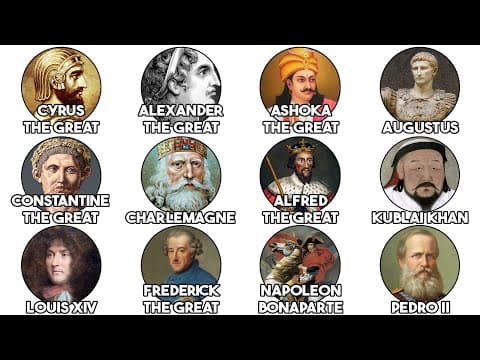
This article explores the lives and legacies of some of history's most influential kings, including Cyrus the Great, Alexander the Great, Ashoka the Great, Augustus, Constantine the Great, Charlemagne, Alfred the Great, Kublai Khan, Louis XIV, Frederick II, Napoleon Bonaparte, and Pedro II, highlighting their contributions to governance, military strategy, and cultural development.
Throughout history, numerous kings have shaped the world through their leadership, military conquests, and cultural advancements. This article delves into the lives and legacies of some of the most influential kings, examining their contributions to governance and society.
Cyrus the Great, the founder of the Achaemenid Empire, was born around 600 BC in Anshan, in present-day Iran. He was the son of Kambissus I and Mandane, the daughter of Astyages, king of Media. Legend has it that Astyages dreamed Cyrus would overthrow him, prompting him to order the infant's death. However, Cyrus was saved and raised by a shepherd.
Cyrus rose to power around 559 BC after his father's death, becoming king of Anshan and leader of the Persians. At that time, Persia was under the Median Empire's control. By 550 BC, Cyrus led a successful revolt against his grandfather, unifying the Medes and Persians and marking the beginning of the Achaemenid Empire.
Over the next two decades, Cyrus expanded his empire through military conquests and diplomacy, notably defeating the Lydian king Croesus around 546 BC and conquering the Neo-Babylonian Empire in 539 BC without bloodshed. His most notable act was freeing the Jewish people from Babylonian captivity, allowing them to return to Jerusalem.
Cyrus was known for his policies of tolerance, allowing diverse peoples to maintain their customs and religions, which created a stable and prosperous empire. His governance principles are encapsulated in the Cyrus Cylinder, regarded as an early example of human rights. Cyrus died in battle around 530 BC, and his legacy influenced many future leaders, including Alexander the Great.
Born in 356 BC in Pella, Macedonia, Alexander was the son of King Philip II and Queen Olympias. He was educated by Aristotle, who instilled in him a love for philosophy and strategy. At just 20 years old, Alexander ascended to the throne after his father's assassination in 336 BC.
He quickly faced rebellions and threats from rival factions, demonstrating decisive leadership by crushing opposition in Greece. Alexander launched an ambitious campaign against the Persian Empire, achieving significant victories at the battles of Granicus, Issus, and Gaugamela, leading to the fall of Persia.
His conquests extended beyond Persia into Egypt, where he was declared pharaoh and founded the city of Alexandria. Alexander's military campaigns reached India, where he fought King Porus at the Battle of the Hydaspes in 326 BC. Exhausted, his troops refused to march further, forcing him to turn back.
Alexander died suddenly in Babylon at 32, with the cause of death remaining a mystery. His empire fragmented after his death, but his influence on culture and military strategy endures, making him one of history's greatest generals.
Ashoka, born around 304 BC in Patali Putra, was the son of Emperor Bimbisara. He received a rigorous education in administration and warfare. After a violent struggle for the throne, Ashoka became emperor in 268 BC.
Initially known for his military ambition, Ashoka's most significant conquest was the Kalinga War, which resulted in immense bloodshed. Witnessing the devastation led him to renounce violence and embrace Buddhism, promoting principles of non-violence and compassion.
Ashoka implemented policies to improve the welfare of his people, including building hospitals and roads. His edicts, inscribed on pillars, conveyed messages of morality and religious tolerance. His reign covered most of the Indian subcontinent, and he died around 232 BC, leaving a legacy that helped spread Buddhism across Asia.
Born as Gaius Octavius on September 23, 63 BC, Augustus was the great-nephew and adopted son of Julius Caesar. After Caesar's assassination, Augustus emerged as a key political figure, forming the Second Triumvirate with Mark Antony and Marcus Lepidus.
Following the defeat of Caesar's assassins, Augustus faced tensions within the Triumvirate, leading to a rivalry with Antony. He decisively defeated Antony and Cleopatra at the Battle of Actium in 31 BC, becoming the uncontested ruler of Rome.
In 27 BC, he restored power to the Senate while retaining ultimate authority, earning the title Augustus. His reign brought about the Pax Romana, a period of peace and prosperity, and he implemented reforms that stabilized Rome, expanded its borders, and improved infrastructure.
Augustus died on August 19, 14 AD, leaving a legacy that shaped the governance of the Roman Empire for generations.
Born in 272 AD in Naissus, Constantine was the son of Constantius Chlorus and Helena. He grew up in the imperial court, gaining military and political experience. After his father's death, he was declared Augustus by his troops.
Constantine famously defeated his rival Maxentius at the Battle of the Milvian Bridge, reportedly after having a vision of a Christian symbol. He became the sole ruler of the Western Roman Empire and later defeated Licinius to reunify the empire.
As emperor, Constantine enacted major reforms, notably supporting Christianity and ending its persecution with the Edict of Milan. He moved the capital to Byzantium, renaming it Constantinople, which became a major political and cultural center.
Constantine's reign marked the transition from the classical Roman Empire to the Byzantine era, and he died in 337 AD, leaving a profound legacy in European history.
Charlemagne, born around 747, was the son of Pepin the Short. After his father's death, he became king of the Franks and embarked on military campaigns that expanded his empire across Western and Central Europe.
He waged wars against the Saxons, converting them to Christianity, and conquered the Lombards in Italy. On Christmas Day in 800, he was crowned emperor of the Romans by Pope Leo III, marking the revival of the Western Roman Empire.
Charlemagne implemented significant administrative reforms, organizing his empire into regions governed by counts and promoting learning and literacy. He ruled until his death in 814, and his legacy influenced the formation of modern European states.
Alfred the Great, born in 849, was the youngest son of King Aethelwulf of Wessex. He became king in 871 during a time of Viking invasions. After initial defeats, he secured a truce and later decisively defeated the Vikings at the Battle of Edington.
Alfred implemented military, legal, and educational reforms, strengthening Wessex's defenses and promoting literacy. He invited scholars to his court and translated Latin texts into Old English, preserving knowledge during a turbulent time.
Alfred died in 899, leaving a legacy that laid the foundation for a united England.
Kublai Khan, born in 1215, was the grandson of Genghis Khan. He became a key contender for leadership within the Mongol Empire and established the Yuan dynasty in China, promoting economic growth and cultural achievements.
Kublai adopted Chinese governance practices and completed the conquest of the Song Dynasty, unifying China under Mongol rule. His reign brought prosperity and increased trade along the Silk Road, and he welcomed foreign diplomats like Marco Polo.
Kublai died in 1294, leaving a significant legacy in both Mongol and Chinese history.
Louis XIV, known as the Sun King, was born on September 5, 1638. He ascended to the throne at a young age and centralized power, famously declaring, "I am the state." His reign was marked by territorial expansion and cultural flourishing.
Louis constructed the Palace of Versailles, symbolizing his absolute power, and ruled for 72 years, the longest of any monarch in European history. He died on September 1, 1715, leaving a legacy that influenced future monarchs.
Frederick II, known as Frederick the Great, was born on January 24, 1712. He ascended to the throne in 1740 and expanded Prussian power through military brilliance, notably during the War of Austrian Succession.
Frederick implemented reforms that modernized Prussia, promoting religious tolerance and economic development. He ruled until his death in 1786, leaving a significant impact on Prussia's transformation into a dominant power.
Napoleon Bonaparte was born on August 15, 1769, in Corsica. He rose to power during the French Revolution and became emperor of France in 1804. His reforms reshaped France and much of Europe, establishing the Napoleonic Code and centralizing administration.
Napoleon's military campaigns saw him conquer much of Europe, but his invasion of Russia in 1812 ended in disaster. He was exiled after his defeat in 1814 but returned for a brief period before his final defeat at Waterloo in 1815.
Napoleon's influence on law and military strategy continues to be felt today.
Pedro II was born on December 2, 1825, and became emperor of Brazil at the age of 14. His reign was marked by modernization efforts, including infrastructure projects and the gradual abolition of slavery.
Despite his successful leadership, Pedro II was overthrown in 1889 and lived in exile until his death in 1891. He is remembered as a symbol of wisdom and integrity in Brazilian history.
The kings discussed in this article left indelible marks on history through their leadership, military conquests, and cultural advancements. Their legacies continue to influence modern governance, military strategy, and societal values, showcasing the enduring impact of their reigns on the world.



















