
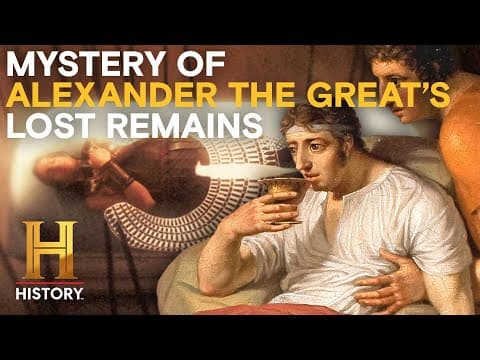
This blog post explores the life, death, and mysterious disappearance of Alexander the Great's tomb, detailing the historical context, the significance of his burial, and the potential reasons behind the loss of his remains in Alexandria.
In the year 323 BCE, in ancient Babylon (modern-day Iraq), Alexander the Great, one of history's most formidable conquerors, succumbed to illness. His death sent shockwaves throughout the ancient world, leaving a power vacuum among his generals and a legacy that would be revered for centuries. This blog post delves into the events surrounding Alexander's death, his elaborate burial, and the subsequent mystery of his tomb's disappearance.
On June 11th, 323 BCE, Alexander the Great passed away after a two-week struggle with illness. His final words, "To the strongest," hinted at the impending chaos among his generals, who were eager to claim parts of his vast empire. In life, Alexander was not only a military genius but also regarded as a deity by many, particularly in Egypt.
Following his death, Alexander's body was mummified in accordance with Egyptian traditions. His remains were dried with salt, his internal organs removed, and aromatic resins added to preserve his body. He was placed in a golden sarcophagus and transported in a lavish funerary bier, designed to resemble a temple, pulled by a fleet of adorned mules.
Two years after his death, the funeral procession finally departed Babylon, making its way westward through the cities of Alexander's empire, drawing crowds eager to pay their respects. However, the journey took an unexpected turn when Ptolemy I, one of Alexander's generals, seized the body during its passage through Syria and transported it to Egypt.
Ptolemy established Alexander's tomb in Memphis, Egypt, to solidify his own power. Eventually, the body was moved to Alexandria, a city founded by Alexander himself, which became a center of learning and culture, home to the famous Library of Alexandria. By placing Alexander's remains in a mausoleum within this intellectual hub, Ptolemy could claim legitimacy as Alexander's true successor.
Historical accounts indicate that Alexander's tomb became a significant pilgrimage site, attracting visitors from all over the ancient world, including notable figures like Cleopatra, Julius Caesar, and Mark Antony. For centuries, the tomb remained a symbol of power and reverence.
However, by the late fourth century, references to Alexander's tomb abruptly ceased. The last known mention came from the Roman teacher Libanius, who noted its existence around 700 years after Alexander's death. Just two decades later, when John Chrysostom sought to visit the tomb, he was met with confusion and blank stares, indicating that it had seemingly vanished.
The late fourth century was a tumultuous time for Alexandria, marked by natural disasters and social upheaval. Historical records indicate that a tsunami struck the city, compounding the political and religious turmoil of the era. As Christianity began to spread throughout the Roman Empire, it faced repression and conflict with pagan traditions, leading to a violent backlash against pagan landmarks, including Alexander's tomb.
In 380 AD, Emperor Theodosius declared Christianity the official religion of the Roman Empire, leading to increased hostility towards pagan sites. By 391 AD, a series of decrees aimed at eradicating pagan practices were enacted, resulting in the destruction of temples and shrines. This period coincides with the last known references to Alexander's tomb, suggesting that it may have been a target during this purge of pagan symbols.
The fate of Alexander the Great's tomb remains one of history's great mysteries. The combination of natural disasters, political upheaval, and the rise of Christianity likely contributed to the erasure of this monumental site. As Alexandria transformed from a center of pagan worship to a Christian stronghold, the tomb of one of history's greatest figures faded into obscurity, leaving behind only whispers of its existence. The loss of Alexander's tomb serves as a poignant reminder of how history can be reshaped by the tides of culture and belief.



















