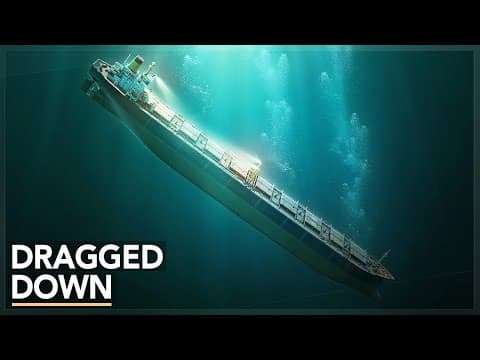
The MV Derbyshire, a massive cargo ship, sank during Typhoon Orchid in 1980 without a distress call, leading to years of speculation and investigation into its disappearance. Despite initial conclusions attributing the loss to the sea, evidence later suggested structural failures and design flaws contributed to the tragedy, prompting changes in maritime safety regulations.
On the evening of September 9th, 1980, the MV Derbyshire, a massive cargo ship, was navigating the Pacific Ocean, bound for Japan. As it approached Typhoon Orchid, a powerful storm, the ship's captain, Jeffrey Underhill, faced a critical decision. With conflicting weather reports and the nearest safe harbor hundreds of kilometers away, he opted to maintain course, believing he could outrun the storm.
The Derbyshire had been at sea for eight weeks, transporting 150,000 tons of iron ore from Canada. Captain Underhill, a seasoned mariner with over two decades of experience, was looking forward to reuniting with his wife in Japan after a long voyage. However, as the storm intensified, the crew prepared for rough seas, securing equipment and adjusting the ship's heading.
Despite the storm's ferocity, the Derbyshire, a state-of-the-art vessel measuring nearly 1,000 feet long and weighing 170,000 tons, was designed to withstand harsh conditions. The crew felt confident in their ship's capabilities, unaware that disaster was looming.
By dawn on September 10th, the Derbyshire had vanished without a trace. No distress call was sent, and for six days, the ship's owner did not report it missing, assuming it had lost radio contact. An international search was launched, but no debris or life rafts were found. The media quickly labeled the disappearance as an oddity, especially since smaller vessels had weathered the same storm without incident.
Authorities concluded that the sea had claimed the Derbyshire, and the search was abruptly called off. Families of the crew were left in anguish, feeling that the investigation was insufficient and that something was being hidden.
The Derbyshire was part of a new class of ships known as Ore-Bulk-Oil carriers (OBO), designed for efficiency in transporting various goods. Built in 1976 at the Swan Hunter shipyard in Britain, the Derbyshire was one of six Bridge Class ships. However, as the British shipbuilding industry faced competition from Japan and South Korea, cost-cutting measures may have compromised the quality of construction.
Peter Ridyard, a ship surveyor and father of a crew member, began investigating the circumstances surrounding the Derbyshire's sinking. He discovered that other Bridge Class ships had developed stress cracks and had been quietly repaired. Alarmingly, Ridyard found that the Derbyshire had not been built according to its original plans, raising concerns about potential design flaws.
In 1984, the families of the Derbyshire crew formed the Derbyshire Families Association, determined to uncover the truth. Their persistence led to an official inquiry after another Bridge Class ship, the Kowloon Bridge, broke apart in 1986. Despite mounting evidence of structural failures, Ridyard was not allowed to present his findings during the inquiry.
On January 18th, 1989, the inquiry concluded that there was no evidence of structural failure, attributing the loss to the sea. The families were outraged, feeling their fight for justice had been dismissed.
In 1994, the International Transport Workers Federation, moved by the families' plight, funded a search for the Derbyshire. Remarkably, the ship was located on the ocean floor, nearly 4 kilometers deep, just 23 hours after the search began. However, it would take another six years to piece together the events leading to its sinking.
On that fateful night, as the Derbyshire battled Typhoon Orchid, the ship began to succumb to the storm's relentless force. Waves battered the foredeck, damaging hatches and allowing water to flood the cargo holds. The ship's bow sank lower into the waves, leading to a catastrophic failure of the hatch covers. The Derbyshire ultimately lost buoyancy and disappeared beneath the Pacific.
Contrary to initial beliefs, the sinking was not due to a singular structural failure but rather a series of compounding breakdowns. The families' refusal to accept the official explanation played a crucial role in prompting changes in maritime safety regulations, ultimately protecting future seafarers.
The tragic sinking of the MV Derbyshire serves as a haunting reminder of the vulnerabilities in maritime safety and the importance of thorough investigations. The persistence of the families not only led to the discovery of the wreck but also instigated significant changes in ship design and safety protocols, ensuring that future generations of seafarers would sail with greater assurance of their ships' integrity.