
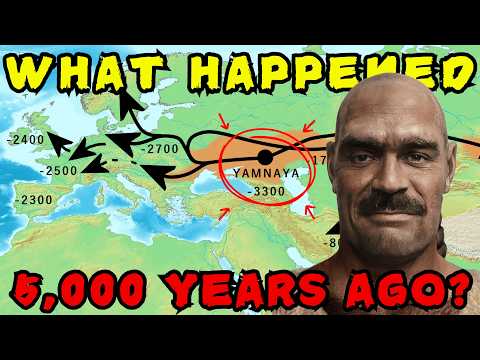
Between 5,000 and 30,000 BCE, the Yamnaya people emerged from the Pontic-Caspian steppe, obliterating 90% of Europe's male bloodlines. Their genetic legacy, cultural impact, and linguistic contributions reshaped Europe and extended into South Asia, leaving a complex and often controversial legacy that echoes in modern society.
Between 5,000 and 30,000 BCE, Europe underwent a dramatic transformation. Genetic studies published in 2015 revealed that up to 90% of male bloodlines vanished during this period, leading to the collapse of entire villages. This phenomenon raised critical questions: What could cause such a drastic obliteration of the male lineage in Europe? Or more intriguingly, who was responsible?
In the same centuries, biologists discovered evidence of plague in the teeth of Neolithic children, but this did not explain the gender bias observed in the genetic data. A new group emerged in the archaeological record: the Yamnaya. Their burials, often filled with wagons, weapons, and sacrificed animals, began to appear across Europe. A 2015 study in Nature identified these burials as belonging to the Yamnaya, who carried the ancestral tongue of nearly every European language.
The Yamnaya imposed patriarchal clans and warrior elites on societies that had previously been more egalitarian. They left behind genes that not only provided some resistance to infections but also increased susceptibility to certain diseases. Their cultural impact resonated throughout history, influencing Europe even into the 20th century.
To understand the Yamnaya, we must first consider their environment—the Pontic-Caspian steppe, a vast expanse stretching from the Black Sea to the Caspian Sea. This flat, treeless landscape was home to pastoralists who relied on herds of cattle and sheep. Unlike the Neolithic farmers of Europe, who were settled and agricultural, the Yamnaya were nomadic, capable of transporting their entire households across great distances.
Their burial practices reflected their status and lifestyle. Kurgans, or burial mounds, filled with weapons and artifacts, marked the resting places of clan leaders, visible from miles away in the barren landscape. Despite their significance, the Yamnaya remained largely a mystery until the early 2000s.
For much of the 20th century, the Yamnaya were considered just another prehistoric culture, lacking the monumental achievements of civilizations like the Egyptians or Sumerians. However, in 2015, Wolfgang Hark and colleagues published groundbreaking research comparing the genomes of Neolithic farmers, Bronze Age herders, and modern Europeans. The results were shocking: the genetic signature of early farmers had been replaced almost overnight by that of the Yamnaya.
In regions like Britain and Iberia, up to 90% of the population was replaced within a few thousand years. This contradicted the long-held belief that cultures spread without significant population movement. Ancient DNA evidence revealed that entire populations could vanish, and the Yamnaya were not merely migrants; they repopulated Europe.
The genetic studies also revealed an asymmetry in the replacement process. Yamnaya men intermarried with local women, leading to a significant shift in the Y chromosome lineages, which overwhelmingly traced back to the Yamnaya. In contrast, mitochondrial DNA, passed down through mothers, showed continuity with earlier European farmers. This means that while the male lineage was largely wiped out, the female lineage persisted, absorbed into the clans of the newcomers.
Today, the most common paternal haplogroups in Europe, R1B in the west and R1A in the east, can be traced back to Yamnaya ancestry. They are, quite literally, the fathers of Europe.
The Yamnaya were not just a genetic force; they also carried a language that would evolve into the Proto-Indo-European language, the ancestor of many modern languages spoken across Europe and Asia. Linguists have long puzzled over the similarities between languages like English, Greek, Sanskrit, and Russian. Scholars in the 18th century, such as Sir William Jones, noted these connections and proposed a common ancestor.
The reconstructed vocabulary of Proto-Indo-European reveals a world of nomadic life, with words for wheel, axle, horse, and cow, as well as terms related to kinship and hierarchy. This linguistic heritage suggests a society where loyalty, obligation, and reputation were paramount. The concept of a skyfather, worshipped in various Indo-European cultures, further illustrates the shared mythic traditions that traveled across vast distances.
What made the Yamnaya so successful? Several factors contributed to their dominance. Their diet, rich in meat and dairy from cattle and sheep, provided them with higher protein levels compared to the predominantly grain-based diets of Neolithic farmers. Isotopic analysis of Yamnaya bones indicates a steady consumption of animal products, leading to greater physical robustness and stature.
Genetic adaptations also played a role. The Yamnaya exhibited higher frequencies of genes linked to lactose tolerance, allowing them to thrive on fresh milk. However, these advantages came with burdens, as some genetic traits increased susceptibility to autoimmune disorders.
The Yamnaya's lifestyle and culture were further enhanced by their mastery of horse domestication. While they did not invent horse domestication, they integrated it into their society in unprecedented ways, using horses for riding and herding. This mobility allowed them to raid farming communities effectively.
Another factor that may have contributed to the Yamnaya's success was the presence of plague in late Neolithic Europe. DNA analysis indicates that the Yamnaya may have been less exposed to the disease due to their nomadic lifestyle. As farming communities collapsed under the weight of plague, the Yamnaya thrived, outpacing and outlasting their agricultural counterparts.
The Yamnaya's migrations did not stop at the borders of Europe. Their influence extended into Central Asia and the Indian subcontinent, where their legacy became a contentious topic. The so-called Aryan invasion theory posited that warriors from the north invaded India, imposing their language and culture on the indigenous population. This theory has been debated for decades, with Indian scholars arguing for indigenous origins of Sanskrit and the Vedas.
Ancient DNA studies have now provided clarity. Research from the Swat Valley in northern Pakistan indicates a significant proportion of ancestry linked to the Yamnaya and their descendants. This ancestry is particularly strong in the male line, carried by the Y chromosome haplogroup R1A, which is still prevalent in Northern India and Pakistan today.
The cultural echoes of the Yamnaya are also evident in the material record. Horses, absent from the Indus Valley civilization, became central to Indo-Aryan culture, and rituals like the Ashvamedha, or royal horse sacrifice, reflect earlier Indo-European traditions.
Fast forward to the 19th and 20th centuries, and the Yamnaya were reimagined in the context of rising nationalism. The concept of an original Indo-European people became a rallying point for various nationalist movements across Europe and India. The term "Aryan," originally meaning noble in Sanskrit, was co-opted into a racial category, leading to dangerous ideologies.
In Germany, the idea of the Aryans as a master race was propagated, culminating in the radicalization of these concepts by the Nazis. This appropriation of Indo-European studies left a lasting stain on the field, causing scholars to shy away from migration theories for decades.
However, the advent of ancient DNA technology has revived interest in migration as a genetic fact, challenging the long-held belief in cultural continuity without significant population movement.
The Yamnaya were a Bronze Age people whose mobility, biology, and culture allowed them to spread far beyond their homeland. They mixed, adapted, and ultimately disappeared, leaving behind a profound legacy. Their genes remade Europe, their languages became the foundation of many modern tongues, and their social systems influenced the development of hierarchical societies.
Despite their significant impact, the Yamnaya left no grand monuments or epic tales of conquest. Instead, they remind us that time ultimately claims all, and their story is a testament to the complex interplay of genetics, culture, and history. The echoes of the Yamnaya still resonate today, shaping our understanding of identity and ancestry in a world that continues to grapple with the legacies of the past.



















