
This blog post explores the naval warfare during World War I, focusing on Britain's blockade of Germany, the Battle of Jutland, and the subsequent strategies that led to Britain's dominance at sea. It highlights the significance of naval power in the war and the impact of submarine warfare.
In the years leading up to World War I, Britain and Germany invested millions in their naval forces. From 1898 to 1912, hundreds of new ships were constructed, reflecting the growing importance of naval power. The British Empire, the largest empire in the world, relied heavily on its navy for control over its vast territories. As Germany began to compete with Britain at sea, concerns grew about the implications of this rivalry. Control of the seas was seen as crucial for supplying allies and denying resources to enemies.
A naval blockade is a military strategy where a naval force prevents ships and goods from entering or leaving a specific country. The primary objective is to limit the enemy's access to essential resources, disrupt their supply chains, and weaken their military and economic capabilities.
By 1914, Britain possessed the most powerful navy in the world, which allowed it to impose a blockade on Germany. The Germans had limited coastline in the North Sea, making it easier for Britain to restrict their access. Britain declared the entire North Sea a war zone, putting all enemy ships at risk of attack. This blockade was critical as Germany was in dire need of steel, oil, coal, medicine, food, and other vital resources. The blockade not only threatened to starve Germany into submission but also severely disrupted its industrial production and military supply lines.
By 1916, Germany was desperate to break the blockade. Both Britain and Germany had been hesitant to engage their full naval forces, but the situation had changed. The Battle of Jutland, fought on May 31, 1916, became the largest naval battle of World War I, involving over 250 warships and 100,000 men.
The German High Seas Fleet, commanded by Admiral Reinhard Scheer, aimed to lure the British Grand Fleet, led by Admiral John Jellicoe, into a trap. They planned to send a small number of ships to provoke the British, while a larger force awaited to ambush them. However, the British had intercepted German communications due to their capture of Germany's naval codebook, allowing them to anticipate the German movements.
The two fleets met in the North Sea, resulting in a fierce battle characterized by poor visibility and heavy losses on both sides. The British had numerical superiority with 28 dreadnoughts and nine battle cruisers compared to Germany's 16 dreadnoughts and five battle cruisers. Despite the British losing 14 ships and 6,000 men, while the Germans lost nine ships and over 2,500 men, neither side achieved a decisive victory. The British maintained control of the North Sea, and the blockade continued, which was crucial for the war effort.
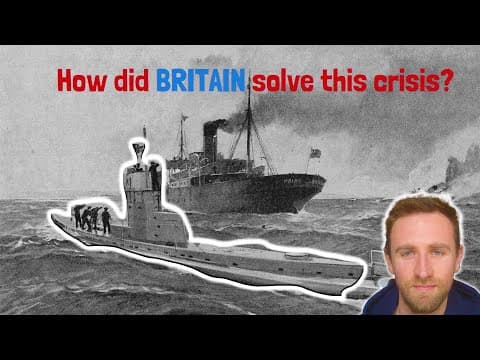
Following the Battle of Jutland, Germany reverted to unrestricted submarine warfare, targeting any ships entering British waters, including civilian vessels. This strategy aimed to disrupt Britain's supply lines, with an average of two supply ships sunk daily. However, this approach risked provoking the United States, which was still neutral but had significant interests in the conflict.
In May 1915, the sinking of the British ship Lusitania, which resulted in the deaths of 128 Americans, created a diplomatic crisis for Germany. In response, Germany temporarily reduced its submarine attacks to avoid further aggravating the United States.
By 1917, facing increasing desperation, Germany resumed unrestricted submarine warfare, sinking numerous supply ships and bringing Britain to the brink of resource depletion. At one point, Britain had only six weeks of supplies left.
To counter the submarine threat, Britain developed several effective strategies. The convoy system was introduced, where supply ships traveled in large groups protected by naval escorts and aircraft. This significantly reduced the effectiveness of U-boat attacks.
The British also laid minefields in the English Channel to destroy U-boats and implemented depth charges, which were designed to explode at specific depths to target submarines. Additionally, Q ships, which were decoy vessels disguised as unarmed merchant ships, were equipped with weapons to engage U-boats.
By mid-1918, these tactics proved highly effective. The British Navy had sunk a significant number of German U-boats, and the German submarine campaign could not be sustained. Ultimately, Britain emerged victorious in the battle for control of the seas.
The naval warfare of World War I was marked by strategic blockades, significant battles, and the evolution of tactics in response to emerging threats. Britain's ability to maintain naval supremacy and adapt to the challenges posed by German submarine warfare played a crucial role in the overall outcome of the war at sea. The lessons learned from these engagements would shape naval strategies in future conflicts.



















