
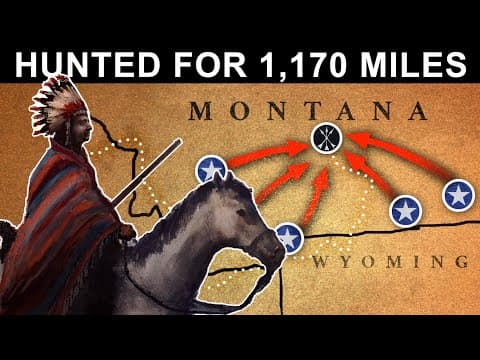
The Nez Perce War of 1877 was a tragic conflict resulting from broken treaties and the encroachment of settlers on Native American lands. Chief Joseph and his people fought valiantly against overwhelming odds, ultimately leading to their forced relocation and suffering, highlighting the injustices faced by indigenous peoples in America.
The Nez Perce War of 1877 stands as a poignant chapter in American history, illustrating the struggles of Native Americans against the encroachment of settlers and the betrayal of treaties. This conflict was not merely a battle for land but a fight for survival and sovereignty for the Nez Perce people, led by the wise and courageous Chief Joseph.
In 1855, a treaty was established that granted the Nez Perce nearly all of their ancestral territory. However, the discovery of gold in the region in 1860 led to a massive influx of Euro-American settlers. Despite their longstanding alliance with the United States, the Nez Perce found themselves increasingly marginalized as settlers violated the treaty, claiming their lands for homes, farms, and ranches.
In 1863, under pressure from settlers and government representatives, certain Nez Perce leaders were persuaded to sign a new treaty that forfeited 90% of their land. Chief Joseph likened this betrayal to a neighbor selling away one’s horses without permission. The Nez Perce were composed of semi-autonomous bands, and the treaty was not binding on all of them, a fact acknowledged by U.S. commissioners in 1873.
By 1877, tensions escalated as General Oliver Otis Howard threatened the Nez Perce with military action. While many Nez Perce remained on their reservation, bands led by Chief Joseph, Looking Glass, and White Bird chose to stay on their homelands. The situation deteriorated when a few young Nez Perce men, seeking revenge for past injustices, attacked settlers, killing around 15 people. Chief Joseph, who was away during the raids, expressed his dismay at the rash actions of the young men, recognizing the broader consequences of their violence.
In response to the attacks, General Howard mobilized over 100 soldiers to confront the Nez Perce. A tragic miscommunication occurred when Nez Perce approached under a white flag, only to be fired upon. The ensuing battle saw the Nez Perce warriors, skilled and organized, inflict heavy casualties on the American forces, who lost over 30 men without killing a single Nez Perce.
Fearing further retaliation, Howard ordered the arrest of neutral Chief Looking Glass and his people, leading to a breakdown of neutrality among the Nez Perce. In early July, Looking Glass joined Joseph and the other bands, and they began a strategic retreat into the Bitter Root Range of the Rockies, hoping to find refuge and assistance from allied tribes.
The Nez Perce, skilled horsemen, managed to evade capture for weeks, utilizing their knowledge of the land and their alliances with other indigenous peoples. However, they faced relentless pursuit from U.S. forces, who were determined to subdue them.
On August 9, 1877, the Nez Perce camped along the Big Hole River, where they were surprised by American forces. The soldiers attacked at dawn, aiming to kill the sleeping Nez Perce. Despite the chaos, the Nez Perce warriors fought back fiercely, resulting in significant casualties on both sides. The Americans lost between 60 to 90 men, while the Nez Perce suffered the loss of many women and children.
As the conflict continued, Chief Joseph and his people faced increasing hardships. They sought refuge with Sitting Bull in Canada, but the U.S. military was relentless in their pursuit. On September 30, 1877, Colonel Nelson A. Miles attacked the Nez Perce camp, leading to a brutal confrontation that resulted in the deaths of many warriors, including Looking Glass.
On October 4, 1877, Chief Joseph, weary and heartbroken, surrendered to General Howard. His poignant words, "I am tired of fighting. Our chiefs are killed. Looking Glass is dead too... I want time to look for my children... I will fight no more forever," encapsulated the despair and resilience of his people.
Following their surrender, the Nez Perce were promised relocation to a reservation, but instead, they were sent to Indian Territory, far from their homeland. The New York Times described the Nez Perce War as an unpardonable blunder, reflecting a growing awareness of the injustices faced by Native Americans.
Chief Joseph became a national figure, advocating for the rights of his people and pleading for a return to their homeland. Despite the hardships, the Nez Perce endured, though they faced significant losses and suffering in the years that followed.
In 1885, the Nez Perce were allowed to return to the Northwest, but they remained fragmented and confined to reservations. Chief Joseph lived out his days in exile, passing away in 1904, still dreaming of the land of his ancestors.
The Nez Perce War serves as a stark reminder of the struggles faced by indigenous peoples in America. It highlights the consequences of broken treaties, the resilience of Native American cultures, and the ongoing fight for justice and recognition. The legacy of Chief Joseph and the Nez Perce continues to resonate today, symbolizing the enduring spirit of those who resist oppression and seek to reclaim their rightful place in history.



















