
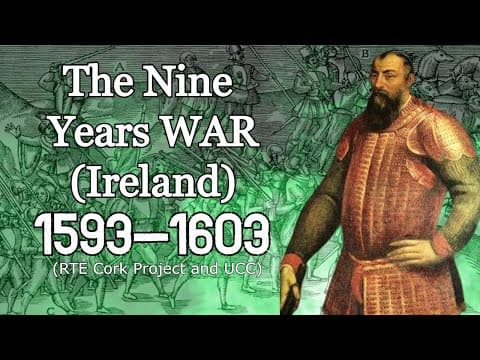
The Nine Years War (1594-1603) marked a significant conflict between Irish chieftains and English rule, led by figures like Hugh O'Neill and Red Hugh O'Donnell. This war was influenced by broader European politics, particularly the rivalry between England and Spain. Despite initial successes for the Irish, the war ultimately resulted in English dominance in Ireland and the decline of Gaelic aristocracy, shaping the future of Ireland and its relationship with England.
The Nine Years War (1594-1603) was a pivotal conflict in Irish history, representing the struggle of Irish chieftains against English rule. This war was not only a local affair but was also influenced by the broader European political landscape, particularly the rivalry between England and Spain. Key figures in this conflict included Hugh O'Neill and Red Hugh O'Donnell, who led the resistance against the encroaching English authority.
By the end of the 16th century, England had begun to assert its authority over Ireland. The Irish chieftains were embroiled in internal conflicts, which made them vulnerable to English expansion. Many Gaelic lords were coerced into submission through fear or greed, while some, like O'Neill and O'Donnell, resisted the Crown's advances.
Hugh O'Neill, born in Gilig Gster and educated in the English Pale, was a complex figure. He was seen as both an Englishman and an Irishman, adept in both cultures. Initially, he served the English Crown but later joined the rebellion against them. His alliance with Red Hugh O'Donnell marked the beginning of a significant resistance movement.
The Nine Years War officially began in 1594 when O'Neill and O'Donnell united against English forces. Their guerrilla tactics proved effective, pushing the English back from Ulster and gaining control over large swathes of territory. The conflict escalated as O'Neill was inaugurated as the O'Neill, a title that symbolized his defiance against English rule.
At this time, Spain was the most powerful nation in Europe, and its influence played a crucial role in the conflict. Philip II of Spain sought to undermine Queen Elizabeth I of England, and the rebellion in Ireland provided an opportunity to distract the English from their conflicts in the Netherlands and elsewhere.
The Irish forces employed guerrilla warfare, which horrified the English government. Notable battles included the Battle of Yellow Ford in 1598, where O'Neill and O'Donnell achieved a significant victory, further emboldening the Irish resistance.
In 1596, O'Neill made a critical decision to ally with Spain, seeking military support against the English. This alliance was fraught with challenges, as Spain was dealing with its own financial difficulties. Despite promises of support, the Spanish aid was slow to arrive, leading to increased tensions and desperation among the Irish forces.
The arrival of the Spanish army at Kinsale in 1601 marked a crucial moment in the war. However, the Spanish forces faced significant challenges, including a lack of support from local Irish chieftains and the harsh winter conditions. The subsequent Battle of Kinsale resulted in a devastating defeat for the Irish, leading to the collapse of their resistance.
Following the defeat at Kinsale, the English forces, under Lord Deputy Mountjoy, tightened their grip on Ireland. The Gaelic aristocracy faced severe repercussions, with many leaders, including O'Neill, fleeing to Spain. The English victory effectively ended the Gaelic order in Ireland and established Protestant ascendancy in both church and state.
The Nine Years War had lasting implications for Ireland. It marked the end of the Gaelic aristocracy and the beginning of a new era of English dominance. The conflict also highlighted the complexities of Irish identity, intertwining nationalism with Catholicism.
The Nine Years War was a significant chapter in Irish history, illustrating the struggle for autonomy against colonial forces. While the war ended in defeat for the Irish, it laid the groundwork for future resistance and shaped the national consciousness of Ireland. The legacy of figures like Hugh O'Neill continues to resonate in the narrative of Irish history, symbolizing the enduring fight for identity and sovereignty.



















