
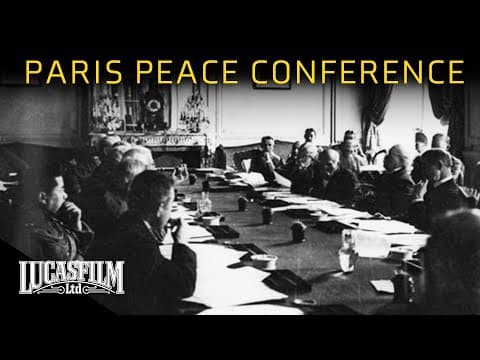
The Paris Peace Conference of 1919 aimed to establish a lasting peace after World War I but ultimately led to unforeseen consequences, including the rise of tensions that contributed to World War II. Key figures like Woodrow Wilson, Georges Clemenceau, and David Lloyd George navigated a landscape of devastation and conflicting national interests, resulting in the Treaty of Versailles, which many viewed as punitive towards Germany.
In May 1919, six months after the end of the Great War in Europe, a French train departed from Berlin, carrying the German delegation to the Paris Peace Conference. As the train entered France, it slowed to a crawl, allowing the German delegates to witness the war-torn countryside, still littered with the remnants of conflict. This devastating landscape served as a stark reminder of the catastrophe that had unfolded over four years, claiming millions of lives. The victors of the war were not only tasked with punishing Germany but also with creating a future devoid of such catastrophic conflicts.
The aftermath of World War I left Europe shattered and forever changed. The war had been unprecedented in its scope and brutality, with over 15 million soldiers and civilians dead and countless others wounded. The three great empires that had dominated the continent—the Ottoman Empire, Austria-Hungary, and Tsarist Russia—had collapsed, leaving chaos and the threat of revolution in their wake. Amidst this turmoil, the leaders of the victorious nations gathered in Paris to negotiate a peace settlement with Germany.
On January 18, 1919, the Peace Conference officially opened at the French Foreign Ministry. Delegates from over 30 victorious countries convened to discuss the terms of the peace treaty. The process was cumbersome and inefficient, with hundreds of committees formed to negotiate various aspects of the treaty. The leaders of the three most powerful nations—U.S. President Woodrow Wilson, French Prime Minister Georges Clemenceau, and British Prime Minister David Lloyd George—took control of the proceedings.
President Wilson arrived in Europe with a vision for a post-war world, armed with his 14-point plan for peace, which emphasized national self-determination and democracy. He was welcomed in Paris with enthusiasm, but his idealism was met with skepticism by Clemenceau and Lloyd George, who viewed him as naïve.
Clemenceau, who had experienced two German invasions of France, was determined to ensure France's security. He was a tough negotiator, advocating for reparations and territorial adjustments to protect France from future German aggression.
Lloyd George, a skilled politician and negotiator, had to balance Britain’s desire for naval supremacy and empire with the need for a stable Europe. He recognized the importance of maintaining Germany as a bulwark against the threat of Bolshevism from Russia.
As the conference progressed, the pressure to deliver a peace settlement mounted. The public in Britain, France, and the United States demanded swift action against Germany, leading to demonstrations and unrest. The Big Three faced the daunting task of determining Germany's future, including military restrictions and reparations.
Despite their differences, the leaders agreed to establish the League of Nations as part of the treaty, aiming to create a framework for international cooperation and conflict resolution. This was seen as a crucial step towards preventing future wars, although Clemenceau and Lloyd George remained skeptical of Wilson's optimistic vision.
On June 28, 1919, the Treaty of Versailles was signed, imposing harsh terms on Germany. The treaty required Germany to accept responsibility for the war, pay reparations, and significantly reduce its military capabilities. The German delegation, led by Count Ulrich von Brockdorff-Rantzau, was shocked by the terms, which they viewed as punitive and humiliating.
Upon returning to Germany, the delegation faced public outrage. The treaty's terms were seen as a betrayal, leading to the rise of the “stab in the back” myth, which blamed politicians and minority groups for Germany's defeat. This narrative would have lasting implications for German society and politics.
Wilson's vision for a new world order quickly unraveled. His refusal to compromise on the treaty led to its rejection by the U.S. Senate, and the United States retreated into isolationism. The League of Nations struggled to assert itself, and the unresolved tensions from the treaty contributed to the rise of radicalism and ultimately World War II.
The Paris Peace Conference serves as a reminder of the complexities involved in negotiating peace. The decisions made in 1919, driven by the pressures of the time, had far-reaching consequences that shaped the course of the 20th century. The flawed legacy of the Treaty of Versailles continues to influence international relations today, highlighting the challenges of reconciling national interests with the pursuit of lasting peace.
In retrospect, one must consider what could have been done differently. The task of making peace in 1919 was fraught with difficulties, and while the Treaty of Versailles was not ideal, it was perhaps the best that could be achieved under the circumstances. The lessons learned from this historical moment remind us that organizing human societies and addressing deep-seated grievances is never an easy task.



















