
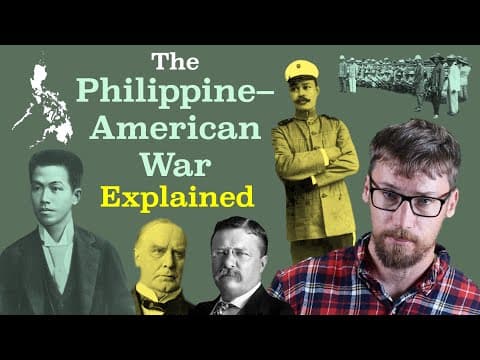
The Philippine-American War, often overlooked in American history classes, was a brutal conflict resulting from U.S. imperialism in the Philippines, leading to significant loss of life and numerous atrocities committed by American soldiers. This blog post explores the war's origins, key events, and its lasting impact on U.S.-Philippine relations.
The Philippine-American War is a significant yet often neglected part of American history. Many Americans are unaware of the brutal conflict that unfolded between the United States and the Philippines at the turn of the 20th century. This war, which some historians estimate resulted in the deaths of up to one million Filipinos, was marked by severe atrocities committed by American soldiers. This blog post delves into the origins, key events, and consequences of the Philippine-American War, shedding light on a dark chapter of U.S. history.
On April 30, 1898, Commodore George Dewey led a fleet into the Philippines, which was then under Spanish control. The backdrop of this military action was the Spanish-American War, during which Filipino nationalists, led by Emilio Aguinaldo, were already fighting for independence from Spain. Aguinaldo's forces had achieved considerable success, and by the time Dewey arrived, they were poised to capture Manila, the capital.
On May 1, 1898, Dewey's forces engaged the Spanish navy at Manila Bay, achieving a decisive victory with no American casualties. This victory prompted Aguinaldo, who was in Hong Kong at the time, to return to the Philippines and continue the fight for independence. Despite the Americans' arrival, the Filipino revolutionaries were already on the verge of defeating the Spanish.
As the situation unfolded, a secret agreement was made between Dewey and the new Spanish Governor-General, Fermin Jaudenes, to stage a fake battle on August 13, 1898. This Mock Battle of Manila allowed the Spanish to surrender to the Americans rather than the Filipinos, effectively sidelining Aguinaldo and his forces. This betrayal set the stage for future conflict.
Following the war, the Treaty of Paris was signed on December 10, 1898, which ceded the Philippines to the United States for $20 million. Notably, no Filipino representatives were present at the negotiations. This treaty sparked a heated debate in the U.S. about imperialism, with anti-imperialists arguing that it contradicted American values of freedom and self-determination.
Tensions escalated when Aguinaldo declared war on the United States on February 4, 1899, leading to the Philippine-American War. The first major battle occurred in Manila, resulting in significant casualties on both sides. The U.S. military, equipped with superior weaponry, initially had the upper hand, but Aguinaldo's forces resorted to guerrilla warfare tactics as the conflict progressed.
As the war dragged on, American troops became increasingly frustrated with the guerrilla tactics employed by Filipino fighters. This frustration led to horrific acts, including scorched earth campaigns, the establishment of concentration camps, and widespread violence against civilians. Reports of torture, including the infamous "water cure," emerged, revealing the brutal reality of the conflict.
Despite the atrocities, many American soldiers were horrified by the actions of their comrades and began to speak out. Letters detailing the violence reached the media, sparking public outrage and protests against the war. The War Department attempted to suppress these reports, but the damage was done, and the American public began to question the morality of the conflict.
The war continued for several years, with Aguinaldo eventually captured in 1901. He swore allegiance to the United States, leading to a gradual end to major hostilities. However, sporadic resistance persisted, particularly from groups like the Moros, who continued to fight against American control until 1913.
The Philippine-American War officially ended on July 2, 1902, with the passage of the Philippine Organic Act, which established a degree of self-governance for Filipinos. However, the U.S. maintained control over the Philippines for several more decades, until full independence was granted in 1946.
The Philippine-American War serves as a painful reminder of the consequences of imperialism and the importance of respecting the sovereignty of other nations. It highlights the need for reflection on past mistakes to prevent their recurrence. Understanding this conflict is crucial for fostering peace, justice, and equality in international relations. The war's legacy continues to shape U.S.-Philippine relations and serves as a call to remember and learn from history.



















