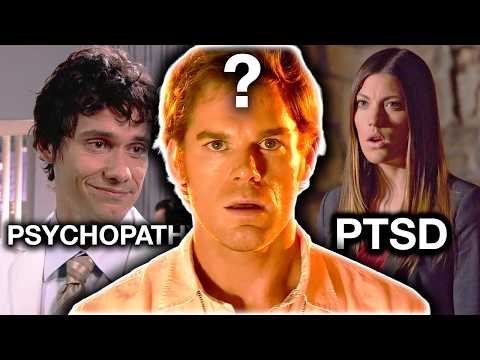
The TV show Dexter portrays its major characters with real, diagnosable psychological disorders, from Lila West's histrionic personality disorder and erotomania to Brian Moser's psychopathy and reactive attachment disorder, Debra Morgan's PTSD and dependent personality disorder, Arthur Mitchell's obsessive-compulsive personality disorder and dissociative functioning, and Dexter Morgan's complex emotional disorder beyond simple psychopathy. This analysis reveals the show's deep psychological veru
The most disturbing aspect of the TV show Dexter is not just the graphic bloodshed but the intricate psychology behind its characters. Each major character in the series exhibits real, diagnosable psychological conditions that explain their behaviors, obsessions, and manipulations. Once these disorders are recognized, they provide a new lens through which to understand the characters and the story.
This article explores the psychological disorders behind five of Dexter's most iconic characters, culminating with Dexter Morgan himself, whose condition is more complex than commonly assumed.
Lila West is one of the most clinically accurate characters in the show. On the surface, she appears mysterious and artistic, but her actions reveal a chronic need for attention and emotional intensity that feels hollow. She exhibits behaviors such as setting her own apartment on fire for attention, falsely accusing a colleague of rape for leverage, and burning a man alive before fleeing to Paris.
These behaviors align with histrionic personality disorder (HPD), characterized by a chronic need for attention and intolerance of being ignored. Beyond HPD, Lila exhibits erotomania, a condition where she fixates on Dexter even after he ends their relationship, believing that his rejection is temporary and that he still belongs to her.
Dexter himself diagnoses her as emotionally color blind, highlighting her lack of awareness of her own evil actions. What makes Lila truly disturbing is not her malevolence but her unawareness of it.
Brian Moser is portrayed as the cleanest psychopath in the series. He kills for pleasure without guilt or empathy, even when it would benefit him to feign such emotions. However, beneath his psychopathy lies reactive attachment disorder (RAD), which developed due to catastrophic early childhood trauma.
Brian's mother was a drug addict, and at around age 10, he witnessed her brutal murder and was trapped with her body for two days alongside Dexter. This traumatic event shattered his ability to form secure attachments. Harry, the adoptive father, deemed Brian too damaged to save and took Dexter home, leaving Brian institutionalized and abandoned.
Brian's attachment system collapsed, leading to his inability to bond normally but a fixation on Dexter, the only person who shared his trauma. This fixation is the one crack in his psychopathy, making him more than a pure predator.
Debra Morgan's character is the most realistic portrayal of trauma in the show. Her psychological wounds accumulate throughout the series: growing up overshadowed by her father's obsession with Dexter's secret life, being manipulated and nearly killed by a serial killer, losing partners and mentors, and becoming an unwilling accomplice to murder.
These experiences reflect complex PTSD, which arises from prolonged, repeated trauma, especially within relationships. Complex PTSD distorts self-perception, causes chronic shame, emotional dysregulation, and a tendency to enter damaging relationships.
Additionally, Debra exhibits dependent personality disorder, relying heavily on her attachment to Dexter for identity, stability, and purpose. Even when she discovers Dexter's true nature, this knowledge deepens her attachment rather than pushing her away, as the disorder prioritizes attachment over logic.
Arthur Mitchell, the Trinity Killer, is the most psychologically complex villain in the series. John Lithgow's portrayal captures a man whose murders follow a precise four-step ritual: a bath, a fall, a burial, and a bludgeoning. Each step recreates a death from his past and is assigned to a specific victim type. This rigid adherence to ritual reflects obsessive-compulsive personality disorder (OCPD).
However, Arthur's complexity extends beyond ritual. He compartmentalizes his life into distinct functional identities: a community pillar at church, a tyrant at home, and the killer during murders. These identities have separate rules and internal logic, indicating dissociative functioning.
Arthur hated what he was, attempted suicide, and did not derive pleasure from his murders. He performed them because he lacked psychological mechanisms to stop. Dexter saw Arthur as a warning: a man who maintained a facade of normalcy yet destroyed everything he touched. Both the community and his family were right in their conflicting views of him.
Dexter Morgan is often labeled a psychopath, and the show reinforces this. However, his clinical profile is more complicated. True psychopathy, as measured by the PCL-R, requires traits such as zero genuine empathy, pathological lying, shallow affect, grandiosity, predatory behavior, and no capacity for real human attachment.
Dexter meets many of these criteria but notably forms genuine attachments. His love for Debra, grief over Rita, and distress over his son Harrison are real. A textbook psychopath would not experience such emotions.
This gap between his desire for connection and inability to access it normally suggests an emotional disorder rooted in extreme childhood trauma. Harry and Vogel did not just give Dexter a code; they constructed an identity around his pathology. They weaponized a traumatized child rather than healing him.
Vogel's notes describe Dexter as a perfect experiment, raising the question the show never fully answers: was Dexter's dark passenger innate or built? If built, then every kill and ritual is partly the product of two adults who chose utility over healing.
Five characters, five psychological diagnoses, and one show that delves deeper into psychology than many viewers realize. Dexter offers a nuanced exploration of mental disorders, trauma, and identity through its characters, making it a compelling study in dark TV psychology.
If you are intrigued by the psychological depth of TV characters, Dexter provides a rich tapestry of clinical accuracy and complex human behavior.