
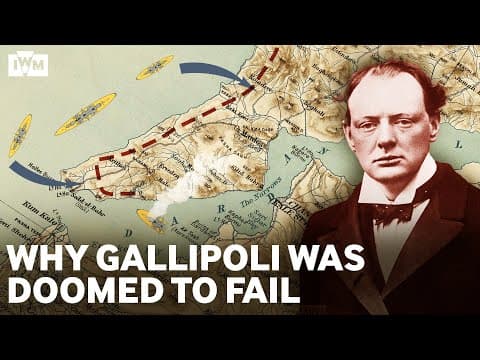
The Gallipoli Campaign, initiated in 1915 during World War I, ended in failure for the Allies due to poor strategic planning, underestimation of the Ottoman forces, and logistical challenges. Despite a successful evacuation, the campaign resulted in significant casualties and had lasting impacts on military strategy and national identities.
On January 9, 1916, the last remaining Allied troops on the Gallipoli peninsula withdrew to the sea. This evacuation, despite dire predictions, was executed successfully with minimal casualties, marking the only success in a campaign otherwise characterized by failure. The Gallipoli Campaign, part of the Dardanelles operation, was plagued by a series of miscalculations and strategic blunders that ultimately led to its downfall.
To understand the failure of the Gallipoli Campaign, we must first look back to the end of 1914. As World War I progressed into a stalemate on both the Western and Eastern fronts, British strategic thinking became increasingly divided. Two factions emerged: the Westerners, who advocated for concentrating forces against Germany, and the Easterners, who sought to exploit perceived weaknesses in the Ottoman Empire and Austria-Hungary.
The Easterners believed that by defeating the Ottomans, they could disrupt Germany's supply lines and resources, thereby weakening their main enemy. The Ottoman Turks, having recently lost territory to Italy and Balkan states, appeared vulnerable and were seen as a tempting target for a quick victory.
Central to the Allied plan was the Royal Navy, which had ships available while the army was engaged on the Western Front. The strategy involved sending a naval force through the Dardanelles Strait to threaten the Ottoman capital of Constantinople, expecting that this would force the Turks to capitulate quickly. However, previous studies had warned of the dangers posed by the strait's fortifications and minefields, leading to a decision in 1907 that such a naval operation was not feasible. By 1915, these warnings had been forgotten.
The naval force assembled included outdated battleships and modern vessels, but the critical task of clearing minefields was assigned to civilian fishing trawlers crewed by inexperienced sailors. The Allies faced formidable Turkish defenses, including fixed fortifications, minefields, and mobile artillery that could strike from hidden positions.
Naval operations began in November 1914, but they primarily served to alert the Turks to impending attacks. By February 1915, Allied ships bombarded outer forts, leading to a major naval assault on March 18. However, the Turkish defenses proved unexpectedly strong, with mines and artillery inflicting heavy damage on Allied ships. The naval forces were forced to withdraw, realizing they could not succeed without ground troops.
To support the naval operations, the Allies assembled the Mediterranean Expeditionary Force, comprising inexperienced troops from various divisions, including the ANZAC Corps. The plan involved simultaneous landings at multiple beaches, but the execution was fraught with difficulties. The landings commenced on April 25, 1915, but faced fierce resistance from the Ottoman Fifth Army, commanded by capable leaders including Mustafa Kemal.
At Cape Helles, some beaches faced little resistance, but troops failed to advance, losing precious time. The ANZACs landed at the wrong location, facing steep cliffs instead of the intended flat terrain, leading to heavy casualties. The Turkish defenders, motivated to protect their homeland, mounted effective counterattacks, thwarting Allied efforts to secure a foothold.
As the campaign dragged on, supply problems became critical. The Allies struggled to maintain adequate supplies, which were often within range of Turkish artillery. The lack of artillery and high-explosive shells hampered their ability to damage Turkish positions effectively. By July, hopes for a breakthrough were renewed with the promise of reinforcements, but subsequent offensives failed to gain ground due to poor planning and execution.
By October 1915, frustration among Allied leadership grew, leading to a change in command. Sir Charles Monroe concluded that evacuation was necessary, but British leadership hesitated to accept this as a defeat. The situation worsened with the Central Powers gaining ground in the Balkans, allowing them to supply the Ottomans with heavy artillery.
In November, after a visit from Lord Kitchener, the decision to evacuate was made. The evacuation was executed with remarkable secrecy, employing tactics to mislead the Turks about Allied intentions. The operation was successful, with the majority of forces evacuated without detection.
The Gallipoli Campaign ended in disaster for the Allies, with 115,000 casualties and no territorial gains, while the Ottomans suffered 186,000 casualties. The failure was attributed to several factors: insufficient forces, underestimation of the enemy, and inexperienced leadership. The campaign severely damaged British prestige and led to significant political repercussions, including the fall of the British government and the resignation of key leaders.
For the Ottomans, Gallipoli became a symbol of national pride and resilience, marking the rise of Mustafa Kemal, who would later become the founder of modern Turkey. The lessons learned from Gallipoli influenced future military operations, particularly during World War II.
The impact of the campaign also resonated in Australia and New Zealand, where ANZAC Day is commemorated annually, symbolizing the emergence of national identities distinct from British colonial ties. The legacy of Gallipoli continues to shape the historical narratives of these nations, emphasizing the themes of bravery and sacrifice.



















