
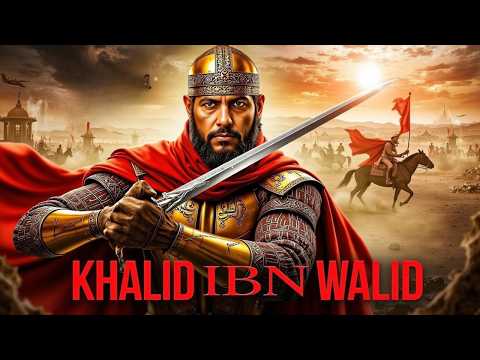
Khalid Ibn Walid, known as The Sword of Allah, was an undefeated military commander who played a pivotal role in the spread of Islam. Born into a noble warrior family in Mecca, he initially opposed Islam but later embraced the faith, becoming one of its greatest champions. His strategic genius led to numerous victories against powerful empires, and his legacy continues to inspire generations.
Khalid Ibn Walid, famously known as The Sword of Allah, was a legendary military commander whose life story is both spine-chilling and incredible. He was a leader who never faced defeat in any battle he entered, a warrior who never slept during wars and never let his soldiers rest. His body bore countless sword scars, symbolizing his dedication and bravery. Khalid was not only one of Islam's greatest devotees but also a genius commander who, with an army of only 3,000 soldiers, fought against 100,000 enemies. He defeated the greatest empires of his time, including the Byzantine and Sasanian empires.
Khalid was born into a noble and warrior family in Mecca, the son of Walid Ibn al-Mughirah, a prominent leader among the idolaters. Following tradition, Khalid was sent to live with a family in the desert after his birth to grow up in a clean and healthy environment. At the age of five or six, he returned to Mecca to live with his family. His father instilled in him values such as heroism, courage, and generosity—qualities admired by all Arabs.
From a young age, Khalid was taught to take pride in his noble lineage, which was significant among Arabs due to the duties carried out by his tribe. He learned to ride horses and master weapons like bows, arrows, spears, shields, and swords. He also trained in leading cavalry units and maintained a strong physique through physical activities. It is said that in his childhood, he wrestled with his peer Umar Ibn al-Khattab and even caused Umar's leg to break.
The Eastern Roman and Sasanian empires had been engaged in a prolonged conflict, while Arabia remained mostly unnoticed. However, a significant change was underway as swords were drawn not for land or wealth but for faith. Muslims, under the leadership of Prophet Muhammad, and the Meccans, led by Abu Jahl, engaged in a crucial battle for their beliefs.
The Battle of Badr marked a turning point. The Muslims, who until a few years earlier could only gather secretly, achieved a great victory. Khalid, like many of his kin, was deeply concerned about his brother Walid, who had gone missing on the battlefield. Khalid later learned that his brother had been captured by the Muslims and was being held prisoner. He paid the ransom to secure his brother's release, but during captivity, Walid had come to know the Muslims closely and had begun to embrace Islam.
This revelation shocked Khalid deeply, setting him on a path of internal conflict between his loyalty to Mecca and the emerging faith of Islam.
Khalid found himself torn between Mecca and Medina, between Islam and idolatry. Muslims were forbidden from entering Mecca, but thanks to Khalid's influence, his brother Walid was allowed to come and go freely. Despite this, Khalid had his brother thrown into prison again, unable to silence the conflicting voices within himself.
A year after the Battle of Badr, the Meccan army prepared for war to seek revenge and secure their trade routes. Prophet Muhammad decided to confront the Meccans at the Battle of Uhud. Khalid, reflecting on the previous battle, devised a different strategy. Although the Muslims were outnumbered, they had the advantage of strategic positioning.
During the battle, Khalid found an alternative route and maneuvered his forces to attack the Muslims from the rear, turning the tide of the battle. Despite initial Muslim success, the battle ended with significant Muslim losses and a retreat.
The ongoing battles between Mecca and Medina eventually led to the Treaty of Hudaybiyyah, a peace agreement granting Muslims the right to perform Umrah and significantly aiding the spread of Islam.
Khalid's internal struggle continued until he received a letter from his brother Walid, urging him to embrace Islam and join the Muslims. Deeply affected by the Prophet Muhammad's kindness and the message of Islam, Khalid decided to convert.
He journeyed to Medina, accompanied by companions, and upon meeting the Prophet, he recited the Shahada, testifying to the Oneness of Allah and the prophethood of Muhammad. The Prophet welcomed him warmly, declaring Khalid to be one of the swords of Allah.
After embracing Islam, Khalid dedicated himself to the cause. He presented his sword to the Prophet, who told him that the sword had served against Islam until now but would now be used for Islam.
Khalid's military genius shone in battles such as the Battle of Mu'tah, where he led a vastly outnumbered Muslim army to victory against the Romans. His tactics instilled fear and chaos among enemy forces, and he broke nine swords in a single battle, earning his title as The Sword of Allah.
He carried a blessed strand of the Prophet's hair in his turban, which he believed brought him victory in every battle.
Khalid participated in over 100 battles and never lost a single one. He played a crucial role in bringing Syria, Persia, and Iraq under the rule of the Islamic State within just three years. Despite his military prowess, he was humble and accepted the decision of Caliph Umar to relieve him from supreme command during a battle, continuing to serve as a regular commander.
Khalid also served briefly as a governor but preferred the life of a warrior. Unlike many companions who died in battle or martyrdom, Khalid fell ill and died peacefully in his bed in Homs, Syria.
In his final moments, he expressed sorrow that he did not die a martyr on the battlefield, recalling the fierce battles he had fought and urging future generations to hold firmly to the spreading of Islam.
Khalid's life exemplifies dedication, courage, and faith. His story teaches that victory in the path of faith requires perseverance and strategic wisdom. In modern times, the concept of Jihad has evolved to emphasize persuasion, knowledge, and dialogue rather than warfare.
Muslims today are encouraged to embody Islam through education, social outreach, and peaceful efforts to inspire others. Khalid's legacy reminds us to strive always for the pleasure of Allah and to avoid heedlessness and worldly distractions.
Khalid Ibn Walid, The Sword of Allah, remains one of the greatest heroes in Islamic history. His unmatched military achievements, unwavering faith, and profound legacy continue to inspire millions around the world. His life story is a testament to the power of conviction, courage, and the transformative impact of embracing faith.
May his example guide us to strive for righteousness and perseverance in all our endeavors.
Salam to the Khalids of our time.



















