
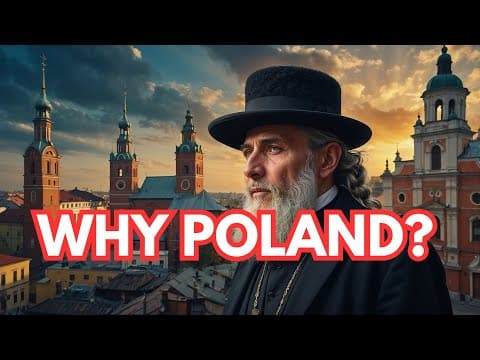
This blog post explores the rich and tumultuous history of Polish Jews, detailing their rise to prominence in Poland, the challenges they faced, and the devastating impact of the Holocaust, while highlighting the resilience of Jewish culture and memory in Poland today.
Poland has long been home to one of the largest Jewish populations in Europe, with a history that spans over a millennium. This blog post delves into the fascinating and complex narrative of Polish Jews, exploring their journey from prosperity to persecution, and the enduring legacy they have left behind.
The history of Jews in Poland can be traced back to the 10th century when Jewish merchants and traders began to settle in the region. Many of these early Jewish immigrants sought refuge from persecution in Western Europe, particularly from Germany and Bohemia. The Crusades, which began in 1096, led to widespread violence against Jews, prompting many to seek safety in Poland.
By the 12th and 13th centuries, Jewish communities were establishing themselves in Poland, often invited by Polish rulers who recognized their economic contributions. A pivotal moment occurred in 1264 when Duke Bolesław the Pious issued the Statute of Kalisz, granting Jews legal protections and religious freedoms. This marked the beginning of Poland's reputation as a haven for Jews, earning it the title of "paradisus Judaeorum" or "Jewish Paradise."
The 16th and 17th centuries are often referred to as the Golden Age of Polish Jewry. During this period, Poland-Lithuania emerged as one of the largest and most powerful states in Europe, and its Jewish community flourished. Jewish scholars, rabbis, and intellectuals transformed Poland into a center of Jewish learning, with cities like Kraków and Lublin becoming renowned for their yeshivas (Jewish academies).
Yiddish culture thrived alongside Hebrew, and Jewish merchants, artisans, and bankers played significant roles in the economy. The Jewish population grew rapidly, and their lives became increasingly intertwined with those of their Christian neighbors, leading to a vibrant and distinct Jewish way of life.
Despite the flourishing Jewish culture, the Golden Age was not without its challenges. The Reformation brought renewed religious intolerance, and anti-Jewish sentiment began to resurface. Discriminatory laws and blood libels limited Jewish economic opportunities, and the Khmelnytsky Uprising in the mid-17th century resulted in widespread violence against Jews, leading to tens of thousands of deaths.
The 18th century brought further turmoil as Poland faced internal strife and external pressures from Russia, Prussia, and Austria. The partitions of Poland from 1772 to 1795 erased the nation from the map, subjecting the Jewish community to the varying laws of these empires. Life became particularly difficult for Jews in the Russian Empire, where restrictive laws and pogroms forced many into the Pale of Settlement, a designated area where Jews were allowed to reside.
As the 19th century progressed, a new movement known as the Haskala, or Jewish Enlightenment, began to take root. Inspired by the broader European Enlightenment, the Haskala advocated for the reexamination of traditional Jewish thought and practices. It emphasized the importance of education, secular knowledge, and integration into broader society, sparking fierce debates within the Jewish community.
While traditionalists viewed the Haskala as a threat, younger Jews saw it as a pathway to a more just future. This movement ultimately led to reforms in Jewish education, assimilation, and the emergence of a modernized Jewish identity.
The year 1918 marked a significant turning point as Poland regained independence after World War I. For the Jewish community, this heralded a new era of hope and opportunity. By 1939, Poland was home to approximately 3.3 million Jews, who were deeply integrated into the political, economic, and cultural fabric of the nation.
Jewish life thrived, particularly in Warsaw, which became a major center of Jewish culture. Yiddish theater, literature, and press flourished, with notable figures such as Nobel laureate Isaac Bashevis Singer contributing to a vibrant cultural renaissance. However, rising anti-Semitism and economic challenges loomed over the community during the interwar years.
The year 1939 brought catastrophic changes for Polish Jews. On September 1, Nazi Germany invaded Poland, unleashing a wave of terror upon the Jewish community. Synagogues were burned, businesses were looted, and the Nazis implemented a cruel plan to isolate and exterminate the Jewish population.
Ghettos were established, with the Warsaw Ghetto becoming the largest, cramming over 400,000 Jews into a confined area. Life in the ghetto was marked by extreme hardship and daily struggles for survival. By 1942, the Nazis' Final Solution was in full effect, with trains transporting Jews from ghettos to death camps. By the end of the war, approximately 90% of Polish Jews—over 3 million men, women, and children—had been killed, resulting in a devastating loss that forever altered the landscape of Jewish life in Europe.
In the wake of the Holocaust, survivors emerged into a desolate landscape of loss and uncertainty. Many chose to immigrate to Israel, the United States, or other countries, leaving behind a shattered but resilient legacy. Despite the horrors of the Holocaust, Jewish life in Poland did not come to an end.
Synagogues have been rebuilt, and the memory of the Holocaust is preserved in museums and memorials, ensuring that this chapter of Jewish history is never forgotten. Kazimierz District in Kraków offers visitors a glimpse into what life was once like for Poland's Jews, serving as a solemn reminder of the enduring impact of war on civilization.
The history of Polish Jews is a testament to resilience, creativity, and profound sorrow. From their early beginnings as a safe haven to the devastating impact of the Holocaust, the story of Polish Jews is woven into the very fabric of European history. As we reflect on this rich and complex narrative, it is crucial to remember and honor the legacy of those who came before us, ensuring that their stories are never forgotten.



















