
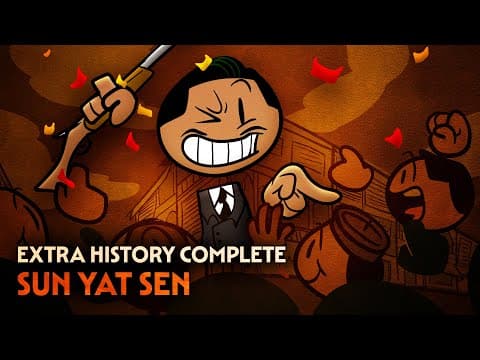
This blog post explores the life of Sun Yat-sen, detailing his transformation from a young student in Hawaii to a revolutionary leader who played a pivotal role in overthrowing the Qing dynasty and establishing the Republic of China. It covers his early influences, failed uprisings, and eventual rise to power, highlighting his vision for a modern China and the challenges he faced along the way.
In the late 19th and early 20th centuries, China was a nation in turmoil, struggling under the weight of imperial rule and foreign intervention. Among those who sought to change the course of Chinese history was Sun Yat-sen, a revolutionary leader whose vision and determination would ultimately lead to the establishment of the Republic of China. This blog post delves into the life of Sun Yat-sen, tracing his journey from a young student in Hawaii to a key figure in the overthrow of the Qing dynasty.
Sun Yat-sen was born in southern China in 1866 to poor peasant parents. His family lacked the means to provide him with a traditional scholarly education, which was essential for upward mobility in Chinese society. The political instability of the time, marked by events like the Taiping Rebellion, further limited opportunities for young boys like Sun.
In 1879, Sun's brother moved to Hawaii to work in the sugarcane fields, and soon after, Sun and his mother followed him. In Hawaii, Sun attended an Anglican boarding school, where he was one of only seven Chinese students. Here, he excelled academically, learning English and gaining exposure to Western ideas about democracy and governance. His education in Hawaii would profoundly shape his worldview and aspirations.
After graduating, Sun returned to China, where he was struck by the stark contrast between his village and the modernity of cities like Hong Kong. He enrolled in college, got married, and earned a medical degree, but his true passion lay in politics. Sun began to associate with like-minded individuals who shared his revolutionary ideals, forming the Revive China Society in 1894, a secret organization dedicated to overthrowing the Qing dynasty.
In 1895, Sun and his comrades attempted their first uprising in Guangzhou. However, the plan was foiled due to a leak, leading to arrests and executions of several revolutionaries, including Sun's close friend Lu Haodong. This failure forced Sun into exile, where he would spend the next several years fundraising and rallying support for his cause.
During his time in exile, Sun traveled extensively, seeking support from overseas Chinese communities and establishing connections with revolutionary groups. He found refuge in Japan, where he formed alliances with various nationalist factions, including the Black Dragon Society, which sought to overthrow the Qing and strengthen China.
The Boxer Uprising of 1900 marked a turning point in Chinese society, as it fueled anti-foreign sentiment and highlighted the Qing's inability to protect the nation. Sun seized this moment to launch further uprisings, but each attempt ended in failure, leading to significant losses among his followers.
After years of planning and failed attempts, the revolution finally gained momentum with the Wuchang Uprising on October 10, 1911. This uprising was sparked by local grievances against the Qing government and quickly escalated into a nationwide revolt. By the end of the year, most provinces had declared their independence from Qing rule.
While Sun was in the United States during the uprising, he learned of his election as the provisional president of the newly formed Republic of China. He returned to China to assume leadership, but the country was still in turmoil, and he faced significant challenges in establishing a stable government.
Sun's presidency was short-lived as he entered negotiations with Yuan Shikai, a powerful general who had been instrumental in the revolution. In a bid to secure peace and stability, Sun agreed to step down in favor of Yuan, who promised to uphold the republic. However, Yuan's ambitions soon led to the dissolution of parliament and the establishment of a dictatorship.
With Yuan's death in 1916, China descended into chaos as warlords vied for control. Sun's vision for a unified republic seemed increasingly distant as the country fractured into competing factions. Despite these setbacks, Sun continued to advocate for a strong, centralized government that could eventually transition to democracy.
Throughout his life, Sun Yat-sen developed his political philosophy, encapsulated in his Three Principles of the People: nationalism, democracy, and the people's livelihood. These principles would later serve as the foundation for the Nationalist Party (Kuomintang) and influence future generations of Chinese leaders.
Sun Yat-sen's health deteriorated, and he passed away in 1925, leaving behind a legacy as the father of modern China. His vision for a democratic and unified nation inspired countless revolutionaries, including Chiang Kai-shek and Mao Zedong, who would continue to shape China's future.
Sun Yat-sen's journey from a young student in Hawaii to a revolutionary leader is a testament to his unwavering commitment to the cause of Chinese nationalism and democracy. Despite facing numerous challenges and setbacks, his legacy endures as a symbol of hope and resilience in the face of adversity. As China continues to navigate its complex history, Sun's ideals remain relevant, reminding us of the power of vision and determination in the pursuit of change.



















