
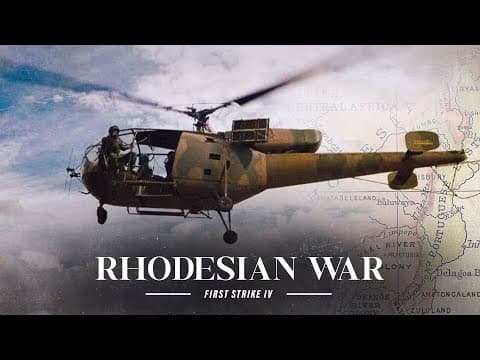
The Rhodesian Bush War, fought from 1965 to 1980, was a complex conflict rooted in colonial history, marked by guerrilla warfare, international involvement, and the struggle for Black majority rule in Rhodesia, which ultimately led to the establishment of Zimbabwe.
In the mid-1970s, the landlocked nation of Rhodesia, located northeast of South Africa, faced significant military and political challenges despite its economic success. Under international scrutiny and limited trade, Rhodesia was embroiled in a conflict known as the Rhodesian Bush War, a struggle often overshadowed by the broader Cold War context.
The roots of the Rhodesian Bush War can be traced back to the late 19th century when businessman Cecil J. Rhodes made mining claims in the region. In 1890, Rhodes negotiated with local leaders for territory rich in minerals, taking advantage of tribal conflicts to secure land for his mining company. This area eventually became Southern Rhodesia, a British colony characterized by a predominantly white electorate and a government policy of 'parallel development' akin to that of South Africa.
By 1965, the demographics had shifted significantly, with approximately 228,000 Europeans and 4,847,000 Africans. Despite the growing African population, political power remained firmly in the hands of white settlers. The British government's attempts to amalgamate Southern Rhodesia with Northern Rhodesia and Nyasaland into the Central African Federation sparked militant African nationalism, leading to the independence of Zambia and Malawi in 1964, while Southern Rhodesia remained a British colony.
On November 11, 1965, the Rhodesian government issued a Unilateral Declaration of Independence (UDI) from the United Kingdom, renaming the country simply 'Rhodesia.' This declaration was met with economic sanctions and trade embargoes from the British government and the United Nations, isolating Rhodesia internationally.
Despite the sanctions, Rhodesia's economy remained buoyant, supported by allies such as South Africa, Portugal, and Israel. Conversely, African nationalists received backing from Russia and China through sympathetic Black African states like Zambia and Tanzania. The conflict began with skirmishes between Rhodesian security forces and rebel groups, marking the start of the Bush War, a counterinsurgency conflict that would last until 1980.
The first phase of the Bush War was characterized by small-scale skirmishes and limited air action. During this time, elite fighting units such as the Selous Scouts and the Rhodesian SAS emerged, with many native Africans joining these forces, including former rebels who switched sides. The Rhodesian forces, despite being outnumbered, demonstrated remarkable tenacity and effective counterinsurgency tactics.
The conflict saw the formation of two major rebel factions: the Zimbabwe African National Liberation Army (ZANLA), backed by China, and the Zimbabwe People's Liberation Army (ZIPRA), supported by the Soviet Union. ZANLA employed guerrilla tactics, while ZIPRA utilized mechanized units and long-term military strategies.
The second phase of the war saw an escalation in violence and larger-scale engagements. The rebels, operating from bases in Zambia and Mozambique, began coordinated attacks against Rhodesian forces. The Rhodesians developed innovative tactics, such as Fireforce operations, which involved rapid deployment of heavily armed units via helicopter to counter insurgent attacks.
One notable operation was Operation Dingo in November 1976, which targeted a large enemy camp in Mozambique. The operation was a significant success, resulting in the destruction of enemy supplies and a high number of casualties among the insurgents.
Throughout the war, the Rhodesian military executed several high-profile operations, including Operation Gatling in October 1978, which targeted a ZIPRA training base in Zambia. This operation was a response to the downing of a civilian airliner by ZIPRA forces, resulting in significant casualties among the insurgents.
Another critical operation was Operation Uric in September 1979, aimed at disrupting ZANLA and FRELIMO forces preparing for a major offensive. Despite initial successes, the operation faced challenges, including heavy enemy fire and the loss of personnel and equipment.
As the war dragged on, the Rhodesian military faced mounting pressure from both the international community and the growing resolve of the nationalist movements. The Internal Settlement agreement in 1978 attempted to create a power-sharing government, but it was rejected by key nationalist leaders like Robert Mugabe and Joshua Nkomo, who continued to fight for complete independence.
In late 1979, the British intervened, leading to the Lancaster House Agreement, which established a ceasefire and set the stage for new elections. The elections in 1980 resulted in Mugabe's victory and the official recognition of Zimbabwe as an independent nation.
The Rhodesian Bush War was a complex and multifaceted conflict that highlighted the struggles for independence and identity in Southern Africa. The war's legacy continues to shape Zimbabwe's sociopolitical landscape today, as the country grapples with the consequences of its tumultuous past. The Rhodesian forces, despite their eventual defeat, are remembered for their resilience and tactical ingenuity in the face of overwhelming odds.



















