
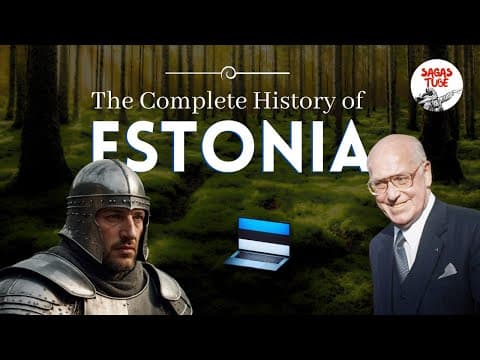
Estonia's history is a complex journey from early Finno-Ugric tribes and Viking interactions to centuries of foreign rule, struggles for independence, and modern digital governance. This blog post explores the key events and transformations that shaped Estonia into a contemporary digital leader.
Estonia, where digital dreams meet medieval streets, is a land where every song tells a tale of freedom. The skyline blends towers with technology, reflecting a unique history that has shaped its identity. This blog post delves into the significant events and transformations that have defined Estonia from its early days to its current status as a digital leader.
Thousands of years ago, as ice glaciers retracted, they revealed a landscape that would become Estonia. The first settlers, Finno-Ugric tribes, laid the foundational stones of Estonian history. The Estonians first entered the annals of history through the writings of the Roman historian Tacitus, who noted their trade connections with the Roman Empire.
Early Estonia was organized into regions overseen by local chieftains, who made decisions in consultation with assemblies of free men, showcasing early forms of democratic governance. From the 9th century, interactions with Vikings marked the beginning of centuries of trade and conflict, particularly with Sweden and Denmark.
From the 11th century onwards, Estonia faced repeated attacks, particularly from Russian forces in the southeast. German and Danish incursions aimed to conquer and Christianize the pagan Estonians. In 1202, the German bishop Albert established the Sword Brother Order in Riga, marking the start of significant conflict. The Estonians faced defeat at the Battle of Viliande, leading to the southern part of Estonia falling under the dominion of the Sword Brother Order.
For centuries, German rule persisted in Estonia, with many cities joining the Hansiatic League and prospering through trade with Russia. Initially, Estonian peasants maintained their freedom, but over time, they were subjected to serfdom. The Reformation began spreading in the Baltics around the 1520s, undermining the authority of the Teutonic Order.
In 1561, Swedish forces captured Tallinn, marking the onset of Swedish rule in Estonia. Despite Ivan the Terrible's ambitions, his efforts to conquer Estonia were thwarted, culminating in a decisive Swedish victory at the Battle of Narva. The ensuing decades saw Estonia as a focal point of numerous conflicts, particularly during the Thirty Years War.
Under Swedish governance, German remained the lingua franca, but several reforms aimed at diminishing the German nobility's influence were introduced. The establishment of a university in Tartu and efforts to promote literacy and the Estonian language were significant cultural advancements during this period.
The Great Northern War brought additional hardships, leading to a drastic population decline. By 1710, Tallinn's Swedish garrison had surrendered, ending Swedish sovereignty and ushering in a new era of Russian dominion. Under Tsarist Russia, Estonia was granted a measure of autonomy, but strict conditions imposed on peasants sparked numerous uprisings.
The Russian Revolution of 1917 catalyzed the end of Russian dominion over Estonia. Political factions unified in their call for autonomy, leading to the proclamation of Estonia's full independence on November 28, 1917. However, this was temporarily thwarted by German control until Estonia declared its independence on February 24, 1918.
Following independence, Estonia faced the challenges of reconstructing its war-torn landscape and overcoming economic adversity. The 1919 land reform radically altered land ownership patterns, diminishing the German aristocracy's hold and fueling a cultural resurgence.
The establishment of a parliamentary republic in 1920 marked the groundwork for democracy. However, political divisions hindered stable governance, leading to a coup in 1934 and the ushering in of a mild dictatorship. Estonia sought to maintain its independence and neutrality but was ultimately overshadowed by regional disputes and the indifference of Western countries.
In September 1939, the Soviet Union forced Estonia into a military alliance, leading to occupation and the establishment of a pro-Soviet government. Following the German invasion in 1941, Estonia fell under German occupation, which resulted in significant suffering and loss of life.
After the war, Estonia became a Soviet republic again, facing further deportations and Russification efforts. The 1980s saw a resurgence of nationalism, culminating in the Singing Revolution, a series of peaceful protests advocating for independence.
Estonia declared its independence on August 20, 1991, following the failed coup in the Soviet Union. The transition from a Soviet-style planned economy to a market-driven system was challenging but marked by significant reforms, including the introduction of the Estonian Kroon in 1992.
In the 21st century, Estonia has emerged as a global exemplar in digital governance and innovation. The adoption of the euro in 2011 and membership in NATO and the EU in 2004 underscored its integration with the West. Estonia's educational achievements and advancements in cybersecurity have garnered international acclaim.
Today, Estonia stands as a dynamic nation, having transformed from a land dominated by crusaders and strong neighbors into a beacon of digital prowess. Its history is a testament to the resilience and courage of its people, who fought for independence not through violence but through song and unity. Estonia's journey is a remarkable narrative of survival, adaptation, and innovation, shaping its role on the international stage.



















