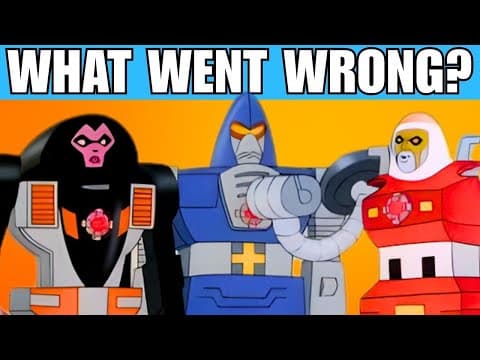
GoBots initially dominated the transforming robot toy market in 1984 with early store presence and a cartoon series, but creative shortcomings and a disastrous movie led to declining sales. Ultimately, Tonka's crippling debt and the 1987 stock market crash sealed GoBots' fate, preventing any revival despite Hasbro acquiring the brand's rights.
Listen up, because this is one of the biggest what-ifs in toy history. In 1984, GoBots made $52.8 million, beating Transformers to store shelves and even premiering the first cartoon on TV. They seemed destined to win the transforming robot toy war. But by 1986, GoBots' sales collapsed by 80%. The reasons behind this dramatic fall are far more complex and tragic than just being outshined by Transformers.
In this article, we will explore three key aspects of the GoBots story:
By the end, you'll understand why GoBots is a cautionary tale about prioritizing speed over quality and why the brand remains unable to make a comeback.
The story begins in 1983. Imagine being a kid walking into a toy store and seeing a robot that transforms into a car — not a clunky wind-up toy, but a real transforming robot. That was GoBots. They beat Transformers to market by months.
Tonka Corporation, known for their indestructible metal trucks, noticed the success of Japan's Machine Robo toy line by Bandai. Seeing the potential, Tonka licensed 28 Machine Robo figures, rebranded them as GoBots, and rushed them into American stores in late 1983.
The pricing was a key factor: at $2.99 each, GoBots were affordable impulse buys that kids could easily convince their parents to purchase. Meanwhile, Hasbro was preparing their own transforming toys, which would become Transformers, but these didn't hit stores until early 1984.
For several months, GoBots owned the transforming robot market. Tonka reported $52.8 million in revenue from GoBots in 1984 — a significant success.
Recognizing the importance of media tie-ins, Tonka commissioned Hanna-Barbera to produce Challenge of the GoBots, a 65-episode cartoon series. This was crucial because, in the 1980s, cartoons were essentially 22-minute commercials that drove toy sales.
The show debuted in October 1984 with a five-part mini-series called Battle for Gobotron, premiering before the Transformers cartoon. The storyline featured heroic Guardians led by Leader One battling evil Renegades led by Cy-Kill on their home planet Gobotron — a premise strikingly similar to Transformers' Autobots, Decepticons, and Cybertron.
Even voice actors Peter Cullen and Frank Welker, famous for voicing Optimus Prime and Megatron, lent their talents to GoBots, showing Tonka's serious intent to compete.
Despite the early lead, kids began choosing Transformers over GoBots, and the difference was stark. By 1986, GoBots' sales had plummeted by 80%, signaling a brand in free fall.
One major issue was the GoBots' lore. Unlike Transformers, which were sentient alien robots with souls from Cybertron, GoBots were cyborgs — organic brains preserved inside mechanical bodies. This concept felt awkward and lacked the epic mythological appeal that Transformers had.
The world-building and mythology were weak, making it hard for kids to emotionally invest in the universe.
The Challenge of the GoBots cartoon also suffered. Hanna-Barbera's animation style was starting to feel outdated by the mid-80s, and the writing was clunky with poor continuity. Characters appeared and disappeared randomly, and some had silly gimmicks — like a character named Wrongway who always went the wrong way.
In contrast, Transformers featured memorable characters with cool names and distinct personalities, such as Megatron, Starscream, and Soundwave.
The toys themselves were smaller and simpler, often transforming in just three or four steps. While this made them durable, it also made them less impressive. Kids preferred the challenge and sophistication of transforming a complex figure like Optimus Prime.
Moreover, many GoBots didn't look like convincing vehicles; their transformations were more like folding a robot into a vehicle shape rather than an elegant transformation. Transformers' toys looked like legitimate vehicles that transformed into robots, which was far more appealing.
GoBots did have some advantages, such as combiners like Puzzler and Monsterous that combined without extra parts, unlike Transformers' combiners that required accessories. However, these benefits were overshadowed by the overall lack of appeal.
By 1986, with sales slipping and the cartoon canceled, Tonka attempted to revive the brand with a movie: GoBots: Battle of the Rock Lords.
The movie featured notable voice actors like Telly Savalas and Margot Kidder, aiming to add legitimacy. However, the concept was flawed — the Rock Lords were characters that transformed into rocks, which lacked excitement or coolness.
Released in January 1986, the movie grossed only $1.34 million worldwide, a quarter of what the Transformers movie made later that year. Critics panned it, audiences stayed away, and the Rock Lords toys failed to sell.
Instead of saving the brand, the movie became a punchline and further damaged GoBots' credibility. By the end of 1986, Tonka ceased producing new GoBots toys, and the brand was effectively dead.
The story takes a darker turn with Tonka's financial troubles. Despite a hit with Pound Puppies, Tonka faced the volatile toy industry where success could quickly turn to unsold inventory.
In 1987, Tonka acquired Kenner Parker for $628 million, a company owning major brands like Star Wars toys, Nerf, Play-Doh, and Monopoly. However, Tonka borrowed heavily to finance this purchase, increasing their debt from $8 million to $360 million and pushing their debt-to-capital ratio to an unsustainable 85-86%.
Then came Black Monday in October 1987, when the stock market crashed, consumer confidence plummeted, and retailers cut orders. Tonka, burdened by massive debt, posted losses in 1987 and 1988 and struggled to pay interest.
By 1991, Tonka was insolvent and unable to pay its bills. Hasbro acquired Tonka's intellectual property, including GoBots trademarks and character names, but not the toy designs, which were licensed from Bandai. The cartoon character designs remained with Warner Brothers.
This fractured ownership means Hasbro owns GoBots but cannot produce toys resembling the originals, making any revival legally and practically impossible.
The GoBots story teaches several important lessons:
Speed isn't everything: Being first to market gave GoBots an early advantage, but rushing the product and cartoon compromised quality.
Creative depth matters: Strong lore, compelling characters, and world-building are crucial for building lasting fan engagement.
Corporate decisions can kill brands: Tonka's massive debt and the timing of the 1987 crash doomed GoBots regardless of creative efforts.
Today, GoBots are a nostalgic footnote, remembered as a cheaper, less sophisticated alternative to Transformers. For a brief moment in 1984, they were on top, but a combination of creative missteps and financial disaster led to their downfall.
The GoBots saga remains a fascinating case study in toy industry history and corporate strategy, illustrating how even early success cannot guarantee survival without quality and sound business management.