Shia LaBeouf's journey from a promising child actor to a troubled Hollywood figure is marked by early success, personal demons, public meltdowns, and controversial artistic stunts. Despite moments of critical acclaim, his career was overshadowed by substance abuse, legal issues, and erratic behavior, ultimately leading to his fall from A-list status.
In an industry overflowing with competition, Shia LaBeouf stands out as a unique figure whose career trajectory is a compelling mix of high-profile success and dramatic self-destruction. Over a decade, his journey has been a roller coaster of fleeting triumphs, public meltdowns, and attempts at reinvention that often left audiences baffled.
Shia Sadi LaBeouf was born in California in 1986, the only child of a jewelry designer and a professional clown. He described his parents as "weird and hippies," with his father being "tough as nails" despite his unconventional profession. His parents divorced when he was young, and his father struggled with chronic drug addiction, leaving his mother to support the family.
Seeking an escape from his challenging upbringing, LaBeouf gravitated towards the performing arts. He began as a performing comedian and cleverly landed an agent by pretending to be his own manager, showcasing early signs of his boldness and ambition.
LaBeouf's breakthrough came with his role as Lewis Stevens on the Disney Channel show Even Stevens, which ran until 2002 and earned him a Daytime Emmy Award. Hollywood quickly recognized his potential, and by 2005, he was starring opposite Keanu Reeves in Constantine.
His performance in the 2007 psychological thriller Disturbia garnered critical praise, but it was Michael Bay's blockbuster Transformers that catapulted him to international fame. The film grossed over $700 million worldwide and launched both LaBeouf and co-star Megan Fox into stardom.
Following this, LaBeouf starred in Indiana Jones and the Kingdom of the Crystal Skull (2008), positioning him as a potential successor to the iconic Indiana Jones character. Despite mixed reviews, the film was financially successful, solidifying his status as a leading man in Hollywood.
LaBeouf continued to secure high-profile roles, including Wall Street: Money Never Sleeps and two more Transformers sequels. Although the latter films received increasingly negative reviews, their box office success kept LaBeouf in the spotlight.
However, behind the scenes, LaBeouf was battling alcohol addiction. His struggles became public with a 2007 arrest for public intoxication and a serious car accident in 2008 that forced rewrites on Transformers 2 due to his injuries. These incidents marked the beginning of a pattern of arrests, rehab stints, and public apologies.
In 2013, LaBeouf faced accusations of plagiarism for his short film Howard.com. His subsequent public apology was itself plagiarized from a Yahoo Answers post, adding to the bizarre nature of his public persona.
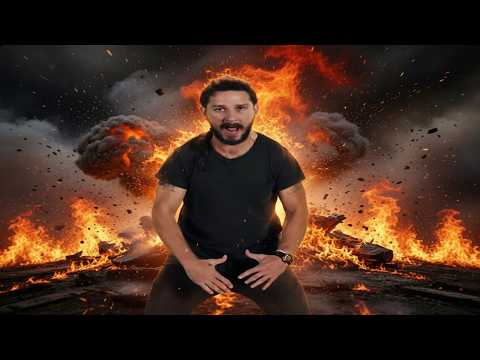
Starting in 2014, LaBeouf embarked on a series of unconventional performance art stunts. These included attending the Berlin Film Festival with a paper bag over his head, live-streaming himself watching his own movies for days, and sitting silently while crying with the infamous bag on his head. Perhaps most famously, he delivered a motivational rant repeatedly shouting the Nike slogan "Just Do It," which became an internet meme.
While these acts were intended as provocative explorations of fame and celebrity, many perceived them as desperate attempts to regain relevance.
Despite his erratic behavior, LaBeouf demonstrated his acting prowess in films like Nymphomaniac and Fury, earning critical praise. However, his personal life continued to unravel. His messy divorce from Mia Goth was followed by a tumultuous relationship with singer FKA Twigs, who later sued him for various forms of abuse. The lawsuit was settled out of court but severely damaged his reputation.
Hollywood, known for overlooking bad behavior in bankable stars, began distancing itself from LaBeouf. Netflix removed his performance in Pieces of a Woman from awards contention, and Olivia Wilde reportedly removed him from the cast of Don't Worry Darling due to difficulties working with him.
He did secure a role in Francis Ford Coppola's Megalopolis, a project that many view as a doomed passion project, symbolizing LaBeouf's precarious standing in the industry.
LaBeouf recently made headlines again for public intoxication and altercations in New Orleans, where he was involved in a fight with a group of gay men, reportedly using homophobic slurs. This incident resulted in another arrest, further tarnishing his public image.
Today, LaBeouf's career is a shadow of its former self. While he may appear in indie films or occasional TV roles, his days as an A-list star are behind him. His unpredictability and personal baggage make him a risky choice for major productions, and his body of work is insufficient to withstand the weight of his controversies.
Shia LaBeouf's story is a poignant example of the perils of fame without the necessary tools to manage its pressures. A man of undeniable talent, he has been haunted by personal demons that have repeatedly undermined his career. Despite numerous second chances, his struggles with addiction, legal issues, and erratic behavior have ultimately led to his downfall.
His journey serves as a cautionary tale about the costs of celebrity and the challenges of sustaining success in Hollywood. When LaBeouf is focused and engaged, he can deliver compelling performances, but these moments have become increasingly rare.
The rise and fall of Shia LaBeouf remind us that talent alone is not enough to navigate the complex and often unforgiving world of fame.