
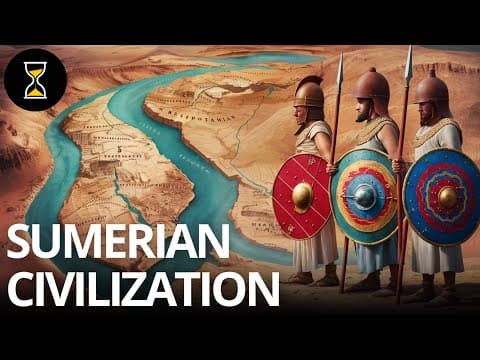
This blog post explores the entire history of the Sumerian civilization, detailing its rise as the first known civilization, its significant contributions to writing, mathematics, and urbanization, and the factors leading to its eventual decline and extinction.
Mesopotamia, often referred to as the cradle of civilization, is a region located between the Tigris and Euphrates rivers. It was here that the Sumerians established the first known civilization around 4000 BCE. This blog post delves into the entire history of the Sumerian civilization, exploring its remarkable achievements, cultural developments, and the eventual factors that led to its decline.
The dawn of civilization marked a significant turning point in human history. The Sumerians transitioned from nomadic hunter-gatherers to settled agricultural communities, laying the groundwork for complex social structures and cultural customs. The fertile plains of Mesopotamia, enriched by the annual floods of the Tigris and Euphrates, provided an ideal environment for agriculture.
The Sumerians utilized the rich soil to cultivate crops such as barley, wheat, and dates. This agricultural surplus allowed for labor specialization and the growth of urban centers, leading to intricate social and economic structures.
One of the most significant contributions of the Sumerians was the invention of writing. Around 3500 BCE, they developed cuneiform, the world's first known writing system, which consisted of wedge-shaped characters pressed into clay tablets. This innovation transformed recordkeeping and communication, enabling the documentation of laws, literature, and administrative records.
As Sumerian society became more urbanized, city-states emerged as cultural and economic hubs. Cities like Uruk, Ur, and Eridu showcased impressive architectural feats, including ziggurats and temples, which symbolized Sumerian authority and religious devotion. The complex social hierarchies within these city-states featured kings and priests wielding significant power.
The Sumerians made remarkable strides in mathematics, developing a base-60 numerical system that laid the foundation for modern mathematics. They also excelled in astronomy, creating lunar calendars and observing celestial events, which influenced agricultural practices and religious beliefs.
The Sumerians were pioneers in technology, inventing the wheel, plow, and sail, which revolutionized transportation, agriculture, and trade. These innovations facilitated the movement of goods and people, contributing to the growth of urban centers.
Sumerian religion was characterized by a pantheon of gods and goddesses, with rituals and ceremonies integral to daily life. The Epic of Gilgamesh, one of the oldest literary works, explores themes of friendship, mortality, and the quest for immortality, reflecting the values and beliefs of Sumerian society.
Sumerian society was hierarchical, with a ruling elite at the top, followed by free citizens, and enslaved individuals at the bottom. This social structure influenced governance, law, and daily life, fostering a sense of community and shared identity among the Sumerians.
Despite its advancements, the Sumerian civilization faced significant challenges, including environmental degradation. Intensive agricultural practices led to soil salinization and depletion, threatening food security and economic stability.
Political instability and internal conflicts among city-states weakened Sumerian society. Rivalries for resources and power often resulted in warfare, further destabilizing the region and eroding social cohesion.
The rise of neighboring powers, such as the Akkadians and Babylonians, led to invasions that ultimately contributed to the decline of Sumerian civilization. These external threats undermined Sumerian authority and disrupted trade and agriculture.
The Sumerian civilization, with its groundbreaking contributions to writing, mathematics, and urbanization, laid the foundation for future societies. However, environmental challenges, internal strife, and external invasions ultimately led to its decline. The legacy of the Sumerians continues to influence modern civilization, reminding us of the resilience and ingenuity of humanity in the face of adversity.



















