
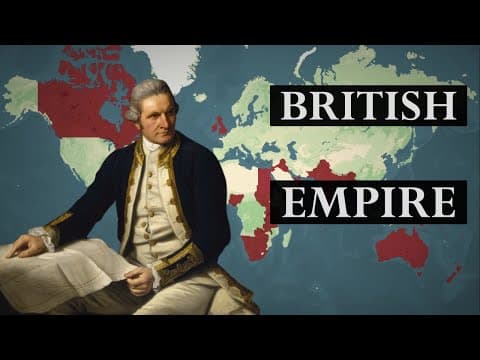
This blog post explores the history of the British Empire, detailing its origins, expansion, and eventual decline, highlighting key events, figures, and the lasting impact of British colonialism on the world.
If you were to look at Britain on a map today, you might think its borders only encompass the British Isles. However, the British government still holds power over 14 overseas territories, from Gibraltar at the entrance of the Mediterranean to the Falkland Islands in the South Atlantic. These territories are the last remnants of Britain's once-mighty empire, which, at its height a little over 100 years ago, covered one quarter of the globe's land mass and ruled almost a third of the world's population. This blog post delves into how such a small island nation became the largest and most powerful empire the world has ever seen.
The foundations of the British Empire were laid long before Britain formally existed as a state. The dominant power in the British Isles was the Kingdom of England, which had a well-developed economy and military force. Throughout much of its history, England ruled over the smaller independent kingdoms of Wales and parts of Ireland, while Scotland remained fiercely independent, successfully resisting frequent invasions.
In the early 17th century, Queen Elizabeth I of England issued several trading and exploration commissions to English adventurers, aiming to explore and colonize unclaimed territories. Notable figures like Sir Francis Drake and Sir Martin Frobisher claimed lands in the name of England, although these were not followed by settlements. The first English colony in North America, established at Roanoke Island in 1585, ended in mystery as the colonists disappeared without a trace.
Elizabeth I also granted royal charters to joint-stock companies for developing overseas trade. Companies like the Levant Company (1592) and the East India Company (1600) were granted monopolies on English trade to and from these areas. After Elizabeth's death in 1603, James VI of Scotland ascended to the throne, uniting England and Scotland under the crown while maintaining separate governance.
James sought to build on his predecessor's colonial efforts, establishing three types of colonies: Crown Colonies, Charter Colonies, and Proprietary Colonies. Over time, many proprietary colonies transitioned to Crown Colonies due to management difficulties.
An important development during this period was the Plantation of Ulster, which saw Protestant settlers from Scotland and England transported to northern Ireland. This model of organized colonization would later influence English colonial expansion in the New World.
Throughout the 1600s, England expanded its colonies in North America and the Caribbean, annexing territories from rival powers, such as New York from the Dutch in 1665. The establishment of trading networks in Africa and the East Indies was critical, with the Royal African Company becoming a leading participant in the transatlantic slave trade.
Scotland attempted its own colonial ventures, but most ended in failure, notably the Darien scheme in 1698, which resulted in a financial crisis for Scotland. This led many Scots to seek opportunities within England's colonial enterprise.
The Acts of Union in 1707 united England and Scotland into Great Britain, paving the way for further colonial expansion. Following victories in wars with European powers, Britain gained significant territorial concessions, including Newfoundland and Acadia from France and Florida from Spain.
The British East India Company played a crucial role in expanding British influence in India. After the Battle of Plassey in 1757, the company wrested control of Bengal from local rulers, marking the beginning of British dominance in the region. The Seven Years War (1756-1763) further solidified Britain's position as a colonial power, with significant territorial gains in North America and the Caribbean.
Despite its successes, Britain's colonial policies led to tensions with its American colonies, culminating in the American Revolution. The colonies declared independence in 1776, and after a protracted war, Britain recognized the United States as an independent nation in 1783. This loss marked a significant turning point for the British Empire, prompting a shift in focus towards Asia, the Pacific, and Africa.
Explorers like Captain James Cook mapped and claimed vast territories in the Pacific, including New Zealand and Australia, which became a penal settlement for British convicts. The Napoleonic Wars (1803-1815) challenged Britain's dominance, but victories, such as the Battle of Trafalgar in 1805, secured British naval supremacy for decades.
The end of the Napoleonic Wars saw Britain acquire additional territories, including Malta, Mauritius, and Trinidad, further expanding its empire.
The Industrial Revolution shifted Britain's economic focus, leading to the abolition of the slave trade in 1807 and the institution of slavery in 1834. The period from 1815 to 1914 is often referred to as Britain's Imperial Century, with significant expansion in Asia and Africa.
The British East India Company faced challenges in India, leading to its dissolution in 1858 and the establishment of direct British rule, which became known as the "jewel in the crown" of the empire.
The late 19th century saw the Scramble for Africa, where Britain expanded its colonial holdings across the continent. The opening of the Suez Canal in 1869 was strategically vital for British trade routes, leading to military occupation of Egypt in 1882.
The First World War (1914-1918) marked a turning point for the British Empire, as it relied heavily on its colonies for military support. Although victorious, the war strained Britain's resources and signaled the beginning of the end for the empire. By 1921, Ireland gained independence, and other colonies began to seek self-governance.
The Second World War further weakened Britain's position, leading to a wave of decolonization in the following decades. The process known as the "Wind of Change" saw many colonies gain independence, although most retained ties to Britain through the Commonwealth.
The final symbolic act of the British Empire's decline occurred in 1997 when Britain handed over Hong Kong to China. The legacy of the empire remains evident today, with the English language as the most widely spoken language globally and British culture continuing to influence many societies.
Modern Britain reflects its imperial past, with a diverse population representing various races, nationalities, and cultures that were once part of the empire. The story of the British Empire is a complex narrative of ambition, conflict, and transformation that has shaped the world we live in today.



















