
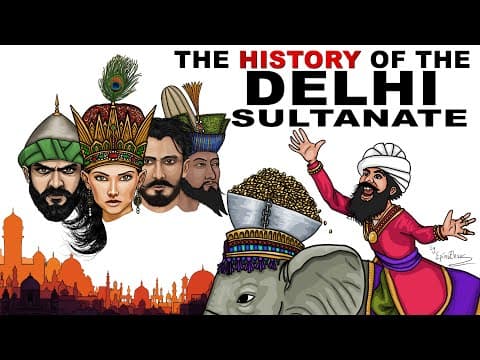
The Delhi Sultanate, a powerful regime that lasted over three centuries, emerged from humble beginnings to control much of the Indian subcontinent. This blog post explores its origins, key figures, military conquests, and eventual decline, highlighting the complex history of this influential empire.
The Delhi Sultanate, often referred to as the golden tiger and the jeweled peacock, was a powerful regime that emerged from the strategically located city of Delhi. For over three centuries, it controlled the crucial choke point between the Ganges and the Indus River Valley systems. At its zenith, the Sultanate nearly conquered the entire Indian subcontinent, encompassing most of modern-day India, Pakistan, and Bangladesh. This post delves into the origins, key figures, military conquests, and eventual decline of the Delhi Sultanate.
The origins of this fabulously wealthy and powerful Sultanate were far from noble. The founders of the dynasty that established the Sultanate were not born into royalty, wealth, or power. Instead, they hailed from a social class where their birthright was virtually non-existent. Many were bought and sold multiple times, often losing their freedom at the hands of their own families.
In the latter half of the 12th century, a significant event unfolded in a small town in East Persia. A young Turkistani boy was auctioned off and purchased by an elderly local magistrate. This magistrate raised the boy, teaching him valuable skills such as reading, writing, horsemanship, and archery. After the magistrate's death, the boy was sold to a merchant, who later resold him to Muhammad of Ghor, a member of a long line of aristocratic warriors from present-day Afghanistan.
Muhammad of Ghor and his brother, Ghori, ruled together as joint Sultans for 30 years. They were known for their unusual camaraderie, which was rare among powerful brothers of that era. One of their notable servants, Iltutmish, rose through the ranks due to his impressive work performance and generosity towards fellow servants. His rise to power was marked by a series of promotions, eventually becoming a general.
After Muhammad of Ghor's campaigns in Central Asia, Iltutmish faced the formidable Rajputs, a warrior class trained in the art of war. Initially, the Ghurids suffered a humiliating defeat. However, they learned from their mistakes and returned with a larger cavalry, employing innovative tactics that led to a decisive victory over the Rajputs. This victory opened the path for the Ghurids to conquer most of northern India.
Despite their initial successes, the Sultanate faced internal strife following Muhammad of Ghor's mysterious death. The empire fell into civil war, with various factions vying for supremacy. Amidst this chaos, Iltutmish emerged as a unifying figure, consolidating power in Northern India and establishing Delhi as the capital.
Iltutmish's reign saw the transformation of Delhi into a grand imperial capital. However, he faced challenges in succession planning, leading to a series of power struggles after his death. His daughter, Razia, was named as his successor, a highly unorthodox decision for the time. Razia's reign was marked by her attempts to assert authority, but she ultimately faced rebellion and was deposed.
The Tughlak dynasty followed, with Muhammad bin Tughlak at the helm. Known for his eccentricities, he implemented several disastrous policies, including the forced relocation of the capital and the raising of a massive army that he later disbanded. His reign was characterized by widespread famine and revolt, leading to the eventual decline of the Sultanate.
The subsequent rulers struggled to maintain control, and the empire faced invasions from the Mongols. The chaos culminated in the invasion by the warlord Tamerlane, who sacked Delhi, leading to the collapse of the Tughlak dynasty.
The Lodi dynasty briefly stabilized the region, but it was soon overthrown by the Mughal Empire, which claimed descent from Genghis Khan and Tamerlane. The Mughals, equipped with advanced weaponry, defeated the Lodi forces at the Battle of Panipat, marking the end of the Delhi Sultanate.
Despite its decline, the Delhi Sultanate left a lasting impact on the Indian subcontinent. The city of Delhi continued to serve as a political and cultural hub, eventually becoming the capital of the Mughal Empire for over 230 years. Today, Delhi remains a significant global center for politics, economics, and culture, with a population exceeding 30 million.
The history of the Delhi Sultanate is a testament to the complexities of power, governance, and cultural exchange in medieval India. Its rise from humble beginnings to a dominant empire illustrates the dynamic nature of history and the enduring legacy of its rulers.



















