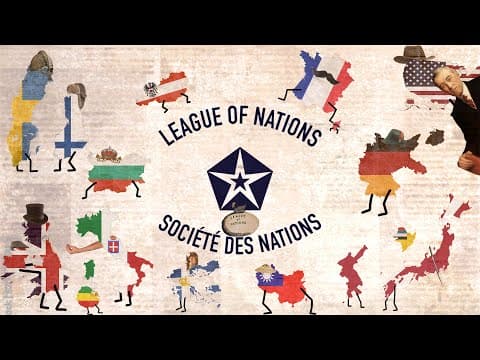
In the aftermath of World War I, the world was desperate for peace. The atrocities of the war led many leaders and politicians to envision an international organization dedicated to maintaining global peace and security. One of the most prominent advocates for this initiative was American President Woodrow Wilson, whose efforts in founding the League of Nations earned him the Nobel Prize in 1920.
Establishment of the League of Nations
The League of Nations was established as part of the Treaty of Versailles in 1919, with its first meeting held on January 16, 1920, in Geneva, Switzerland. The League was founded on the principle of collective security, which meant that member states would act together to punish any country that attacked another. The League's methods of enforcement included economic sanctions and, in some cases, military action.
Structure of the League
The League of Nations was structured into several key bodies:
- The Council: Composed of representatives from both permanent and non-permanent members, elected for three-year terms.
- The Assembly: The main body of the League, consisting of representatives from all member states, which met annually to make recommendations on various issues, including economic and social progress, disarmament, and peacekeeping. However, the Assembly had limited power compared to the Council.
- The Secretariat: Responsible for the day-to-day operations of the League, headed by the Secretary-General. The Secretariat prepared reports, conducted investigations, and maintained communication with member states and international organizations.
Initially, the League had 41 member states. However, the United States, which was expected to play a leading role, never joined due to disagreements between President Wilson and the U.S. Senate. The Council included four permanent members: the British Empire, France, Italy, and Japan, with Germany joining in 1926 and the Soviet Union in 1934.
Achievements of the League
Despite its challenges, the League of Nations achieved some successes in the 1920s:
- Dispute Resolution: In 1920, the League mediated a dispute between Finland and Sweden over the ownership of the Åland Islands, ultimately deciding that the islands would remain part of Finland while granting special privileges to the Swedish-speaking population.
- Economic Assistance: In 1922, the League helped Austria recover from a financial crisis by providing loans and facilitating economic reforms, including the establishment of a new currency and central bank.
- Conflict Mediation: The League successfully negotiated a resolution to the Greek-Italian conflict over the island of Corfu in 1923 and prevented war between Greece and Bulgaria in 1925.
These early successes demonstrated the League's potential to address international conflicts through diplomacy.
Decline of the League
However, the League's weaknesses became increasingly apparent in the 1930s. Key events highlighted its inability to maintain peace:
- Japanese Aggression: In 1931, Japan invaded Manchuria, a vital economic region. The League's response was slow and ineffective, largely due to the lack of support from major powers, many of whom had significant trading ties with Japan. Frustrated by the League's criticism, Japan withdrew in 1933.
- Germany's Withdrawal: In 1934, Adolf Hitler withdrew Germany from the League, further destabilizing international relations as Germany pursued aggressive expansionist policies.
- Italian Invasion of Ethiopia: In 1935, Italy invaded Abyssinia (modern-day Ethiopia). The League's imposition of economic sanctions was ineffective, and Mussolini left the League in 1937, signaling a loss of credibility for the organization.
Reasons for Failure
Historians argue that the League was doomed from the start due to several factors:
- Absence of Major Powers: The refusal of the United States to join significantly weakened the League's authority. The absence of other powerful nations like Germany and the USSR further diminished its effectiveness.
- Internal Disagreements: The major powers within the League, particularly Britain and France, often disagreed on strategies and priorities, undermining collective action.
- Unanimous Decision Requirement: The requirement for unanimous decisions within the Council made it difficult to implement timely and decisive actions.
- Lack of Military Power: The League had no standing army and member states were reluctant to commit their military forces to enforce League decisions.
- Impact of the Great Depression: The economic crisis of 1929 distracted major powers from international issues, allowing aggressive nations like Japan and Italy to act without fear of repercussions.
Conclusion
The failures of the League of Nations in the 1930s contributed to its decline and eventual collapse, paving the way for the outbreak of World War II. The League's inability to maintain peace and stability serves as a historical lesson on the challenges of international cooperation and the importance of collective security in preventing conflict.