
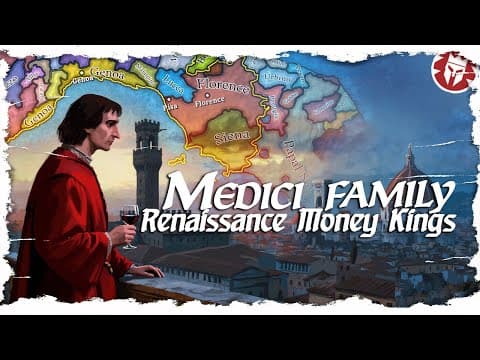
The Medici family rose from modest origins in 13th-century Tuscany to dominate Florence through banking, politics, and patronage of the arts during the Renaissance. Despite political rivalries, exile, and economic challenges, they shaped Florence's cultural and political landscape, producing popes and rulers, and leaving a legacy of artistic and intellectual achievements that endure today.
Spanning from the 14th to the 16th century CE, the Renaissance era in Italy was a period marked by a blossoming of fine art, classical education, and mercantile trade, alongside intense political intrigue. Among the many cities that flourished during this time, Florence stood out as a major hub of Renaissance developments. This status was largely due to its cadre of aristocratic families, with one family rising above the rest: the magnificent Medici.
The Medici were a clan of highbrow patrons and shrewd politicians who dominated Florentine politics. Their members ranged from industrious polymaths to villainous tyrants. To understand their legacy and how they transformed Florence, it is essential to explore the entire history of the family.
The Medici family's origins trace back to the 13th century CE in Tuscany. Although natives of the region, they were likely not originally residents of Florence itself. The first document mentioning them dates to 1230, locating them in Magello, north of Florence.
During this tumultuous period, the Italian peninsula was divided into multiple regional polities, including the Papal States around Rome, Iberian monarchies in the south, and oligarchic republics in the north. Florence, or Firenze in Italian, was one such republic, governed by various guilds of craftsmen and nobles. A council of nine, known as the Signoria, formed the governing body, led by a justice official called the Gonfaloniere and an unofficial head of state known as the Grand Maestro.
This guild-organized governance created distinct networks of political and economic elites that ambitious politicians had to navigate carefully. Florence's rise as a powerful polity was fueled by profitable industries like clothmaking and the growth of its banking system. These businesses funded mercenary armies and allowed nobles to expand their estates and industrial ventures.
The Medici likely moved to Florence proper early in their history, amassing wealth through guild work. Their rise to power began in 1371 when Sylvestro de' Medici assumed the political office of Gonfaloniere. Sylvestro passed laws favoring emerging minor guilds excluded from power by older nobles allied with the Pope.
The most important early Medici was Giovanni de' Medici, founder of the Medici Bank in 1390. Despite receiving only a minor inheritance, Giovanni increased his wealth through wool workshops and guild connections. He maintained a modest lifestyle to appear as a man of the people. The bank vastly expanded the family's wealth, enabling strategic marriages with other noble families and elevating their political status.
The Medici soon clashed with the established Albizzi family, Florence's great family. This rivalry intensified when Giovanni's son, Cosimo de' Medici, expanded the bank across Europe and secured it as the favored partner of Pope John XXIII. However, in 1433, anti-Medici politicians backed by the Albizzi gained a majority in the Signoria and exiled Cosimo to Venice. He returned a year later after new elections favored him.
Cosimo was a patron of the arts and education, supporting Byzantine scholars and commissioning works like Donatello's statue of David. Upon his death in 1464, he was named Pater Patriae, or Father of the Fatherland.
Cosimo's son Piero had a minor political impact due to illness, but his son Lorenzo, born in 1449, became a central figure in Florentine politics. Educated by humanists and influenced by his poet mother Lucrezia, Lorenzo balanced diplomacy and cultural patronage.
Lorenzo navigated Florentine politics skillfully, alternating between public office and behind-the-scenes influence. His main opponents were the Pazzi family and Pope Sixtus IV, who opposed the Medici's business ventures. These enemies conspired in the infamous Pazzi Conspiracy of 1478, attempting to assassinate Lorenzo and his brother Giuliano. Giuliano was killed, but Lorenzo survived.
Following the attack, Pope Sixtus IV excommunicated Lorenzo and organized an invasion of Florence with Neapolitan troops. Lorenzo rallied the people and mercenaries, achieving a stalemate. He later negotiated peace in Naples, using his wealth and connections to survive politically.
Lorenzo's economic management was less successful; many Medici banks closed due to mismanagement, and he misappropriated public funds. He died in 1492, leaving a mixed legacy.
After Lorenzo's death, the Medici faced a new challenge from the Dominican friar Girolamo Savonarola, who preached social justice and denounced clerical corruption and Renaissance art's moral decay. Invited by Lorenzo in 1490 to strengthen religious institutions, Savonarola's populist message soon clashed with the elites.
In 1494, when the Medici surrendered Florence to the invading French King Charles VIII, Savonarola capitalized on public anger to expel the Medici. He ruled Florence as a religious puritan, conducting the Bonfire of the Vanities in 1497, burning art deemed immoral.
Savonarola defied Pope Alexander VI and was excommunicated. Losing control, he was burned at the stake in 1498. The Medici remained in exile until 1512.
The Medici returned to Florence in 1512, resuming political power. Pope Clement VII, a Medici, granted the title Duke of Florence to family members, ending the republic and establishing hereditary Medici rule.
Alessandro de' Medici and Cosimo I de' Medici held the ducal title. Cosimo I, after Alessandro's assassination in 1537, defeated anti-Medici exiles and ruled with mercenaries and papal support. In 1569, he was elevated to Grand Duke of Tuscany.
The Medici influence extended beyond Florence. Catherine de' Medici became Queen Consort and Queen Mother of France, managing state affairs and orchestrating events like the St. Bartholomew's Day Massacre in 1572. Maria de' Medici also ruled as Queen Consort and Regent of France, supporting Cardinal Richelieu's rise before her exile.
The Medici placed family members in the Church to gain religious political power, emulating the Spanish Borgia family. Popes Leo X (1513–1521) and Clement VII (1523–1534) were Medici.
Pope Leo X was a major arts patron, nearly bankrupting the Papacy to fund artists. He attempted to halt the Protestant Reformation and was known for his eccentric personality.
Pope Clement VII faced the Sack of Rome in 1527 by Holy Roman Emperor Charles V's forces, fled Rome, but later returned. He negotiated key alliances, including Catherine de' Medici's marriage into the French royal family.
The Medici were central patrons of Renaissance art and culture, sponsoring religious and secular works that embodied Renaissance and humanist values. Florence is adorned with palaces and churches like the Medici Chapel, reflecting their generosity.
They supported the Platonic Academy in Florence, where luminaries like Leonardo da Vinci thrived. Da Vinci produced works such as the Adoration of the Magi under Medici patronage and served as an ambassador to Milan.
Pope Clement VII sponsored Raphael, commissioning the Transfiguration of Christ.
The Medici also fostered scholarship, supporting figures like Catholic priest Marsilio Ficino, a humanist who translated the Corpus Hermeticum, and Greek immigrant Demetrius Chalcondyles, who translated Greek works into Latin.
Niccolò Machiavelli, a foundational political theorist, was involved in Florentine politics during the Medici exile. Though imprisoned and tortured by the Medici upon their return, he later allied with Lorenzo de' Medici and dedicated his work "The Prince" to him.
The late 17th century marked the decline of the Medici and the Italian city-states. Despite artistic and scientific sponsorship by Grand Duke Ferdinando II, Tuscany's economic base weakened.
By 1705, Tuscany was nearly bankrupt. Cosimo III attempted economic reforms and considered restoring the republic but died in 1723. His successor, Gian Gastone, was weak and died in 1737.
The duchy passed to the Habsburgs, then briefly to the Bourbons, and after Napoleonic upheavals, was restored to Habsburg control until Tuscany merged into the Kingdom of Italy in 1861.
Parts of the Medici lineage survive in European nobility, and their artistic legacy remains a testament to their influence.
The Medici family transformed Florence through a complex interplay of politics, trade, art, and religion. Their patronage helped define the Renaissance, fostering cultural and intellectual achievements that continue to inspire. Despite political rivalries, exile, and decline, the Medici's impact on history and Florence's identity is undeniable, making them one of the most powerful and enduring dynasties of the Renaissance era.



















