
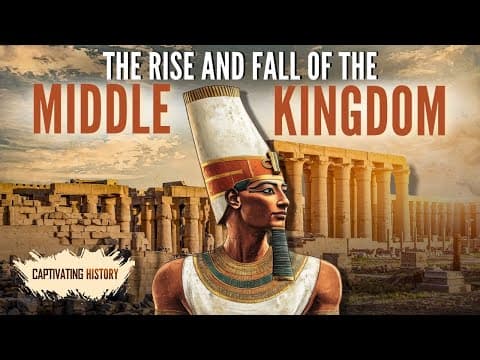
The Middle Kingdom of ancient Egypt, marked by a golden age of art and literature, rose from a period of chaos and decline, led by King Mentuhotep II. It experienced prosperity under the Twelfth Dynasty but eventually fell due to weak leadership, external invasions, and cultural shifts, leading to the Second Intermediate Period.
The Middle Kingdom is often cited as the classical period of ancient Egypt, recognized as a golden age for ancient Egyptian art and literature. This era also witnessed the construction of massive temples, such as those at Karnak, and other impressive architectural feats. However, the journey of the Middle Kingdom from its rise to its eventual fall is a complex narrative filled with key events that shaped its history.
The rise of the Middle Kingdom followed a significant period of decline in Egypt, characterized by climate change, foreign invasions, and civil war. These factors brought famine and destruction, leading to a decentralized rule where provinces asserted independent governance. This chaotic time, known as the First Intermediate Period, lasted around 100 years and saw Upper and Lower Egypt divided under two rival dynasties: the Theban kings in Upper Egypt and the Heracleopolitans in Lower Egypt.
The Theban rulers ultimately emerged victorious when King Mentuhotep II ascended to the throne of Upper Egypt around 2000 BCE. His reign marked the beginning of the Middle Kingdom and the reunification of Upper and Lower Egypt. Although details of the final conflict between the Thebans and Heracleopolians are scarce, it is recorded that Mentuhotep launched a decisive campaign against Heracleopolis in the fortieth year of his reign, leading to the unification of the country.
Mentuhotep II assumed the name Horus, Divine of the White Crown, symbolizing his rule over a unified Egypt. He consolidated power by allowing local governors to retain their positions in exchange for loyalty and extended his influence by annexing northern Nubia. The capital was moved to Thebes, where he appointed loyal supporters to key positions while also integrating some defeated Heracleopolitans into his administration.
The reunification initiated a period of increased trade and monumental building projects. Mentuhotep II's successor, Mentuhotep III, inherited a prosperous kingdom. The Middle Kingdom is often associated with the Eleventh Dynasty, which ended with a palace coup led by the vizier of Mentuhotep IV, Amenemhet, who founded the Twelfth Dynasty.
Amenemhet I moved the capital to the Memphite region and attempted to revive the architectural and artistic styles of the Old Kingdom. His reign was marked by stability, although he was allegedly murdered, leading to his son Senusret I taking the throne. The Middle Kingdom continued to expand its influence, particularly into Lower Nubia, and the written word was standardized into classical Middle Egyptian.
The Twelfth Dynasty is often regarded as the peak of the Middle Kingdom. One of its most notable rulers, Amenemhet III, presided over a time of economic prosperity, extensive building projects, and advancements in irrigation systems. His achievements included the regulation of water inflow to Lake Moeris and the construction of a labyrinth described by the Greek historian Herodotus.
Following Amenemhet III, his son Amenemhet IV ruled for a brief period before the first female pharaoh, Sobekneferu, ascended the throne. Although her reign was peaceful, it lasted less than four years and ended the Twelfth Dynasty, leading to a century of chaos with around seventy kings ruling in quick succession.
Despite the apparent prosperity, the Middle Kingdom began to decline due to weak leadership and internal rivalries. The Thirteenth Dynasty emerged, but it struggled with succession issues and was marked by political instability. During this time, waves of immigrants from Palestine began to settle in Egypt, bringing new technologies and cultural practices that further complicated the social landscape.
The loss of control over Lower Nubia and the rise of the powerful Nubian Kingdom of Kerma contributed to the decline. The Palestinian immigrants established trade dominance in the Nile Delta, leading to the emergence of the Hyksos, a group that would eventually challenge Egyptian authority.
The Thirteenth and Fourteenth Dynasties faced increasing pressure from the Hyksos, who likely infiltrated Egypt through trade and diplomacy rather than outright military conquest. The gradual decline of the Thirteenth Dynasty, exacerbated by famine and internal conflict, allowed the Hyksos to establish control over northern Egypt, leading to the fragmentation of the kingdom.
The period following the Middle Kingdom is known as the Second Intermediate Period, characterized by conflict between the Hyksos kings of the Fifteenth Dynasty and the Seventeenth Dynasty ruling from Thebes. The Sixteenth Dynasty was short-lived and plagued by famine, further complicating the political landscape.
The fall of the Middle Kingdom was a gradual process influenced by various factors, including weak leadership, external invasions, and cultural shifts. The power vacuum created by the decline of centralized authority allowed the Hyksos to rise, leading to the eventual division of Egypt into smaller dynasties. This tumultuous period set the stage for the rise of the New Kingdom in the 16th century BCE, marking a significant transition in ancient Egyptian history.



















