
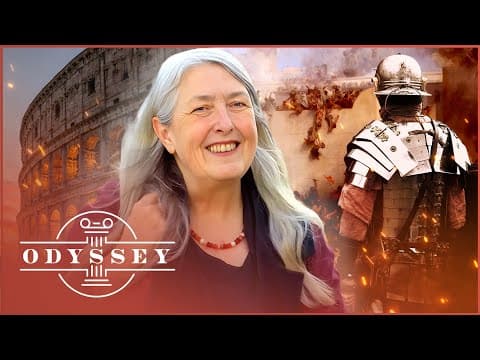
This blog post explores the complete history of the Roman Empire, from its mythical origins with Romulus and Remus to its vast expansion across Europe, North Africa, and the Middle East, and ultimately its decline and transformation into the Byzantine Empire. It highlights key events, cultural exchanges, and the complexities of Roman citizenship, governance, and the impact of Christianity.
The story of the Roman Empire begins with a fairy tale: once upon a time, a princess gave birth to twin sons, Romulus and Remus. Rescued by a mother wolf and raised by a shepherd, these twins would go on to found Rome, a small town that would transform into a powerful empire stretching from the Sahara to Britain, and from Spain to Israel.
The early Romans were not the marble-columned civilization we often envision. Instead, they were a people committed to conquest and military glory, as evidenced by the tombstone of Scipio Barbatus, the first man buried in Rome. His epitaph reveals the Roman values of strength, bravery, and wisdom, showcasing their priorities in life and death.
The myth of Romulus and Remus encapsulates the Roman psyche, reflecting their cultural priorities and anxieties. The story of fratricide, where Romulus kills Remus over a dispute about the city’s founding, symbolizes the bloody civil wars that would later plague Roman politics.
Initially ruled by kings, Rome transitioned to a form of democracy, electing officials to govern and fight wars. The construction of massive city walls in the 4th century BC marked the beginning of Rome's expansion beyond its original territory. Unlike their neighbors, the Romans established permanent relationships with conquered peoples, incorporating them into their military and society.
By the 3rd century BC, Rome had formed alliances with various Italian towns, allowing them to call upon a vast army of over 700,000 soldiers. This military strength was crucial as Rome faced its first major rival, Carthage, leading to the Punic Wars. The Romans, initially lacking naval power, adapted by copying Carthaginian ships, ultimately securing victory and expanding their territory into Sicily.
The conquest of Carthage and Greece brought not only territory but also cultural wealth. The Romans adopted Greek art, literature, and philosophy, leading to a flourishing of culture in Rome. This cultural exchange was not one-sided; as Rome expanded, it also spread its own culture, creating a unique blend of Roman and local traditions across the empire.
One of the most revolutionary aspects of the Roman Empire was its approach to citizenship. The Romans extended citizenship to conquered peoples, allowing them to participate in the political and social life of the empire. This inclusivity helped maintain stability and loyalty among diverse populations.
As the empire expanded, so did the influence of Christianity. Initially seen as a sect within Judaism, Christianity grew rapidly, spreading through the empire via trade routes and the efforts of missionaries like St. Paul. The religion's emphasis on a single God and moral teachings posed a challenge to traditional Roman polytheism, leading to periods of persecution.
Despite its vastness and cultural richness, the Roman Empire faced numerous challenges that led to its decline. Internal strife, economic troubles, and external pressures from invading tribes weakened the empire. The construction of Hadrian's Wall in Britain symbolized a shift in Roman strategy, marking the empire's boundaries and signaling a defensive posture.
By the 3rd century AD, the empire was divided into multiple regions, each governed by its own emperor. This fragmentation, coupled with the rise of Christianity as a dominant force, transformed the political landscape of the empire.
The fall of the Western Roman Empire in the 5th century did not signify the end of Roman influence. The Eastern Roman Empire, known as the Byzantine Empire, continued to thrive for centuries, preserving Roman law, culture, and governance.
The legacy of Rome is evident in modern governance, law, and culture. The idea of citizenship, the integration of diverse cultures, and the complexities of imperial rule continue to resonate today.
From its mythical beginnings to its vast empire and eventual decline, the history of Rome is a testament to the complexities of power, culture, and identity. The Roman Empire's ability to adapt and incorporate diverse peoples and ideas laid the groundwork for many modern societies, making its story one of enduring significance.



















