
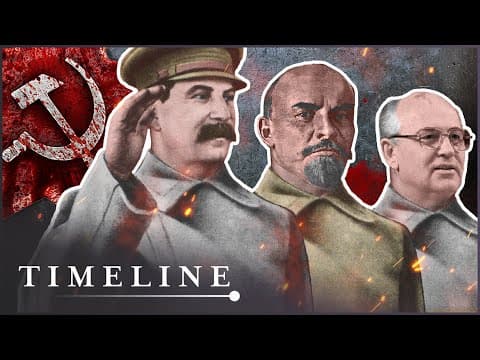
This blog post explores the complete history of the Soviet Union from its formation in 1922 to its dissolution in 1991, detailing key events, leaders, and policies that shaped its rise as a global superpower and its eventual collapse.
In 1922, the Soviet Union was formed, emerging from the remnants of the Russian Empire after a long and bloody Civil War. This new nation would have a profound impact on the globe, marked by significant achievements and catastrophic failures. This post chronicles the complete history of the Soviet Union, detailing its formation, key leaders, major events, and the eventual dissolution of this once-mighty superpower.
The Russian Revolution of 1917 led to the fall of the Romanov dynasty and the rise of Vladimir Lenin and the Bolsheviks. Following the revolution, Russia was embroiled in a civil war between the Red Army (Bolsheviks) and the White Army (anti-Bolsheviks), alongside various national groups and foreign interventions. The Bolsheviks ultimately emerged victorious, establishing a new socialist state.
In December 1922, the Union of Soviet Socialist Republics (USSR) was officially created. Lenin envisioned a decentralized system with considerable power for each republic, while Joseph Stalin, who would later succeed him, sought a centralized authority dominated by Russia. Lenin's death in 1924 marked the beginning of a power struggle, with Stalin eventually consolidating power and eliminating rivals.
Stalin's leadership was characterized by ruthless political maneuvering and the establishment of a cult of personality. He implemented the New Economic Policy (NEP) initially but later shifted to radical collectivization and industrialization through a series of Five-Year Plans. This period saw significant industrial growth but also widespread famine, particularly in Ukraine, leading to millions of deaths.
The late 1930s were marked by the Great Terror, where Stalin purged the Communist Party and military leadership, resulting in the execution of thousands. The show trials served as public spectacles to demonstrate Stalin's power and eliminate perceived threats.
On June 22, 1941, Adolf Hitler launched Operation Barbarossa, invading the Soviet Union. Initially, the Red Army suffered catastrophic losses, but as the war progressed, the Soviet Union began to regroup and mount a formidable defense, culminating in significant victories at battles such as Stalingrad.
During the war, the Soviet Union formed alliances with Western powers, leading to a united front against Nazi Germany. The Yalta Conference in 1945 set the stage for post-war Europe, with Stalin emerging as a key player in shaping the new world order.
After World War II, the Soviet Union expanded its influence over Eastern Europe, establishing satellite states and solidifying its position as a superpower. The onset of the Cold War was marked by ideological conflicts with the United States, leading to a series of proxy wars and arms races.
The launch of Sputnik in 1957 and the first human in space, Yuri Gagarin, in 1961, showcased Soviet technological prowess and intensified the competition with the United States. The space race became a symbol of Cold War rivalry.
By the 1970s, the Soviet economy began to stagnate, plagued by inefficiencies and corruption. Leonid Brezhnev's leadership saw a focus on military spending at the expense of consumer goods, leading to widespread dissatisfaction.
The Soviet invasion of Afghanistan in 1979 marked a significant turning point, drawing the USSR into a costly and unpopular conflict that drained resources and morale.
Mikhail Gorbachev came to power in 1985, introducing policies of glasnost (openness) and perestroika (restructuring) in an attempt to revitalize the economy and political system. However, these reforms inadvertently accelerated the disintegration of the Soviet Union.
By the late 1980s, nationalist movements gained momentum in various republics, leading to calls for independence. The failed coup in August 1991 against Gorbachev further weakened the central government.
On December 25, 1991, Gorbachev resigned, and the Soviet Union was officially dissolved the following day, marking the end of a significant chapter in world history. The republics that had once formed the USSR became independent nations, and Russia emerged as a separate entity.
The history of the Soviet Union is a complex narrative of revolutionary ideals, authoritarian rule, and eventual collapse. It serves as a reminder of the challenges faced by nations attempting to balance power, ideology, and the aspirations of their people. The legacy of the Soviet Union continues to influence global politics and society today.



















