
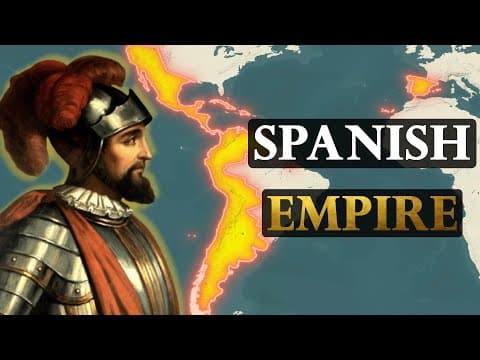
The Spanish Empire, once the world's first superpower, rose to prominence through exploration and conquest, particularly in the Americas, but faced decline due to poor governance, competition, and independence movements, culminating in the loss of its colonies by the late 19th century.
The territory of modern-day Spain covers approximately 195,365 square miles, primarily located on the Iberian Peninsula, bordered by Portugal to the west and France to the north. Spain also controls the Balearic Islands in the Mediterranean and the Canary Islands in the Atlantic. However, at the beginning of the 19th century, Spain's territorial claims exceeded a staggering 5 million square miles, encompassing vast regions of the Americas and even extending to the Philippines in Asia. This remarkable expansion marked Spain's ascent as the world's first superpower.
In the latter half of the 15th century, Spain as a unified entity did not exist. The Iberian Peninsula was divided into several Christian kingdoms, primarily Castile and Aragon. Over the previous seven centuries, these kingdoms gradually reclaimed territory lost to the Moors, Islamic invaders from North Africa. In 1469, Queen Isabella I of Castile and King Ferdinand II of Aragon married, effectively uniting their kingdoms and consolidating Christian power in the region.
In 1491, they completed the Reconquista by ousting the last Muslim faction, the Emirate of Granada. With their internal borders secured, the Catholic Monarchs turned their attention to overseas expansion, inspired by the burgeoning international trade routes.
Spain's neighbor, Portugal, had already begun exploring the Atlantic and African coastlines in search of a faster route to the spice-producing East Indies. Against this backdrop, Christopher Columbus, a Genoese sailor, proposed an alternative route to Asia by sailing westward. After failing to gain support from Portugal, Columbus turned to Isabella and Ferdinand, who were eager to establish Spain's own overseas trade routes.
On August 3, 1492, Columbus set sail with three ships: the Niña, the Pinta, and the Santa María. After a two-month voyage, he landed on an island he named San Salvador on October 12, 1492, mistakenly believing he had reached the East Indies. His subsequent explorations charted much of the Caribbean, leading to further voyages and the discovery of the mainland of South America.
The discovery of new lands sparked a dispute between Spain and Portugal over control and influence. The Treaty of Tordesillas, signed on June 7, 1494, divided the world outside Europe into two spheres of influence, granting Spain the majority of the Americas. Following the treaty, Spain established permanent settlements, with Santo Domingo being the first in 1496.
The Spanish Empire's expansion was marked by the conquest of advanced Native American civilizations. In 1519, Hernán Cortés led an expedition to the Aztec Empire, which ruled much of modern-day Mexico. Initially welcomed by the Aztecs, relations soured, leading to the fall of Tenochtitlán and the establishment of Mexico City as the capital of New Spain.
Similarly, Francisco Pizarro conquered the Inca Empire in Peru, establishing the Viceroyalty of Peru in 1542. The Spanish exploited native populations for labor, particularly in gold and silver mining, which fueled Spain's wealth and global influence.
As the Spanish Empire expanded, a complex society emerged. Most settlers were single men seeking prosperity, leading to intermarriage with native women and the rise of a mestizo population. Spanish became the dominant language, and Catholicism permeated colonial life. However, the influx of treasure led to inflation and economic challenges.
By the 17th century, the Spanish Empire began to stagnate. The decline in gold and silver from the Americas, coupled with excessive spending on European wars, led to financial instability. The rise of competing powers, such as France, the Netherlands, and England, further threatened Spanish dominance.
By the late 18th century, the Spanish colonial society had matured, but divisions among the population grew. The Creoles and mestizos increasingly sought independence, leading to uprisings across South and Central America following Napoleon's invasion of Spain in 1808.
The early 19th century saw a series of independence movements led by figures like Simón Bolívar and José de San Martín. By the 1820s, most of Spain's colonies in the Americas had gained independence, leaving only a few territories under Spanish control.
The Cuban War of Independence in 1895 marked the beginning of the end for the Spanish Empire. The subsequent Spanish-American War in 1898 resulted in Spain's defeat and the loss of its remaining colonies, including Cuba, Puerto Rico, and the Philippines.
In conclusion, the Spanish Empire's rise to superpower status was marked by exploration, conquest, and wealth. However, internal strife, competition from other nations, and independence movements ultimately led to its decline and the loss of its vast territories, ending a 400-year legacy of imperial dominance.



















