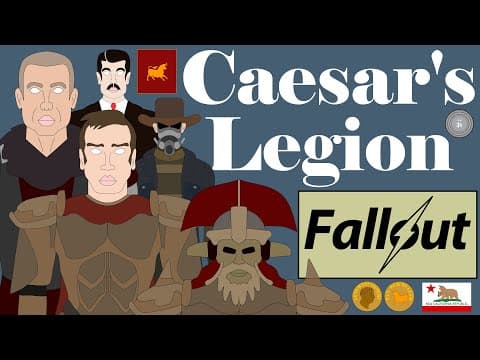
This article explores the origins, ideology, military structure, and key events in the history of Caesar's Legion, a powerful faction in the Fallout universe. Founded by Edward Sallow, who modeled it after the Roman Empire, the Legion sought to unify and conquer tribes through militaristic and autocratic rule, culminating in conflicts with the New California Republic and control over the Mojave region.
"War never changes." This iconic phrase sets the tone for the story of Caesar's Legion, a formidable faction in the post-apocalyptic world of Fallout. Founded by Edward Sallow, later known as Caesar, the Legion is a militaristic autocracy inspired by the ancient Roman Empire. This article delves into the origins, ideology, military organization, and key historical events surrounding Caesar's Legion.
Edward Sallow was born in 2226 near the Boneyard under the flag of the New California Republic (NCR). He lost his father to raiders at a young age, prompting his mother to seek refuge with the Followers of the Apocalypse, a humanitarian organization dedicated to preserving human knowledge and providing education and medical services in the wasteland.
Thanks to his mother's efforts, Edward received a free education and showed high intelligence, though he was selective about his studies. Known for a bad temper and narcissistic attitude, he was disliked by his peers and felt out of place among the Followers, whom he considered naive in their mission to enlighten the wasteland.
Edward specialized in anthropology and linguistics, with a keen interest in history. In 2246, he was sent on a mission with Bill Calhoun to learn the dialects of local tribes in the Grand Canyon.
During their expedition, Edward and his companions met Joshua Graham, a Mormon missionary from New Canaan. The trio was captured by the Blackfoots, a primitive tribe fighting a losing war against seven other tribes.
To prevent their defeat, Edward taught the Blackfoots how to use firearms, produce explosives, and employ small unit military tactics based on his historical readings. Impressed by his knowledge, the Blackfoots made Edward their chieftain.
He led them to victory against rival tribes, employing brutal tactics such as the total annihilation of the Ridgers tribe. His success in warfare introduced the concept of total war to the tribes, who had previously engaged only in small-scale raids.
Inspired by the decline and fall of the Roman Empire and admiring Julius Caesar, Edward Sallow crowned himself Caesar in 2247. He sought to create a highly militarized autocracy that integrated conquered cultures into a single monolithic society.
Caesar envisioned a new Pax Romana in the wasteland, a nationalist, imperialist, totalitarian culture where the individual’s value was measured solely by utility to the state.
He released Bill Calhoun to return to the Followers and warned them against interfering with the Legion. Joshua Graham became his second-in-command, earning the title Malpacle Leot.
Caesar modeled his empire on the Roman Republic and the NCR’s history, particularly admiring the rule of NCR’s second president, Tandee. He viewed the NCR as a once-prosperous but now corrupt and bureaucratic state.
To avoid similar pitfalls, Caesar organized society around wasteland realities, enforcing strict laws and cultural norms:
Caesar suppressed knowledge of Roman history to maintain the illusion that the Legion’s culture was his original creation.
Caesar introduced his own currency:
The Legion’s military was inspired by the Marian reforms of the late Roman Republic:
Tactics included sending inexperienced soldiers first to prove themselves, followed by prime legionaries, and finally veteran soldiers as rear guard.
Specialized roles included:
Caesar’s Legion conquered 86 tribes across Utah, Colorado, Arizona, and New Mexico, establishing Flagstaff as their capital in 2255.
Meanwhile, the NCR expanded eastward into Nevada, signing the Treaty of New Vegas in 2274 with Mr. House, securing control of Hoover Dam and McCarron Airport.
In 2275, the Legion learned of the NCR’s occupation of Hoover Dam and prepared for further expansion.
Caesar planned a campaign akin to Julius Caesar’s conquest of Gaul, aiming to take New Vegas as his Rome and overthrow the NCR, which he saw as a corrupt republic needing transformation into an empire.
In 2277, Caesar launched the first battle of Hoover Dam under Joshua Graham’s command. The NCR, prepared and led by Chief Hanland of the Rangers, set a trap:
The Legion was forced to retreat, suffering a significant morale blow.
Caesar punished Joshua Graham by burning him alive and casting him into the Grand Canyon. Graham survived and became known as the Burned Man.
Caesar appointed Leot Lanius as his new second-in-command. Lanius was a fearsome warrior with a mysterious past, known for his brutal campaigns and unique armor.
Lanius continued the Legion’s conquests, adding 14 more tribes to their domain and preparing for another assault on Hoover Dam.
Caesar’s health declined, suffering headaches and a stiff leg, possibly from a brain tumor. Despite this, he continued his plans, allying with the White Legs tribe and the Omeas of New Vegas.
Meanwhile, Mr. House sought the Platinum Chip, a lost upgrade to New Vegas’s defense system. The Courier, a key figure in the Mojave Wasteland, became involved in this quest, ultimately deciding the fate of Hoover Dam and New Vegas by choosing to ally with the NCR, Caesar’s Legion, Mr. House, or none.
Caesar's Legion represents a brutal, militaristic vision of order in the chaotic wasteland, drawing heavily from Roman history and ideology. Its rise from the ambitions of Edward Sallow to a powerful empire highlights themes of power, culture, and survival in a post-apocalyptic world. The Legion’s conflicts with the NCR and other factions shape much of the political landscape in the Fallout universe, making it a pivotal force in the struggle for control over the Mojave.
This comprehensive history of Caesar's Legion provides insight into one of Fallout's most complex and compelling factions, illustrating how history and ideology can be reinterpreted in a dystopian future.