
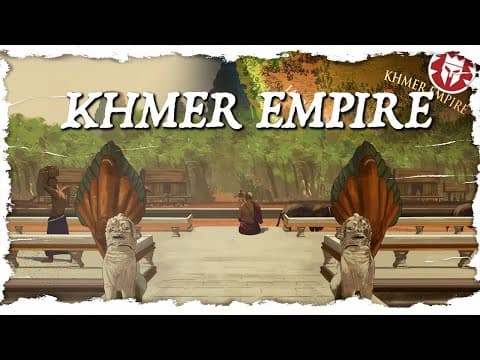
The Khmer Empire, spanning from the 9th to 15th centuries CE in Southeast Asia, was renowned for its religious diversity, monumental architecture, and hydraulic engineering. Originating from Indian cultural influences, it evolved through periods of expansion, religious shifts, and conflicts, culminating in its decline due to ecological and political factors by the 15th century.
The Khmer Empire, also known as the Kamur Empire, was a dominant force in medieval Southeast Asia from the 9th to the 15th centuries CE. Situated in the fertile heart of the Mekong Delta, it ruled much of the peninsula and left a lasting legacy through its religious practices, monumental architecture, and sophisticated hydraulic systems.
The origins of the Khmer Empire trace back to the early centuries CE during a period known as Indianization, when Indian culture, language, and religions spread throughout Southeast Asia. This cultural diffusion introduced Sanskrit, Hinduism, and Buddhism to the region, influencing the development of small statelets.
One such early state was Funan, which existed from the 1st to the 7th century CE in areas now part of southern Cambodia, Thailand, and Vietnam. Funan established key institutions such as Sanskrit inscriptions, Hindu and Buddhist statues, and temples. It was a loosely centralized kingdom with local chiefs holding significant power and maintained diplomatic relations with China.
In the late 8th century, a chieftain from the Funan tributary state of Zenla, known as Jayavarman II, initiated military campaigns that laid the foundation of the Khmer Empire. In 802 CE, he declared himself a divine king, combining Buddhist and Hindu titles, and proclaimed the independence of Kambuja (the Khmer state) from Java or another neighboring entity.
Jayavarman II established the capital at Hariharalaya and was succeeded by rulers who continued to develop the empire's religious and infrastructural foundations.
Indravarman I (877–889 CE) initiated the construction of large water reservoirs and temples dedicated to Hindu deities, notably Shiva. His son Yasovarman I founded Yasodharapura, which later became Angkor, the empire's famed capital.
Following periods of decentralization and reunification, rulers like Rajendravarman II (944 CE) expanded the empire's territory and sponsored massive temple constructions. Rajendravarman II also engaged in warfare with the neighboring Champa kingdom, marking the beginning of centuries-long conflicts.
The Khmer Empire expanded its territory through military campaigns, especially under kings like Suryavarman I, who subdued neighboring kingdoms such as Mandalay and fought wars with the Srivijaya Empire in modern-day Malaysia. Suryavarman I also fostered international relations, notably with the Chola Empire of southern India, seeking aid against rivals.
Despite military successes, the empire faced internal rebellions and external invasions, particularly from Champa in the south.
Jayavarman VII, a Mahayana Buddhist prince, ascended the throne in 1181 CE after liberating Angkor from Cham occupation. He relocated the capital to Angkor Thom and constructed numerous Buddhist temples, including the famous Bayon temple.
His reign was marked by extensive public works, including road networks, hospitals, and rest houses for travelers. Jayavarman VII projected an image of compassion and humility, often depicted in meditation rather than royal regalia.
The Khmer Empire was a cosmopolitan society comprising Tamil merchants, Chinese diplomats, local farmers, and nobles. Its social hierarchy mirrored the Indian caste system, with kings and nobles at the top, supported by Brahmin priests and Buddhist monks who managed land and resources.
Agriculture was central to the empire's prosperity, with extensive canal networks supporting rice cultivation and trade. The empire is often described as a hydraulic civilization due to its sophisticated water management.
Religiously, the empire blended indigenous beliefs with Hinduism and Buddhism. Hinduism, particularly the worship of Vishnu and Shiva, was favored by most kings, while Mahayana Buddhism was also prominent. Over time, Theravada Buddhism gained influence, especially among merchants.
Temples and monuments were designed with cosmological significance, featuring intricate reliefs and statues crafted from sandstone and gold. Sanskrit and Old Khmer inscriptions praised kings and deities with eloquence.
The empire's decline began in the 13th century with religious shifts, including a move from Mahayana Buddhism back to Hinduism and later to Theravada Buddhism under Indravarman III. This religious transition may have weakened the divine authority of kings.
Political instability, internal conflicts, and external pressures from the Thai kingdom of Ayutthaya culminated in the siege and capture of Angkor in 1431 CE. Ecological factors, such as stress on the canal systems, likely contributed to the decline.
Despite a brief reconquest in the 1500s, Angkor was eventually abandoned, and the Khmer Empire transformed into later Cambodian dynasties and vassal states under Thai control.
The Khmer Empire's legacy endures through its monumental architecture, especially Angkor Wat and Angkor Thom, which remain symbols of Cambodia's cultural heritage. Its achievements in hydraulic engineering, art, and religious synthesis continue to fascinate historians and visitors alike.
The empire's history is a testament to the complex interplay of culture, religion, politics, and environment in shaping civilizations.
The story of the Khmer Empire is one of grandeur and resilience, marked by remarkable feats in governance, spirituality, and engineering. From its Indianized origins to its golden age under Jayavarman VII and eventual decline, the empire's narrative offers profound insights into the history of Southeast Asia and the enduring human spirit.



















