
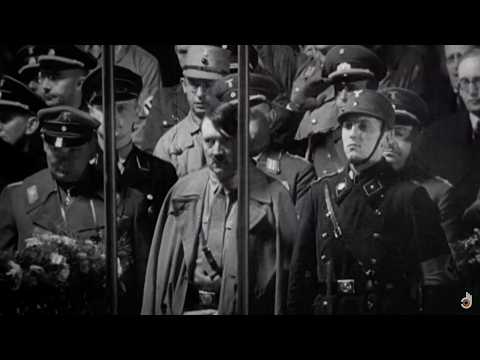
This blog post explores the early life and rise of Adolf Hitler, detailing his transformation from a struggling artist in Vienna to the architect of the Holocaust and the instigator of World War II. It examines key events and influences that shaped his ideology, including his experiences in World War I, his anti-Semitic beliefs, and his political ascent through the Nazi Party.
In Vienna, 1910, a 21-year-old Adolf Hitler was a nobody, living in a men's hostel and selling paintings to tourists. Little did the world know that in just 30 years, he would become the most powerful man in Germany, leading the nation into the Second World War and committing atrocities that would leave a permanent scar on human history.
Adolf Hitler was born on April 20, 1889, in Braunau am Inn, Austria. His father, Alois Hitler, was a customs officer, and his mother, Klara, was a homemaker. Hitler's childhood was marked by a strict upbringing, particularly from his father, who wanted him to follow in his footsteps as a civil servant. However, young Adolf aspired to be an artist, a dream that was met with resistance and violence from his father.
At the age of 13, after his father's death, Hitler pursued his passion for art. He moved to Vienna in 1907 to apply to the Academy of Fine Arts but was rejected twice due to a lack of originality and preparation. This rejection was a significant blow to him, leading to feelings of shame and humiliation that would later fuel his resentment towards society.
In 1907, shortly after his rejections, Hitler's mother died of breast cancer. He was devastated by her death, which marked a turning point in his life. During her illness, he cared for her deeply, and her passing left him emotionally scarred. Interestingly, he spared the life of her Jewish doctor, Dr. Bloch, during his later anti-Semitic campaigns, referring to him as a "noble Jew."
After his mother's death, Hitler lived a bohemian lifestyle in Vienna, relying on the money she left him. He became increasingly isolated and depressed, often sleeping in homeless shelters and living off soup kitchens. During this time, he developed a deep-seated resentment towards the elite, particularly targeting the Jewish community, whom he blamed for his misfortunes.
Vienna was a hotbed of anti-Semitism, and Hitler's views began to crystallize during this period. He perceived Jews as the root cause of Germany's problems, a belief that would later manifest in his political ideology. Historians debate the authenticity of his claims about his early life, suggesting that he fabricated parts of his autobiography in "Mein Kampf" to create a myth around his persona.
When World War I broke out in 1914, Hitler, an Austrian national, enlisted in the German Army. He served as a courier and was eventually awarded the Iron Cross for bravery. The war provided him with a sense of purpose and belonging, but the defeat in 1918 shattered his world. He believed that internal enemies, particularly Jews, were responsible for Germany's loss.
After the war, Hitler remained in the army and was recruited as a propaganda agent. His oratory skills began to shine, and he quickly rose through the ranks of the German Workers' Party (DAP), which later became the National Socialist German Workers' Party (NSDAP). His first speech in 1919 captivated audiences, marking the beginning of his political ascent.
In 1923, Hitler attempted a coup known as the Beer Hall Putsch, which failed and led to his arrest. During his trial, he used the platform to gain national attention, portraying himself as a martyr for the German cause. He was sentenced to prison, where he wrote "Mein Kampf," outlining his ideology of Aryan supremacy and anti-Semitism.
Upon his release, Hitler shifted his strategy to gain power through democratic means. The Great Depression in 1929 provided fertile ground for his rise, as millions of Germans were desperate for change. By 1933, he was appointed Chancellor of Germany, and he wasted no time in establishing a totalitarian regime.
The Reichstag fire in February 1933 allowed Hitler to consolidate power by blaming communists and suspending civil liberties. The Enabling Act passed in March 1933 gave him the authority to enact laws without parliamentary consent, effectively dismantling the democratic institutions of the Weimar Republic.
In 1934, Hitler eliminated potential rivals within the SA during the Night of the Long Knives, securing his position as the sole leader of the Nazi Party. Following the death of President Hindenburg, Hitler merged the offices of Chancellor and President, becoming the Führer of Germany.
Adolf Hitler's rise from a struggling artist to the dictator of Germany was marked by a series of pivotal events and influences that shaped his ideology and ambitions. His anti-Semitic beliefs, fueled by personal grievances and societal conditions, laid the groundwork for the horrific policies that would lead to the Holocaust and the devastation of World War II. Understanding this trajectory is crucial in comprehending the depths of human cruelty and the importance of vigilance against such ideologies in the future.



















