
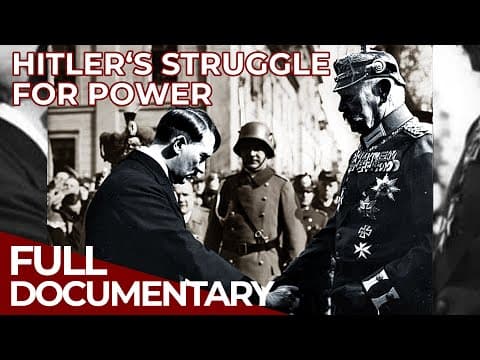
This blog post explores the rise of Adolf Hitler and the Nazi Party in Germany during the early 1930s, detailing the socio-economic conditions that facilitated their ascent, the strategic propaganda campaigns employed, and the pivotal events leading to Hitler's consolidation of power, including the Night of the Long Knives and the eventual declaration of himself as the Fuhrer.
In 1930, Germany was engulfed in the Great Depression, with factories closing and unemployment soaring to four and a half million. Amidst this chaos, Adolf Hitler emerged as a figure who seemed to predict the nation's downfall, positioning himself as the solution to Germany's woes. This blog post delves into how Hitler subverted the democratic process to seize power in Germany.
As the Nazi Party prepared for the September 1930 general election, Germany was in economic turmoil. Hitler blamed the Democratic Weimar government for the crisis, which had been exacerbated by the Wall Street Crash and the subsequent withdrawal of American loans. The government's austerity measures only deepened the economic despair, leading to widespread unemployment and suffering.
For Hitler, this dire situation was an opportunity. With the public desperate for change, he and his propaganda chief, Joseph Goebbels, devised a campaign that directly appealed to the suffering populace. Their slogans promised bread, work, and freedom, presenting Hitler as Germany's last hope.
Hitler's charisma set him apart from the conventional politicians of the Weimar Republic. His speaking tours across the country showcased his oratory skills, captivating audiences and convincing them that he could restore Germany's strength. He promised to reject the Treaty of Versailles, improve the lives of farmers, and put the unemployed back to work. However, he also scapegoated the Jewish community, blaming them for the economic crisis.
The results of the September election were staggering. The Nazis garnered nearly 6.5 million votes, increasing their representation in the Reichstag from 12 to 107 seats, making them the second most popular party in Germany.
Hitler understood the power of propaganda and organized massive rallies to bolster the Nazi image. The annual rallies in Nuremberg became spectacles of order, unity, and discipline, showcasing the Nazi Party as a powerful movement. These events were meticulously planned, featuring torch-lit processions and dramatic lighting, creating an almost religious experience for attendees.
Hitler's speeches were theatrical, designed to manipulate the audience's emotions. He would often delay his entrance to heighten anticipation, and once on stage, he would build up his rhetoric to a fever pitch, leaving his audience in rapture.
Despite his public image, Hitler's personal life was tumultuous. He developed an obsessive relationship with his niece, Geli Raubal, which became a source of scandal. Their relationship soured, leading to Geli's tragic death, which was shrouded in rumors and speculation. The Nazi propaganda machine quickly worked to mitigate the fallout, portraying her death as a suicide to protect Hitler's reputation.
Following Geli's death, Hitler realized he needed to distance himself from women to maintain his messianic image. He kept his next girlfriend, Eva Braun, hidden from the public eye, presenting himself as married to Germany.
Hitler's ambitions grew as he prepared to run in the presidential elections against the esteemed Field Marshal Paul von Hindenburg. Despite losing the election, Hitler's popularity surged, and he became the most recognized civilian leader in Germany. His campaign strategies included innovative propaganda, such as postcards depicting him as an ordinary man, which endeared him to the public.
As political instability continued in Germany, Hitler capitalized on the situation, meeting with influential industrialists and military leaders to gain their support. His charm offensive paid off when he was appointed Chancellor in January 1933, although he still lacked a majority in the Reichstag.
Just days before the general election, the Reichstag building was set on fire, an event that Hitler exploited to consolidate power. Blaming the Communists, he convinced President Hindenburg to declare a state of emergency, allowing him to suppress opposition. The Nazis used this crisis to intimidate and eliminate their political rivals.
In March 1933, the Nazis pushed through the Enabling Act, which granted Hitler dictatorial powers. This act allowed him to enact laws without parliamentary approval, effectively dismantling the democratic framework of the Weimar Republic.
With power secured, Hitler faced threats from within his own party, particularly from Ernst Röhm, the leader of the SA (Brown Shirts). Fearing Röhm's growing influence and the potential for a coup, Hitler orchestrated the Night of the Long Knives in June 1934, where he ordered the execution of Röhm and other SA leaders.
This purge not only eliminated internal dissent but also sent a clear message to the world about Hitler's ruthless approach to power. Following the death of President Hindenburg, Hitler abolished the presidency and declared himself the Fuhrer, solidifying his control over Germany.
The rise of Adolf Hitler was marked by a combination of economic despair, charismatic propaganda, and ruthless political maneuvering. By exploiting the vulnerabilities of the Weimar Republic and eliminating his rivals, Hitler transformed himself from a fringe politician into the supreme leader of Germany. His ascent to power serves as a cautionary tale about the fragility of democracy in times of crisis.



















