
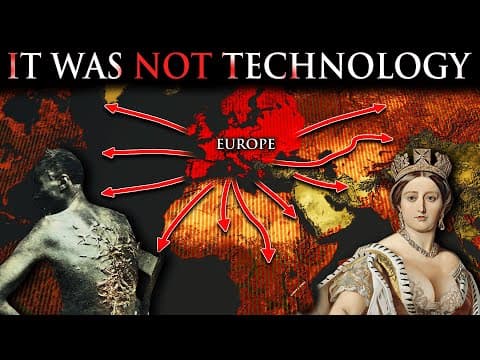
This article explores the transformation of Europe from a fragmented region vulnerable to foreign empires in the 8th century to a dominant global power by the late 19th century, driven by military advancements, political changes, and the impacts of the Industrial Revolution.
In the winter of 717 AD, Constantinople, Europe's largest city, faced a dire threat. The Umayyad Caliphate had besieged the city for six months, showcasing the overwhelming power of a Muslim empire that had rapidly expanded across Europe. By the early 8th century, this empire had conquered modern-day Spain and Portugal, advancing dangerously close to Paris. Meanwhile, Europe was fragmented, vulnerable, and reeling from a devastating plague that had halved its population.
During this tumultuous period, Europe was not only threatened by the Umayyad forces to the south but also faced invasions from nomadic raiders such as the Avars, Khazars, and Bulgars. The continent was a patchwork of divided Christian kingdoms, struggling to maintain stability. A century later, the Viking raids would further exacerbate the chaos, brutally attacking the coasts of Britain and mainland Europe. The future of Christendom appeared bleak, with the continent on the brink of extinction.
Fast forward to 1884, where delegates from the most powerful royal houses of Europe gathered in Berlin, hosted by German Chancellor Otto von Bismarck. This assembly was not about resolving conflicts or negotiating trade; instead, it was focused on the division of Africa. Within decades, European powers would establish control over 84% of the globe, fueled by the advancements of the Industrial Revolution.
The late 19th century marked a period of unprecedented advancements in science, technology, and weaponry in Europe. The Industrial Revolution transformed the continent, enabling rapid travel and communication. Steam-powered boats and trains reduced transatlantic journeys to just seven days, while telegraph cables allowed for almost instant communication across oceans. European control extended from the Sahara Desert to the Amazon Rainforest, showcasing a dominance that was both remarkable and brutal.
The transformation of Europe from a land of fragmented kingdoms to a center of global dominance was a complex process. By the end of the 17th century, Europe had been ravaged by nearly a century of bloody religious wars. Protestant and Catholic rulers turned the fertile plains of Western and Central Europe into a violent chessboard. However, this chaos led to a significant shift in power dynamics.
Monarchs began to wield far greater control over their kingdoms compared to their medieval predecessors. The small armies of feudal levies were replaced by large, professional forces directly under royal command. This shift minimized the personal risks for monarchs, as military failures no longer threatened their lives or thrones. With the stakes lowered, European rulers engaged in constant military competition, heavily investing in their militaries and adopting new innovations, particularly in gunpowder weaponry.
This intense arms race resulted in European armies becoming far superior to those of their Asian and African counterparts. While China had utilized gunpowder weapons long before Europe, its focus on fighting nomadic horse riders made such technology less practical. Similarly, Japan's advancements in gunpowder weaponry declined as the Tokugawa Shogunate unified the islands, reducing the need for military innovation.
The Americas were colonized by Europeans as early as the 1500s, facilitated by the rapid spread of European diseases among native populations. The Spanish and Portuguese conquests were made possible by superior ship design, a result of centuries of navigating the harsh waters of Europe. This combination of constant competition, unencumbered rulers, and significant military investments propelled Europe ahead of other continents in military advancement.
The unique circumstances that led to Europe's rise as a dominant global power were marked by a combination of military innovation, political changes, and the impacts of the Industrial Revolution. From a fragmented region vulnerable to foreign empires in the 8th century to a technologically advanced empire by the late 19th century, Europe's journey is a testament to the complex interplay of historical forces that shaped the modern world. The legacy of this dominance, however, came at a significant cost, involving the brutal suppression and exploitation of millions of non-European peoples.



















