
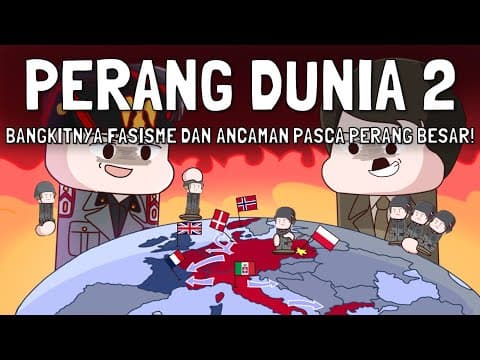
This blog post explores the socio-economic conditions following World War I that led to the rise of fascism in Germany, Italy, and Japan, detailing how these nations plunged the world into a more brutal conflict during World War II.
The end of World War I was not a moment of celebration for many nations. Instead, the world quickly fell into a severe economic depression that devastated economies across the globe. Countries like America and Italy, despite being on the winning side, faced rampant unemployment and poverty. Meanwhile, Germany, having lost the war, was burdened with reparations and military restrictions, setting the stage for the rise of radical political parties.
The Treaty of Versailles imposed harsh penalties on Germany, limiting its military to just 100,000 troops and demanding exorbitant reparations. This created a sense of humiliation and anger among the German populace, which was further exacerbated by the Great Depression that struck in the late 1920s.
In Italy, the disillusionment with the post-war settlement led to the rise of Benito Mussolini and his Fascist Party. Mussolini's oratory skills and promises of national rejuvenation resonated with a populace desperate for change. After several attempts to seize power, he successfully pressured King Victor Emmanuel III to appoint him as Prime Minister, marking the beginning of fascist dictatorship in Europe.
Across the Alps in Germany, Adolf Hitler emerged as a prominent figure within the National Socialist German Workers' Party (Nazi Party). Initially a failed artist, Hitler's powerful speeches and propaganda gained him a following. After a failed coup in 1923, he wrote "Mein Kampf" and eventually became Chancellor in 1933, influenced by Mussolini's fascist ideology.
Italy, initially aligned with Germany, switched sides during World War I but felt betrayed by the Allies after the war. Mussolini sought to expand Italy's influence, while Japan, emboldened by its victories in previous conflicts, aimed to establish dominance in Asia, particularly in China.
Both Germany and Italy intervened in the Spanish Civil War, supporting Francisco Franco's nationalists. This conflict served as a testing ground for their military capabilities, with Germany using it to trial new weaponry and tactics.
Despite various attempts at diplomacy, including the establishment of the League of Nations and several naval treaties, the aggressions of the Axis powers went largely unchecked. Hitler's annexation of Austria in 1938 and the occupation of the Sudetenland were met with minimal resistance from the Allies, emboldening further expansionist policies.
On September 1, 1939, Germany invaded Poland, triggering the start of World War II. The swift and brutal attack was made possible through a non-aggression pact with the Soviet Union, allowing Hitler to focus his military efforts without fear of a two-front war. Britain and France declared war on Germany shortly after, but initial military responses were tepid.
The period following the declaration of war was marked by a lack of significant military engagement, known as the Phoney War. However, this was soon disrupted by Germany's rapid conquests in Western Europe, including the fall of Denmark and Norway.
Germany's military strategy, which involved a surprise attack through the Ardennes, led to the swift defeat of France in just 46 days. The effectiveness of the German military was evident, as they coordinated their forces with remarkable efficiency.
Following the fall of France, Hitler turned his attention to Britain, launching the Battle of Britain in an attempt to gain air superiority. Despite initial successes, the Luftwaffe faced fierce resistance from the Royal Air Force, leading to significant losses for Germany.
The rise of fascism in Germany, Italy, and Japan, fueled by economic despair and nationalistic fervor, set the stage for a conflict that would engulf the world in unprecedented violence. As the war progressed, the dynamics shifted, with the Allies beginning to regroup and strategize against the Axis powers. The next phase of this global conflict would reveal the true scale of the war and the resilience of those fighting against tyranny.



















