
This blog post explores the transformation of Germany from a democracy to a dictatorship under Adolf Hitler from January 1933 to August 1934, detailing key events such as the Reichstag Fire, the Enabling Act, and the Night of the Long Knives, which facilitated the Nazi Party's consolidation of power.
In this blog post, we will explore the critical period in German history from January 1933 to August 1934, during which Adolf Hitler and the Nazi Party transformed Germany from a democracy into a totalitarian dictatorship. We will examine key events, including the Reichstag Fire, the Enabling Act, and the Night of the Long Knives, that facilitated this dramatic shift in power.
The Nazi Party was founded in 1919 by Anton Drexler as a small right-wing political group with nationalist views. Its main support base was in Bavaria, particularly around Munich. Adolf Hitler joined the party in 1919 and became its chairman by 1921.
On November 8, 1923, the Nazis attempted to seize power in what is known as the Munich Beer Hall Putsch. The coup failed, resulting in the deaths of 16 Nazis and Hitler's arrest. He was convicted of treason and sentenced to five years in prison but served only nine months. During his imprisonment, he wrote Mein Kampf, outlining his political ideology and gaining publicity for the Nazi Party.
After his release, Hitler relaunched the Nazi Party in 1925, shifting its strategy to gaining power through legal means and democratic elections. Despite poor electoral performance in the late 1920s, the party's support surged during the early 1930s, largely due to the economic turmoil caused by the Great Depression, which left millions unemployed.
On January 30, 1933, President Hindenburg appointed Hitler as Chancellor of Germany. This appointment was influenced by conservative politicians who believed they could control him. However, Hindenburg was skeptical of Hitler and had to be persuaded to make the appointment.
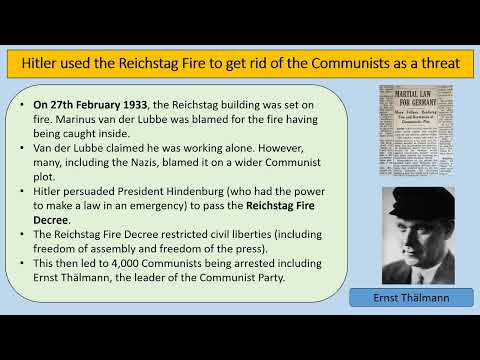
On February 27, 1933, the Reichstag building (German Parliament) was set on fire. A Dutch communist, Marinus van der Lubbe, was arrested at the scene. The Nazis used this event to claim it was part of a larger communist conspiracy, leading to the Reichstag Fire Decree, which suspended civil liberties and allowed for the arrest of thousands of communists.
Despite widespread intimidation, the Nazis did not secure an outright majority in the March 5, 1933 elections. However, they were able to pass the Enabling Act on March 24, 1933, which granted Hitler the power to enact laws without parliamentary consent, effectively establishing a legal dictatorship.
Following the Enabling Act, Hitler moved quickly to eliminate opposition:
On June 30, 1934, Hitler orchestrated the Night of the Long Knives, a purge of the SA leadership, including Ernst Röhm. This event eliminated potential rivals within the party and secured the loyalty of the German Army, which had grown wary of the SA's power.
President Hindenburg died on August 2, 1934. Following his death, Hitler combined the offices of Chancellor and President, declaring himself Führer (Leader) of Germany. The German Army was made to swear an oath of loyalty to Hitler, solidifying his control over the country.
This period marked the complete transformation of Germany from a democratic state to a totalitarian regime under Hitler, characterized by repression, propaganda, and the systematic elimination of dissent. The events from January 1933 to August 1934 laid the groundwork for the Nazi regime's policies and actions that would follow in the years leading up to World War II.



















