
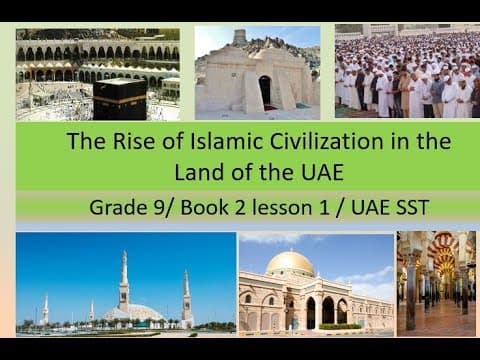
This blog post explores the historical development of Islamic civilization in the UAE, highlighting key events, cultural influences, and the impact of trade and religion on the region's growth.
The United Arab Emirates (UAE) has a rich history that is deeply intertwined with the rise of Islamic civilization. This post delves into the key events and cultural influences that shaped the UAE into a significant center of Islamic culture and trade.
The history of the UAE dates back thousands of years, with evidence of human settlement in the region as early as 5000 BC. However, the rise of Islamic civilization in the UAE began in the 7th century with the advent of Islam. The region was strategically located along trade routes, which facilitated the spread of Islamic teachings and culture.
In 610 AD, the Prophet Muhammad began preaching the message of Islam in Mecca. By the time of his death in 632 AD, Islam had spread rapidly across the Arabian Peninsula. The tribes in the UAE, particularly the Bani Yas and the Bani Qitab, embraced Islam, which led to significant changes in their social and political structures.
The UAE's geographical location made it a vital hub for trade between the East and West. The establishment of trade routes allowed for the exchange of goods, ideas, and cultures. Merchants from the UAE played a crucial role in the spread of Islam, as they traveled to various regions, bringing with them Islamic teachings and practices.
As Islamic civilization flourished, it brought with it a wealth of cultural influences. The UAE became a melting pot of various cultures, with Persian, Indian, and African influences evident in its architecture, cuisine, and traditions. The Islamic Golden Age, which spanned from the 8th to the 14th century, saw advancements in science, mathematics, and philosophy, which also impacted the UAE.
Islamic architecture began to take shape in the UAE during this period. The construction of mosques and forts reflected the Islamic aesthetic, characterized by intricate geometric patterns and calligraphy. The Al Ain Oasis and the forts of Fujairah are prime examples of this architectural heritage.
Religion played a pivotal role in shaping the identity of the UAE. The establishment of Islamic law (Sharia) influenced the legal and social systems in the region. The UAE's leaders have historically emphasized the importance of Islam in governance, promoting a society that values tolerance and coexistence among different cultures and religions.
In recent decades, the UAE has emerged as a global center for commerce and tourism while maintaining its Islamic heritage. The government has invested in preserving historical sites and promoting cultural initiatives that celebrate the rich Islamic history of the region. Events such as the Sheikh Zayed Heritage Festival showcase the UAE's commitment to honoring its past while looking towards the future.
The rise of Islamic civilization in the UAE is a testament to the region's historical significance as a center of trade, culture, and religion. From the early days of Islam to the modern era, the UAE has embraced its Islamic heritage while evolving into a global hub. Understanding this history is essential for appreciating the unique identity of the UAE today.



















