
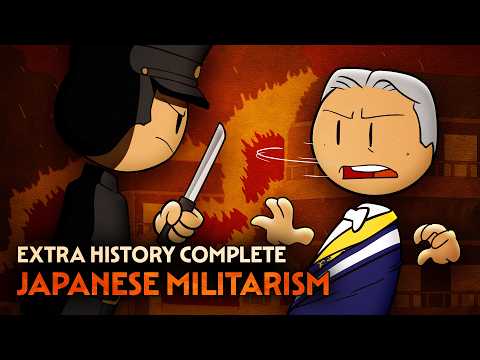
This blog post explores the evolution of Japanese militarism from the Meiji Restoration through the early 20th century, detailing key events, political factions, and the impact of societal changes leading to World War II.
On November 4th, 1921, Haratakashi, a symbol of modern Japan, was assassinated at Tokyo station. As the first commoner and Christian prime minister, he had navigated Japan through significant international events, including the Paris Peace Conference and the League of Nations. However, his moderate policies and attempts to ease colonial rule in Korea earned him powerful enemies. This event marks a pivotal moment in Japan's transition towards militarism, a topic often overshadowed by the rise of fascism in Europe.
Following the Satsuma Rebellion, the Meiji Emperor was restored to power, leading to the abolition of the samurai class and the establishment of a council of elder statesmen known as the Meiji oligarchy. This period was characterized by a singular focus on modernization to avoid colonization by Western powers. The rallying cry of "Enrich the country, strengthen the military" encapsulated the national agenda.
In just a few decades, Japan underwent rapid industrialization, building railroads, factories, and a modern economy. The government invested heavily in military modernization, creating a formidable army and navy. Diplomatic efforts were made to renegotiate unequal treaties imposed by Western nations, which were ultimately successful. This modernization brought about a population explosion, creating new job opportunities and amplifying the voices of common people advocating for democracy.
By 1889, the Meiji oligarchs drafted a constitution that combined elements of various Western political systems. While it established a parliamentary diet and guaranteed certain rights, these rights were conditional, allowing the government to revoke them at will. The military was an independent entity, answerable only to the emperor, which would later lead to significant political turmoil.
Japan's military successes in the Sino-Japanese War (1895) and the Russo-Japanese War (1905) solidified its status as a major power. However, the death of the Meiji Emperor in 1912 and the subsequent rise of Emperor Taisho marked a shift in political dynamics. The military began to assert its influence, leading to a constitutional crisis and increasing radicalization among the populace.
On September 1, 1923, the Great Kanto earthquake devastated Yokohama and Tokyo, killing approximately 140,000 people. In the aftermath, right-wing mobs targeted Koreans and anarchists, blaming them for the disaster. This event catalyzed the rise of ultra-nationalist groups, such as the Black Ocean Society and the Black Dragon Society, who began to advocate for military expansion as a means of national security.
Between 1912 and 1927, Japan experienced a period known as Taisho democracy, characterized by the rise of political parties. The conservative Saiyukai and the liberal Kenzekai emerged as key players, with the former leaning towards militarism and colonialism, while the latter advocated for labor rights and economic reforms.
The economic turmoil following the Great Kanto earthquake and the global financial crisis of the late 1920s led to widespread dissatisfaction with the government. The rise of radical political movements and the assassination of key political figures, including Prime Minister Hara, highlighted the increasing violence and instability within Japanese politics.
As the military's influence grew, it began to act independently of civilian leadership. The assassination of Chinese warlord Chang Zolin in 1928 by junior officers exemplified the military's willingness to bypass government authority. The subsequent invasion of Manchuria in 1931 marked a significant turning point, as the military effectively seized control of foreign policy and military action.
In 1936, a faction of young officers attempted a coup known as the February 26 Incident, aiming to restore the emperor's power and eliminate perceived traitors. Although the coup was ultimately suppressed, it demonstrated the military's increasing dominance over the government and the willingness to resort to violence to achieve political goals.
By the late 1930s, Japan's militaristic policies culminated in the Second Sino-Japanese War, which began in 1937. The military's lack of a coherent strategy for managing its territorial gains led to widespread atrocities, including the Nanjing Massacre. As Japan aligned itself with Axis powers, it further isolated itself diplomatically, setting the stage for its involvement in World War II.
The rise of Japanese militarism was a complex interplay of political, social, and economic factors. From the Meiji Restoration to the onset of World War II, Japan's journey was marked by rapid modernization, political violence, and the eventual dominance of the military over civilian governance. Understanding this history is crucial for comprehending the broader implications of militarism and its impact on global events in the 20th century.



















