
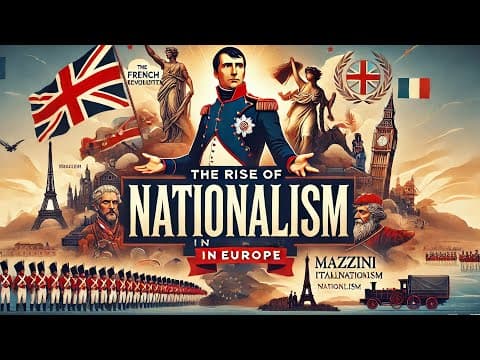
This blog post explores the rise of nationalism in Europe, tracing its roots from the French Revolution through the unification of Germany and Italy, and examining the cultural, political, and social factors that shaped national identities across the continent.
Before the French Revolution of 1789, Europe was characterized by monarchies with absolute power, where kings ruled with little involvement from the populace. Society was divided into rigid classes: the clergy, the nobility, and the commoners, leading to vast inequalities in wealth and rights. Economic hardship, high taxes, and widespread dissatisfaction among the lower classes contributed to growing unrest, which ultimately sparked the French Revolution.
The French Revolution marked the emergence of nationalism as a political force. Prior to the revolution, France was a territorial state ruled by an absolute monarch. However, the revolution shifted political power from the king to the citizens, declaring that the people would form the nation and decide its future. Revolutionary leaders introduced measures to foster unity and identity among the French populace, emphasizing concepts such as "La Patrie" (the Fatherland) and "La Citoyen" (the Citizen).
The revolution led to the adoption of a new tricolor flag, the establishment of the National Assembly, and the creation of national hymns. A centralized administrative system was introduced, uniform laws were enacted, and regional dialects were discouraged in favor of the Parisian French language. The revolutionaries aimed to inspire other European nations to break free from despotism.
After the revolution, Napoleon Bonaparte rose to power in 1799 and implemented reforms that enhanced administrative efficiency. His Napoleonic Code of 1804 abolished privileges based on birth, established equality before the law, and secured property rights. These reforms extended to countries under French control, simplifying administrative divisions and ending feudal systems. However, reactions to French rule varied; while some regions initially welcomed the changes, resentment grew due to high taxes and censorship.
In the mid-18th century, Europe lacked the nation-states we recognize today. Regions like Germany, Italy, and Switzerland were fragmented into smaller kingdoms and duchies, each with its own rulers. The Habsburg Empire, for example, encompassed diverse populations with different languages and cultures, complicating political unity.
The landed aristocracy, a powerful class in Europe, maintained a common lifestyle across regions, yet most people were peasants. Industrial growth in the late 18th and 19th centuries led to the rise of towns and a commercial class focused on market production, further complicating the social landscape.
In early 19th-century Europe, the idea of national unity became intertwined with liberalism. Liberalism, derived from the Latin word "Liber" (meaning free), emphasized individual freedom, equality before the law, and government by consent. However, voting rights were limited, often excluding non-property owners and women.
The middle class advocated for free markets and the removal of government restrictions on trade. The establishment of the Zollverein, a customs union in 1834, facilitated economic growth by removing tariff barriers and standardizing measures, further fueling nationalist sentiments.
The period following Napoleon's defeat saw a resurgence of conservatism, yet liberalism and nationalism became linked to revolutions across Europe. The July Revolution in France in 1830 led to the establishment of a constitutional monarchy, inspiring uprisings in Belgium and other regions.
The Greek War of Independence (1821-1832) exemplified the nationalist struggle, garnering support from Europeans who admired ancient Greek culture. The Treaty of Constantinople in 1832 officially recognized Greece as an independent nation.
Nationalism was also shaped by cultural movements. Romanticism emphasized emotions and intuition, fostering a sense of shared heritage. Figures like Johann Gottfried Herder advocated for the importance of folk culture in building national identity. In Poland, music and language became symbols of resistance against foreign control, with composers celebrating national struggles through their works.
The revolutions of 1848 were marked by widespread unrest, driven by economic hardship and demands for political rights. In France, the monarchy was overthrown, leading to the establishment of a republic with universal male suffrage. Similar movements occurred in Germany, Italy, and the Austro-Hungarian Empire, where the middle class pushed for national unification and constitutional governments.
Despite initial successes, many of these revolutions were suppressed, yet they led to significant changes, including the abolition of serfdom in various regions.
Post-1848, nationalism in Europe began to shift away from democratic ideals. In Germany, Otto von Bismarck led the unification movement through a series of wars, culminating in the declaration of the German Empire in 1871. This process showcased the dominance of Prussian power and the centralization of state authority.
In Italy, the unification process was spearheaded by figures like Giuseppe Garibaldi and Count Camillo di Cavour, culminating in the establishment of a unified Italian state in 1861. However, many Italians remained unaware of nationalist ideas, highlighting the complexities of national identity.
The formation of the British nation state was a gradual process, influenced by the Act of Union in 1707, which united England and Scotland. The English Parliament played a crucial role in shaping the British identity, often suppressing the unique cultures of Scotland, Ireland, and Wales.
The rise of nationalism in Europe was a multifaceted process influenced by political, economic, and cultural factors. From the revolutionary fervor of the French Revolution to the unification of Germany and Italy, nationalism reshaped the continent's political landscape. Despite the challenges and complexities, the legacy of nationalism continues to influence European identity today.



















