
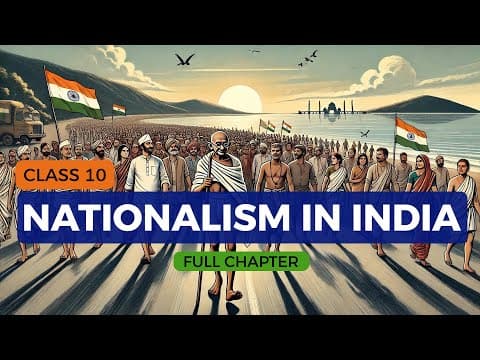
This blog post explores the evolution of nationalism in India during the struggle against British rule, focusing on key movements such as the Non-Cooperation and Civil Disobedience movements led by Mahatma Gandhi. It discusses the socio-political context, the involvement of various social groups, and the challenges faced in uniting diverse interests under a common nationalist agenda.
Nationalism in India emerged as a powerful force during the struggle against British colonial rule. This blog post delves into the evolution of modern nationalism in India, highlighting the significant movements and leaders that shaped this journey, particularly focusing on the Non-Cooperation and Civil Disobedience movements of the 1920s.
Modern nationalism in India grew through the collective struggle against British rule. Various groups united despite their differing experiences and ideas about freedom. Mahatma Gandhi and the Indian National Congress played pivotal roles in bringing these groups together, although challenges and conflicts arose in achieving unity.
The aftermath of World War I significantly influenced India's national movement. The war brought economic and political turmoil, including higher taxes, rising prices, forced soldier recruitment, crop failures, and a deadly influenza outbreak. These issues led to widespread suffering and anger, particularly in rural areas where forced recruitment was met with resistance. The 1921 census revealed that 12 to 13 million people lost their lives due to famine and the epidemic, further fueling discontent.
Mahatma Gandhi returned to India in 1915 after successfully employing his nonviolent method of Satyagraha in South Africa. Satyagraha focused on fighting injustice through truth and nonviolence, emphasizing that physical force was unnecessary to combat oppression. Gandhi believed that nonviolence could unite Indians and led several Satyagraha movements across the country:
In 1919, Gandhi launched a nationwide protest against the Rowlatt Act, which granted the British government sweeping powers to suppress political activities and detain individuals without trial. The Act faced strong opposition from Indian members of the legislature, but it was pushed through quickly. Gandhi organized a strike on April 6, 1919, leading to widespread protests. The British response was brutal, culminating in the tragic Jallianwala Bagh massacre on April 13, where General Dyer ordered troops to fire on a peaceful gathering, killing hundreds.
In response to the growing unrest, Gandhi saw an opportunity to unite Hindus and Muslims by supporting the Khilafat issue, which defended the Ottoman Khalifa. In September 1920, he convinced Congress leaders to initiate the Non-Cooperation Movement, advocating for both the Khilafat and Indian self-rule (Swaraj).
Gandhi believed that British rule depended on Indian cooperation. By withdrawing cooperation, he argued, Indians could effectively end British rule. The Non-Cooperation Movement was structured in stages, beginning with boycotts and civil disobedience. It was officially accepted at the Congress session in Nagpur in December 1920.
The Non-Cooperation Movement saw participation from diverse social groups:
In February 1922, Gandhi ended the Non-Cooperation Movement due to escalating violence and the need for better training among participants. The global economic depression exacerbated conditions in India, leading to the Simon Commission protests and Congress's demand for full independence (Purna Swaraj) by January 26, 1930.
Gandhi's Salt March in 1930 became a pivotal moment in the Civil Disobedience Movement. He used salt as a symbol of resistance against British oppression, leading a 240-mile march from Sabarmati to Dandi to protest the salt tax. The movement encouraged widespread civil disobedience, including boycotting foreign goods and ignoring oppressive laws.
Despite the momentum, the Civil Disobedience Movement faced challenges:
Nationalism in India was also shaped by cultural elements, folklore, and symbols that fostered a sense of collective belonging. Figures like Bankim Chandra Chattopadhyay and Rabindranath Tagore played crucial roles in promoting Indian identity through literature and art. The tricolor flag and Gandhi's Swaraj flag became powerful symbols of resistance and unity.
The early 20th century witnessed a surge of anger against British rule, uniting various Indian groups in the fight for independence. While the Congress, led by Gandhi, aimed to create a common nationalist movement, differing goals and perspectives often led to conflicts. The struggle for freedom in India was marked by diverse voices and conflicting demands, ultimately culminating in the Quit India Movement of 1942, which called for the British to leave India. This complex tapestry of nationalism laid the groundwork for India's eventual independence.



















