
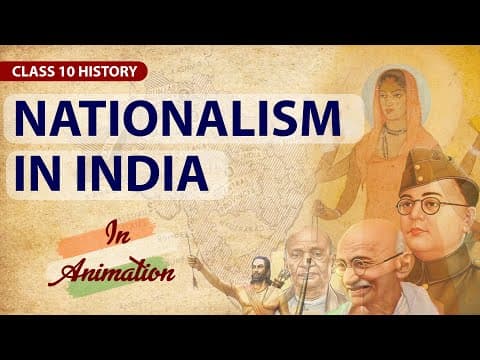
This blog post explores the evolution of nationalism in India during the struggle against British rule, focusing on key movements like the Non-Cooperation and Civil Disobedience movements led by Mahatma Gandhi. It discusses the diverse social groups involved, the challenges faced, and the impact of these movements on India's quest for independence.
Nationalism in India emerged as a powerful force during the struggle against British colonial rule. This movement was characterized by the unification of various groups, each with distinct experiences and ideas about freedom. Mahatma Gandhi and the Indian National Congress played pivotal roles in bringing these groups together, despite facing numerous challenges and conflicts along the way.
The roots of modern nationalism in India can be traced back to the aftermath of World War I. The war brought significant economic and political challenges, including higher taxes, rising prices, forced soldier recruitment, crop failures, and a deadly influenza outbreak. These hardships fueled public discontent and a desire for change.
Mahatma Gandhi returned to India in 1915 after successfully employing his non-violent method of Satyagraha in South Africa. Satyagraha emphasized fighting injustice through truth and nonviolence, aiming to unite Indians against British oppression. Gandhi's leadership became instrumental in mobilizing the masses for the national movement.
In 1919, Gandhi launched a nationwide protest against the Rowlatt Act, which granted the British government oppressive powers to suppress political activities. The protest included strikes and rallies, culminating in the tragic Jallianwala Bagh massacre in April 1919, which intensified public outrage.
In September 1920, Gandhi proposed the Non-Cooperation Movement to support both the Khilafat Movement (which aimed to protect the Ottoman Khalifa) and Indian self-rule (Swaraj). He believed that British rule depended on Indian cooperation, and if Indians ceased to cooperate, colonial rule would collapse.
The Non-Cooperation Movement began in January 1921, attracting various social groups, including the middle class, peasants, and tribal communities. Each group had its own interpretation of Swaraj, leading to diverse goals within the movement.
In urban centers, the Non-Cooperation Movement saw significant participation from students, teachers, and lawyers. Many boycotted foreign goods, which boosted Indian textile production. However, the movement faced challenges as the cost of khadi cloth was prohibitive for many, leading some to revert to British institutions.
The movement also spread to rural areas, where peasants and tribal groups engaged in struggles against landlords and oppressive labor practices. Leaders like Baba Ramachandra and Aluri Sitaramaraju emerged, advocating for the rights of the oppressed and leading local uprisings against British policies.
In February 1922, Gandhi ended the Non-Cooperation Movement due to escalating violence and the need for better training among participants. The global economic depression further exacerbated conditions in India, leading to the Simon Commission protests and demands for full independence.
Gandhi's Salt March in 1930 became a pivotal moment in the Civil Disobedience Movement. By walking 240 miles from Sabarmati to Dandi, Gandhi symbolically broke the salt laws, rallying support against British oppression. The movement encouraged widespread acts of civil disobedience, including boycotts of foreign goods and defiance of British laws.
The Civil Disobedience Movement attracted various social classes, including rich peasants, business people, and industrial workers. However, the movement faced internal tensions, particularly regarding the representation of poorer peasants and the Dalit community.
The Dalit community, who began identifying as Dalit or oppressed, felt marginalized within the broader nationalist movement. Leaders like Dr. B.R. Ambedkar advocated for separate electorates and political representation, leading to conflicts with Gandhi, who sought to integrate Dalits into the national movement.
As nationalism grew, cultural symbols and folklore played a crucial role in fostering a sense of collective identity. Figures like Rabindranath Tagore and Bakim Chandra Chattopadhyay contributed to the revival of Indian culture, using art and literature to inspire pride and unity among the populace.
The early 20th century marked a significant period in India's struggle for independence, characterized by the unification of diverse groups under the banner of nationalism. Despite differing goals and frequent disagreements, the collective efforts of various communities laid the groundwork for India's eventual independence.
The failure of the CPS Mission and the onset of World War II further fueled unrest, leading Gandhi to initiate the Quit India Movement in 1942, which called for an end to British rule. This movement saw widespread participation and marked a critical phase in India's journey towards freedom.



















