
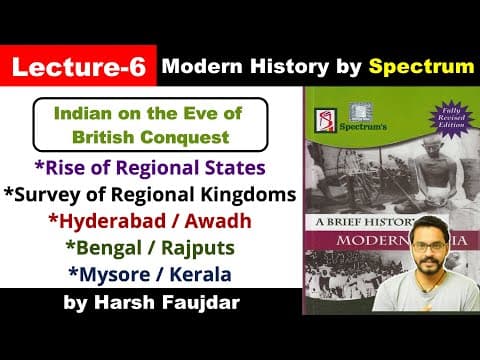
The decline of the Mughal Empire in the 18th century led to the emergence of several regional powers in India, categorized into successor states, independent kingdoms, and new states. This blog explores the formation and significance of key regional states such as Hyderabad, Awadh, Bengal, Rajputana, Mysore, and Kerala, highlighting their leaders and historical contexts.
The decline of the Mughal Empire marked a significant turning point in Indian history, leading to the emergence of various regional powers. As the empire weakened, many local rulers began consolidating their power and establishing independent states. This blog post delves into the rise of these regional states, focusing on Hyderabad, Awadh, Bengal, Rajputana, Mysore, and Kerala.
The newly emerging states can be broadly categorized into three groups:
Hyderabad was established as an independent state in 1724 by Chin Qilich Khan, who was later known as Nizam-ul-Mulk. The idea of establishing Hyderabad as an independent state was first proposed by Zulfikar Khan, but he passed away in 1713 before executing his plan. Nizam-ul-Mulk successfully defeated the Mughal governor Mubarak Khan in the Battle of Shakar Kheda, solidifying Hyderabad's status as an independent state. Although he maintained a facade of loyalty to the Mughal Empire, he effectively ruled independently.
In Awadh, Saadat Khan was appointed as the governor in 1722. He successfully quelled local revolts and earned the title Burhan-ul-Mulk from Emperor Muhammad Shah. However, his relationship with the Mughal court soured, leading him to focus on consolidating power in Awadh. His son-in-law, Safdar Jang, was appointed as deputy governor, ensuring a succession plan. The political landscape shifted dramatically during the invasion of Nadir Shah, which further complicated Awadh's political dynamics.
Bengal became a significant regional power under Murshid Quli Khan, who was appointed as the Mughal governor. He gradually asserted independence while maintaining a nominal allegiance to the Mughal Empire. His administration was marked by economic reforms and the establishment of law enforcement structures. After his death in 1720, the power shifted to Shuja-ud-Din, and later to Ali Vardi Khan, who played a crucial role in Bengal's political landscape.
The Rajputs played a pivotal role in the history of the Mughal Empire. Initially, during Akbar's reign, relations between the Rajputs and the Mughals were cordial, with intermarriages and mutual respect. However, under Aurangzeb, relations soured due to his intolerant policies. The Rajputs began to assert their independence in the 18th century, forming alliances against Mughal authority. Notable figures like Ajit Singh and Jai Singh II were instrumental in this movement.
Mysore emerged as a significant power under the Wodeyar dynasty, which had previously been part of the Vijayanagara Empire. The rise of Hyder Ali, a soldier who became the ruler of Mysore, marked a new era. He implemented several reforms and established a strong administration, making Mysore a formidable state. After his death in 1782, his son Tipu Sultan continued his legacy, leading to significant conflicts with the British.
In Kerala, Marthanda Varma established the region as an independent state, making Travancore its capital. He was known for his strong military and administrative reforms, successfully managing to keep the Dutch and British at bay. His successor, Rama Varma, further enhanced Kerala's reputation as a center of scholarship and art.
The 18th century was a transformative period in Indian history, characterized by the rise of regional states as the Mughal Empire declined. Each of these states—Hyderabad, Awadh, Bengal, Rajputana, Mysore, and Kerala—played a crucial role in shaping the political landscape of India. Understanding their histories provides valuable insights into the complexities of Indian politics during this era. As we continue to explore these regional powers, we uncover the rich tapestry of India's past and the legacies that continue to influence the present.



















