
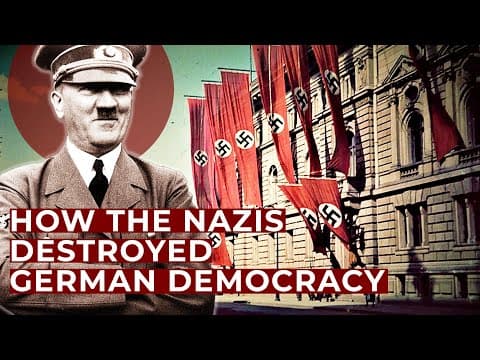
This blog post explores the early years of Adolf Hitler's regime in Germany, detailing the methods used by the Nazis to consolidate power, the societal changes that occurred, and the devastating impact of their policies, particularly against Jewish citizens and political opponents.
1933 marks the beginning of one of the darkest chapters in German history as Adolf Hitler and his National Socialist Party assume power. This period not only transformed Germany but also altered the global perception of the nation, with the shadows of this past still haunting the present.
On January 30, 1933, Adolf Hitler was appointed Chancellor of Germany. His rise to power was marked by great hopes and unprecedented jubilation among his supporters. However, the Third Reich was unique in its ambition to destroy the values of Judeo-Christian civilization that had existed for over two millennia. This revolutionary attempt aimed to upturn established norms and values.
The Nazi regime's control over the nation was swift and unprecedented. From day one, it burdened the state with debts for short-term political gains, revealing a fundamentally flawed governance model. Hitler's vision extended beyond Germany; he sought to dominate the world, fueled by an intense hatred for Jews, who were systematically ostracized, persecuted, and ultimately murdered in death factories.
The radicalization of the Nazi regime escalated during wartime, making it easier to enforce extreme measures. The German military subjugated much of Europe, looting defeated nations, until the Allies intervened to halt this aggression. The early successes of Hitler's military campaigns led to a dangerous belief in his infallibility, which began to wane after the catastrophic defeat at Stalingrad.
The legacy of Hitler's regime is staggering, with an estimated 60 million dead, including six million Jews in the Holocaust. Despite the horrors, few resisted the regime, and even as Allied air raids devastated German cities, the populace remained largely unrebellious, held together by fear and a misguided faith in eventual victory.
In the spring of 1933, the Ministry of Public Enlightenment and Propaganda staged a march by the Stormtroopers at the Brandenburg Gate, glorifying Hitler's assumption of power. This event marked the beginning of a systematic effort to rewrite history in favor of the Nazis. Hitler's appointment was seen as a leap into darkness, as he quickly moved to consolidate power, targeting political opponents and dissenters.
The burning of the Reichstag on February 27, 1933, provided Hitler with the pretext to suspend civil liberties and crack down on opposition. The Nazis organized a political rally declaring war on Communists, and by March elections, they secured a coalition government, allowing them to push through dictatorial measures.
On April 1, 1933, the Nazis initiated a nationwide boycott of Jewish shops, a shocking event that marked the beginning of open anti-Semitic policies. Despite the propaganda, the boycott was not particularly successful, as many Germans ignored the calls to action. However, it left a lasting traumatic impact on Jewish citizens.
The regime's campaign against dissent culminated in the public burning of 20,000 books, symbolizing the rejection of intellectual freedom. Joseph Goebbels, the Minister of Propaganda, addressed the youth, warning against subversive elements and promoting a vision of a healthy society devoid of perceived threats.
By the end of 1933, Hitler had consolidated his power through a combination of terror and propaganda. The establishment of the Gestapo and the systematic persecution of political opponents marked the regime's descent into totalitarianism. The Nazis presented themselves as the saviors of the German people, promising economic recovery through massive public works projects, including the construction of the Autobahn.
On March 21, 1933, the opening ceremony of the new Reichstag symbolized the merging of old Prussian elites with the new Nazi leadership. The Social Democrats were the only party to oppose the Enabling Act, which stripped Germany of its last remnants of democracy. The Nazis swiftly moved to eliminate all opposition, leading to the establishment of concentration camps.
As Hitler's power grew, so did the cult of personality surrounding him. He was portrayed as the redeemer of the German people, and propaganda films like "Triumph of the Will" glorified his image. The film depicted Hitler as the embodiment of the nation, further solidifying his control over the populace.
In 1935, the Nuremberg Laws were enacted, legally codifying the discrimination against Jews and stripping them of their rights. This marked a significant escalation in the Nazi regime's anti-Semitic policies, leading to widespread persecution and violence against Jewish citizens.
The early years of the Third Reich were characterized by a rapid consolidation of power, the systematic dismantling of democracy, and the implementation of brutal policies against Jews and political opponents. The legacy of this period is a stark reminder of the consequences of totalitarianism and the fragility of democratic institutions. The hopes of the German people were buried under the rubble of a regime that sought to redefine their identity through oppression and violence.



















