
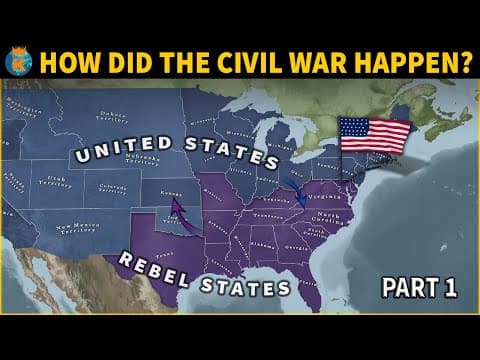
This blog post explores the complex events leading to the American Civil War, detailing the political, social, and economic tensions between the North and South from 1819 to 1861, including key events like the Missouri Compromise, the Mexican-American War, and the rise of abolitionism.
In 1819, the United States was a nation of delicate balance, with 11 free states and 11 slave states. This equilibrium, however, masked the growing tensions that would eventually lead to the American Civil War. The concept of Manifest Destiny fueled a relentless drive for territorial expansion, setting the stage for conflict over the institution of slavery.
The push for statehood by the Missouri Territory in 1818 ignited a fierce debate in Congress. The potential admission of Missouri as a slave state threatened to disrupt the balance between free and slave states. Pro-abolitionists argued against the expansion of slavery, while Southerners insisted on the right of new states to determine their own status.
In 1820, the Missouri Compromise was reached, allowing Missouri to enter as a slave state while Maine entered as a free state. Additionally, it established a boundary at the 36º 30’ latitude line, dictating that territories north of this line would be free states. This compromise initiated a pattern of adding states in pairs—one slave and one free—to maintain balance.
The annexation of Texas in 1845 further complicated the balance. Texas, having declared independence from Mexico, sought to join the United States as a slave state. President James K. Polk, a proponent of Manifest Destiny, aimed to expand U.S. territory, leading to the Mexican-American War after failed diplomatic attempts to purchase land from Mexico.
The war concluded with the Treaty of Guadalupe Hidalgo in 1848, which ceded vast territories to the U.S., including California and New Mexico. However, this new land reignited the debate over slavery, leading to the Compromise of 1850, which admitted California as a free state while allowing other territories to decide their status through popular sovereignty.
The Kansas-Nebraska Act of 1854, proposed by Senator Stephen Douglas, allowed settlers in those territories to vote on the legality of slavery, effectively repealing the Missouri Compromise. This led to violent confrontations known as "Bleeding Kansas," as pro-slavery and anti-slavery settlers flooded into the territories, resulting in significant bloodshed.
The Dred Scott case further escalated tensions. Scott, a slave who had lived in free territories, sued for his freedom. The Supreme Court ruled against him, declaring that African Americans could not be citizens and thus had no right to sue. This decision outraged abolitionists and intensified the divide between North and South.
In 1859, abolitionist John Brown attempted to incite a slave rebellion by raiding the federal armory at Harper's Ferry. His capture and execution made him a martyr for the abolitionist cause, further inflaming tensions between the North and South.
The election of Abraham Lincoln in 1860, viewed as a threat to slavery, prompted South Carolina to secede from the Union. This act of defiance was soon followed by ten other Southern states, forming the Confederate States of America under Jefferson Davis.
As the nation stood on the brink of war, the stark differences between the industrialized North and the agrarian South became irreconcilable. The Civil War began with the Confederate attack on Fort Sumter in April 1861, marking the start of a brutal conflict that would reshape the United States forever. The events leading up to this moment were fueled by deep-seated issues of slavery, state rights, and economic disparity, setting the stage for one of the most significant wars in American history.



















